The power output of local obscured and unobscured AGN: crossing the absorption barrier with Swift/BAT and IRAS
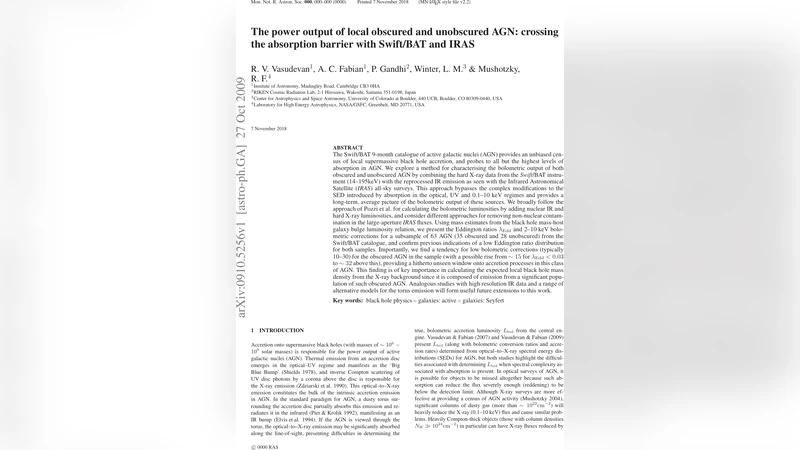
The Swift/BAT 9-month catalogue of active galactic nuclei (AGN) provides an unbiased census of local supermassive black hole accretion, and probes to all but the highest levels of absorption in AGN. We explore a method for characterising the bolometric output of both obscured and unobscured AGN by combining the hard X-ray data from Swift/BAT (14-195keV) with the reprocessed IR emission as seen with the IRAS all-sky surveys. This approach bypasses the complex modifications to the SED introduced by absorption in the optical, UV and 0.1-10 keV regimes and provides a long-term, average picture of the bolometric output of these sources. We broadly follow the approach of Pozzi et al. for calculating the bolometric luminosities by adding nuclear IR and hard X-ray luminosities, and consider different approaches for removing non-nuclear contamination in the large-aperture IRAS fluxes. Using mass estimates from the M_BH-L_bulge relation, we present the Eddington ratios \lambda_Edd and 2-10 keV bolometric corrections for a subsample of 63 AGN (35 obscured and 28 unobscured) from the Swift/BAT catalogue, and confirm previous indications of a low Eddington ratio distribution for both samples. Importantly, we find a tendency for low bolometric corrections (typically 10-30) for the obscured AGN in the sample (with a possible rise from ~15 for \lambda_Edd<0.03 to ~32 above this), providing a hitherto unseen window onto accretion processes in this class of AGN. This finding is of key importance in calculating the expected local black hole mass density from the X-ray background since it is composed of emission from a significant population of such obscured AGN. Analogous studies with high resolution IR data and a range of alternative models for the torus emission will form useful future extensions to this work. (Abridged)
💡 Research Summary
The authors present a novel, absorption‑independent method for estimating the bolometric output of local active galactic nuclei (AGN) by combining hard X‑ray measurements from the Swift/BAT 9‑month catalogue (14–195 keV) with infrared (IR) fluxes from the all‑sky IRAS surveys (12–100 µm). Because BAT detects photons above 10 keV, it is essentially immune to column densities below the Compton‑thick regime (N_H ≈ 10²⁴ cm⁻²), while IRAS captures the re‑processed dust emission that dominates the AGN energy budget at longer wavelengths. By adding the nuclear IR luminosity to the hard X‑ray luminosity, the authors obtain a direct estimate of the bolometric luminosity (L_bol) without having to correct the optical/UV and soft X‑ray SED for complex absorption.
To isolate the nuclear IR component from the large IRAS beam, two correction strategies are employed. The first scales a standard AGN IR template (based on Elvis et al.) to the observed 12 µm flux, assuming that this band is dominated by the torus. The second statistically removes the contribution of star formation by subtracting a template star‑forming spectrum calibrated at wavelengths ≤ 60 µm. Both approaches yield consistent nuclear IR estimates, demonstrating that the bulk of the IRAS flux can be reliably attributed to the AGN.
Black‑hole masses are derived from the empirical M_BH–L_bulge relation, using host‑galaxy bulge luminosities compiled from the literature. With M_BH and L_bol in hand, the authors compute the Eddington ratio λ_Edd = L_bol/L_Edd and the 2–10 keV bolometric correction k_bol = L_bol/L_X for a subsample of 63 BAT AGN (35 obscured, N_H > 10²² cm⁻², and 28 unobscured). The key findings are:
- Both obscured and unobscured populations exhibit low Eddington ratios, typically λ_Edd ≈ 0.01–0.05, confirming that the local AGN census is dominated by low‑efficiency accretion.
- Obscured AGN show systematically lower bolometric corrections, k_bol ≈ 10–30, compared with the often‑assumed value of ~20–30 for the whole AGN population. Within the obscured sample, k_bol rises from ~15 for λ_Edd < 0.03 to ~32 for higher λ_Edd, suggesting a modest dependence of the correction on accretion rate even in heavily absorbed sources.
- The reduced k_bol for obscured AGN implies that the contribution of these objects to the X‑ray background (XRB) translates into a smaller bolometric output than previously estimated. Consequently, calculations of the local black‑hole mass density (ρ_BH) based on the XRB may need to be revised downward.
The study acknowledges several limitations: the coarse IRAS aperture mixes nuclear and host galaxy emission; the M_BH–L_bulge relation carries intrinsic scatter; and the torus emission is modeled with a single template rather than a suite of clumpy or smooth torus models. The authors propose that future work with high‑resolution IR facilities (e.g., JWST, SOFIA, ALMA) and more sophisticated torus simulations will refine the nuclear IR extraction and test the robustness of the low k_bol values.
In summary, by exploiting the complementary strengths of hard X‑ray and far‑IR observations, this work provides a robust, absorption‑free estimate of AGN bolometric luminosities. The discovery that obscured AGN possess low bolometric corrections offers a fresh perspective on accretion physics in these sources and has important implications for population synthesis models of the X‑ray background and for the inferred growth history of supermassive black holes in the nearby universe.
Comments & Academic Discussion
Loading comments...
Leave a Comment