Model for solvent viscosity effect on enzymatic reactions
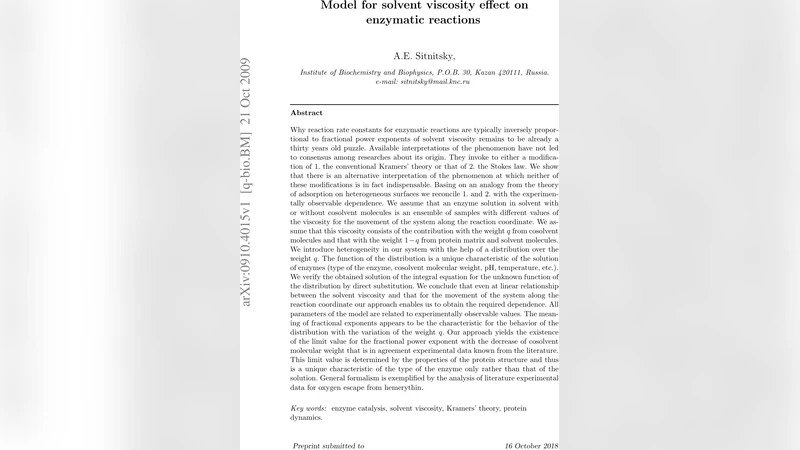
Why reaction rate constants for enzymatic reactions are typically inversely proportional to fractional power exponents of solvent viscosity remains to be already a thirty years old puzzle. Available interpretations of the phenomenon invoke to either a modification of 1. the conventional Kramers’ theory or that of 2. the Stokes law. We show that there is an alternative interpretation of the phenomenon at which neither of these modifications is in fact indispensable. We reconcile 1. and 2. with the experimentally observable dependence. We assume that an enzyme solution in solvent with or without cosolvent molecules is an ensemble of samples with different values of the viscosity for the movement of the system along the reaction coordinate. We assume that this viscosity consists of the contribution with the weight $q$ from cosolvent molecules and that with the weight $1-q$ from protein matrix and solvent molecules. We introduce heterogeneity in our system with the help of a distribution over the weight $q$. We verify the obtained solution of the integral equation for the unknown function of the distribution by direct substitution. All parameters of the model are related to experimentally observable values. General formalism is exemplified by the analysis of literature experimental data for oxygen escape from hemerythin.
💡 Research Summary
The paper addresses a long‑standing puzzle in enzymology: why the rate constant k of many enzymatic reactions scales with solvent viscosity η as an inverse fractional power, k ∝ η⁻ᵝ (0 < β < 1). Traditional explanations either modify Kramers’ theory, introducing a non‑linear friction‑viscosity relationship, or alter the Stokes law to account for enzyme‑specific hydrodynamics. Both approaches require additional assumptions and often fail to capture the full experimental trend without extensive parameter fitting.
The authors propose an alternative that does not rely on any modification of Kramers or Stokes. They view an enzyme solution as an ensemble of microscopic “samples,” each characterized by a distinct effective viscosity governing motion along the reaction coordinate. This effective viscosity η_eff is assumed to be a weighted sum of two contributions: (i) a component arising from cosolvent molecules, weighted by a factor q, and (ii) a component arising from the protein matrix together with the bulk solvent, weighted by (1 − q). The weight q is not a fixed number; rather, it varies from sample to sample because of microscopic heterogeneity in cosolvent distribution, protein conformational states, and local solvent structuring.
To capture this heterogeneity the authors introduce a probability distribution f(q) over the interval
Comments & Academic Discussion
Loading comments...
Leave a Comment