Radiolysis of ammonia-containing ices by energetic, heavy and highly charged ions inside dense astrophysical environments
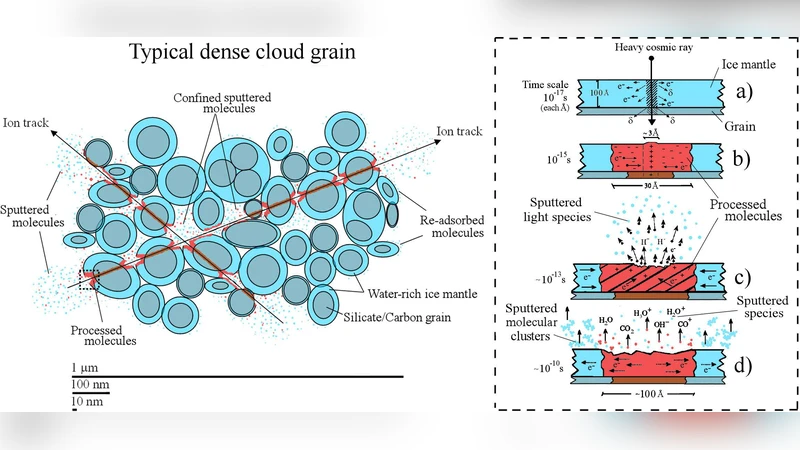
Deeply inside dense molecular clouds and protostellar disks, the interstellar ices are protected from stellar energetic UV photons. However, X-rays and energetic cosmic rays can penetrate inside these regions triggering chemical reactions, molecular dissociation and evaporation processes. We present experimental studies on the interaction of heavy, highly charged and energetic ions (46 MeV Ni^13+) with ammonia-containing ices in an attempt to simulate the physical chemistry induced by heavy ion cosmic rays inside dense astrophysical environments. The measurements were performed inside a high vacuum chamber coupled to the heavy ion accelerator GANIL (Grand Accelerateur National d’Ions Lourds) in Caen, France.\textit{In-situ} analysis is performed by a Fourier transform infrared spectrometer (FTIR) at different fluences. The averaged values for the dissociation cross section of water, ammonia and carbon monoxide due to heavy cosmic ray ion analogs are ~2x10^{-13}, 1.4x10^{-13} and 1.9x10^{-13} cm$^2$, respectively. In the presence of a typical heavy cosmic ray field, the estimated half life for the studied species is 2-3x10^6 years. The ice compaction (micropore collapse) due to heavy cosmic rays seems to be at least 3 orders of magnitude higher than the one promoted by (0.8 MeV) protons . In the case of the irradiated H2O:NH3:CO ice, the infrared spectrum at room temperature reveals five bands that were tentatively assigned to vibration modes of the zwitterionic glycine (+NH3CH2COO-).
💡 Research Summary
The authors investigate how heavy, highly charged, and energetic cosmic‑ray ions affect ammonia‑containing interstellar ices, a scenario relevant to the interiors of dense molecular clouds and protostellar disks where stellar UV photons are largely blocked. Experiments were carried out at the GANIL heavy‑ion accelerator in Caen, France, using 46 MeV ^58Ni^13+ ions to simulate the most penetrating component of galactic cosmic rays (GCRs). Thin ice films composed of H₂O, NH₃, and CO in a 1:1:1 ratio were deposited at ≤10 K under high vacuum. The ion beam was delivered in incremental fluence steps while an in‑situ Fourier‑transform infrared (FTIR) spectrometer recorded the evolving absorption spectra. This set‑up allowed simultaneous monitoring of molecular dissociation, product formation, and structural changes (compaction) as a function of ion dose.
From the FTIR data the authors derived average dissociation cross‑sections of σ(H₂O) ≈ 2.0 × 10⁻¹³ cm², σ(NH₃) ≈ 1.4 × 10⁻¹³ cm², and σ(CO) ≈ 1.9 × 10⁻¹³ cm² for the heavy‑ion analogues. Compared with previous studies using 0.8 MeV protons, the heavy‑ion induced compaction (micropore collapse) is at least three orders of magnitude faster, indicating that the dense ionization tracks of high‑Z ions are far more efficient at restructuring the ice matrix. By adopting a typical GCR flux (≈1 ion cm⁻² s⁻¹) the authors estimate half‑lives of 2–3 × 10⁶ years for the three parent molecules under a steady heavy‑ion bombardment. This timescale suggests that, even in the most shielded regions, heavy cosmic rays can gradually process ices over the lifetime of a molecular cloud or protoplanetary disk.
A particularly striking result emerges from the post‑irradiation warm‑up of the H₂O:NH₃:CO ice. After heating to room temperature, five distinct infrared bands appear at ~1600, 1500, 1400, 1300, and 1150 cm⁻¹. The authors tentatively assign these features to vibrational modes of the zwitterionic form of glycine (⁺NH₃CH₂COO⁻). If confirmed, this would constitute the first laboratory demonstration that heavy‑ion cosmic‑ray analogues can generate an amino‑acid precursor directly within an ammonia‑rich ice matrix. The formation pathway likely involves radiolysis‑induced radicals (·OH, ·NH₂, ·CO) that recombine during the warm‑up phase, a process that could be further enhanced by the increased density of reaction sites resulting from ice compaction.
The astrophysical implications are twofold. First, heavy GCR components, despite their low flux relative to protons, dominate the chemistry of the deepest ice layers because of their high stopping power and ability to induce extensive molecular fragmentation and structural rearrangement. This challenges models that consider only UV photons or low‑energy ions for ice processing, and it provides a plausible route to prebiotic molecules in environments previously thought chemically inert. Second, the observed compaction suggests that the physical state of interstellar ices evolves under cosmic‑ray bombardment, potentially altering diffusion rates, binding energies, and the accessibility of reaction partners. Consequently, any realistic astrochemical model must incorporate both the chemical yields (cross‑sections, product branching ratios) and the morphological evolution (porosity loss) induced by heavy ions.
In summary, the study demonstrates that 46 MeV Ni^13+ ions efficiently dissociate H₂O, NH₃, and CO in mixed ices, dramatically accelerate ice compaction, and can lead to the formation of a zwitterionic glycine precursor upon warm‑up. The derived dissociation cross‑sections and half‑life estimates provide quantitative inputs for astrochemical networks, while the compaction data highlight the need to consider ice structural changes in models of dense cloud and disk chemistry. This work thus bridges laboratory ion‑irradiation experiments with the broader quest to understand the origin of complex organic molecules in the hidden interiors of star‑forming regions.
Comments & Academic Discussion
Loading comments...
Leave a Comment