Variation of microphysics in wind bubbles: an alternative mechanism for explaining the rebrightenings in GRB afterglows
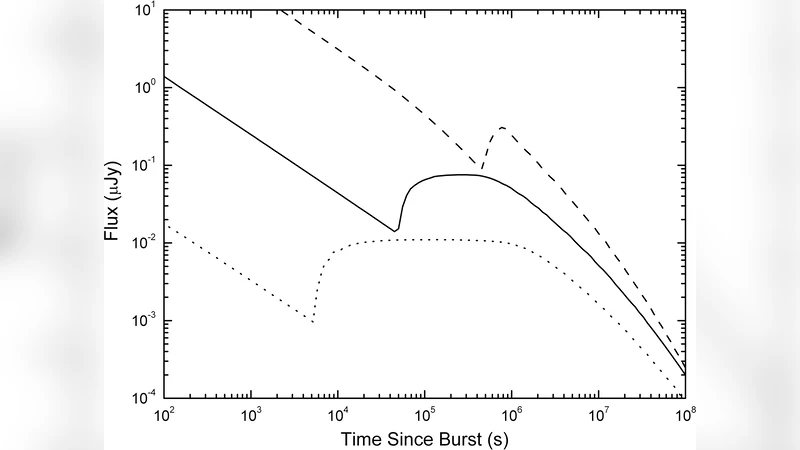
Conventionally, long GRBs are thought to be caused by the core collapses of massive stars. During the lifetime of a massive star, a stellar wind bubble environment should be produced. Furthermore, the microphysics shock parameters may vary along with the evolution of the fireball. Here we investigate the variation of the microphysics shock parameters under the condition of wind bubble environment, and allow the microphysics shock parameters to be discontinuous at shocks in the ambient medium. It is found that our model can acceptably reproduce the rebrightenings observed in GRB afterglows, at least in some cases. The effects of various model parameters on rebrightenings are investigated. The rebrightenings observed in both the R-band and X-ray afterglow light curves of GRB 060206, GRB 070311 and GRB 071010A are reproduced in this model.
💡 Research Summary
Long‑duration gamma‑ray bursts (LGRBs) are widely believed to originate from the core collapse of massive stars (the collapsar scenario). During the life of such a star a powerful stellar wind creates a circum‑stellar “wind bubble” whose density follows a ρ ∝ r⁻² law inside a termination shock radius (Rₜ) and becomes roughly constant (interstellar medium, ISM) beyond that point. Conventional afterglow models treat the external forward shock propagating into this medium with fixed micro‑physical parameters: the fractions of shock energy given to electrons (εₑ) and magnetic fields (ε_B), and the electron power‑law index (p). However, plasma simulations and theoretical work suggest that these parameters can change dramatically when the shock encounters a different environment, because electron acceleration efficiency and magnetic field amplification depend on local turbulence, density, and composition.
In this paper the authors propose a model in which εₑ, ε_B, and possibly p are allowed to jump to new values when the blast wave crosses the wind‑ISM termination shock. The density profile is taken as a two‑zone structure (wind: ρ = A r⁻²; ISM: ρ ≈ n₀) with a sharp transition at Rₜ. The dynamical evolution of the blast wave is computed using the standard energy‑conservation and shock‑physics equations, while the synchrotron emission is calculated with the appropriate εₑ, ε_B, and p for each zone. By varying the location of Rₜ and the magnitude of the parameter jumps, the model naturally produces a temporary increase in the observed flux—a “rebrightening”—as the shock decelerates more rapidly in the denser medium and the post‑shock electron and magnetic energy fractions rise.
A systematic parameter study shows that:
- The time of the rebrightening is set primarily by Rₜ (t ≈ Rₜ/(2cΓ²) where Γ is the bulk Lorentz factor at the transition).
- An increase in εₑ after the transition boosts the optical (R‑band) flux because more shock energy is transferred to relativistic electrons.
- An increase in ε_B enhances the X‑ray flux by strengthening the magnetic field, which raises the synchrotron characteristic frequency and overall emissivity.
- Changes in p affect the spectral slope and the decay rate after the bump.
The authors apply the model to three well‑observed bursts that display clear rebrightenings: GRB 060206, GRB 070311, and GRB 071010A. For each case they find a set of parameters that reproduces both the optical and X‑ray light curves. Typical values are Rₜ ≈ (1–3) × 10¹⁸ cm, εₑ,inner ≈ 0.05–0.1 → εₑ,outer ≈ 0.2–0.4, ε_B,inner ≈ 0.01 → ε_B,outer ≈ 0.03, and p ≈ 2.2 in both zones. The model captures the timing (≈0.3–1 day after the burst) and amplitude (≈0.5 mag in R‑band, ≈30–50 % increase in X‑ray flux) of the observed bumps without invoking additional energy injection, refreshed shocks, or late‑time central‑engine activity.
The paper discusses possible physical origins of the parameter jumps: at the termination shock the wind‑driven turbulence can amplify magnetic fields more efficiently, and the change in upstream density can alter the shock compression ratio, thereby modifying the fraction of energy given to electrons. While the current implementation assumes abrupt, step‑function changes, the authors acknowledge that a realistic transition would be smoother and possibly three‑dimensional. Nevertheless, the success of the model demonstrates that micro‑physical evolution in a wind‑bubble environment is a viable and perhaps essential ingredient for interpreting GRB afterglow rebrightenings.
In conclusion, the study provides a coherent framework that links the circum‑stellar wind structure of massive‑star progenitors with evolving shock microphysics to explain rebrightening features in GRB afterglows. It challenges the common practice of fixing εₑ, ε_B, and p throughout the afterglow phase and suggests that future multi‑wavelength observations, combined with high‑resolution numerical simulations, should focus on constraining how these parameters evolve as the blast wave traverses different ambient media.