Nonthermal and thermal emission from the supernova remnant RX J1713.7-3946
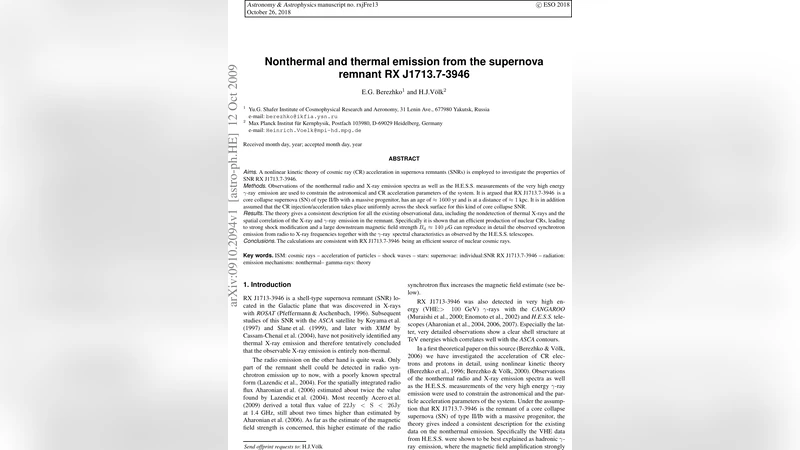
A nonlinear kinetic theory of cosmic ray (CR) acceleration in supernova remnants (SNRs) is employed to investigate the properties of SNR RX J1713.7-3946. Observations of the non-thermal radio and X-ray emission spectra as well as the H.E.S.S. measurements of the very high energy gamma-ray emission are used to constrain the astronomical and CR acceleration parameters of the system. It is argued that RX J1713.7-3946 is a core collapse supernova (SN) of type II/Ib with a massive progenitor, has an age of ~1600 yr and is at a distance of ~1 kpc. It is in addition assumed that the CR injection/acceleration takes place uniformly across the shock surface for this kind of core collapse SNR. The theory gives a consistent description for all the existing observational data, including the non-detection of thermal X-rays and the spatial correlation of the X-ray and gamma-ray emission in the remnant. Specifically it is shown that an efficient production of nuclear CRs, leading to strong shock modification and a large downstream magnetic field strength B_d ~140 mkG can reproduce in detail the observed synchrotron emission from radio to X-ray frequencies together with the gamma-ray spectral characteristics as observed by the H.E.S.S. telescopes. The calculations are consistent with RX J1713.7-3946 being an efficient source of nuclear cosmic rays.
💡 Research Summary
The paper presents a comprehensive study of the super‑nova remnant (SNR) RX J1713.7‑3946 using a nonlinear kinetic theory of cosmic‑ray (CR) acceleration that couples particle acceleration with the hydrodynamics of the expanding shock. By fitting the observed non‑thermal radio and X‑ray spectra together with the very‑high‑energy γ‑ray data from the H.E.S.S. telescopes, the authors constrain the fundamental parameters of the system. They argue that RX J1713.7‑3946 is the remnant of a core‑collapse supernova of type II/Ib, located at roughly 1 kpc from Earth and about 1.6 kyr old.
A key assumption is that CR injection occurs uniformly over the entire shock surface, which is plausible for a core‑collapse SNR where the progenitor’s wind has created a relatively homogeneous circum‑stellar environment on the scales probed by the shock. The model incorporates magnetic‑field amplification driven by CR streaming instabilities; the downstream magnetic field is found to reach ≈140 µG, far above typical interstellar values. This amplified field strongly influences the electron population, causing rapid synchrotron cooling that reproduces the thin X‑ray filaments and the hard X‑ray synchrotron spectrum observed by Suzaku and XMM‑Newton.
The authors compute both leptonic (inverse‑Compton) and hadronic (π⁰‑decay) γ‑ray production. The hadronic channel dominates the H.E.S.S. spectrum, especially above a few TeV, and naturally explains the close spatial correlation between the X‑ray and γ‑ray emission. The model predicts a CR acceleration efficiency of order 10 % of the supernova explosion energy, implying a strong shock modification: the total compression ratio exceeds the canonical value of 4, and the sub‑shock is weakened, consistent with the lack of detectable thermal X‑ray lines. The suppressed thermal emission is attributed to most of the shock energy being transferred to non‑thermal particles and the amplified magnetic field, leaving the downstream plasma relatively cool.
Radio observations, which show a very low flux, are also reproduced because low‑energy electrons lose energy quickly in the strong magnetic field, limiting their contribution to the synchrotron spectrum. The overall spectral energy distribution—from radio through X‑ray to TeV γ‑rays—is fitted with a single set of parameters, demonstrating the internal consistency of the approach.
In summary, the study provides strong evidence that RX J1713.7‑3946 is an efficient accelerator of nuclear cosmic rays. The nonlinear kinetic framework successfully accounts for the observed non‑thermal emission across the entire electromagnetic spectrum, the absence of thermal X‑rays, and the morphological coincidence of X‑ray and γ‑ray structures. These results support the view that young, core‑collapse SNRs can convert a substantial fraction of their kinetic energy into relativistic nuclei, reinforcing their role as the primary sources of Galactic cosmic rays. The methodology and conclusions also set a benchmark for interpreting future high‑resolution observations of other young remnants.
Comments & Academic Discussion
Loading comments...
Leave a Comment