INTEGRAL probes the morphology of the Crab nebula in hard X-rays/soft gamma-rays
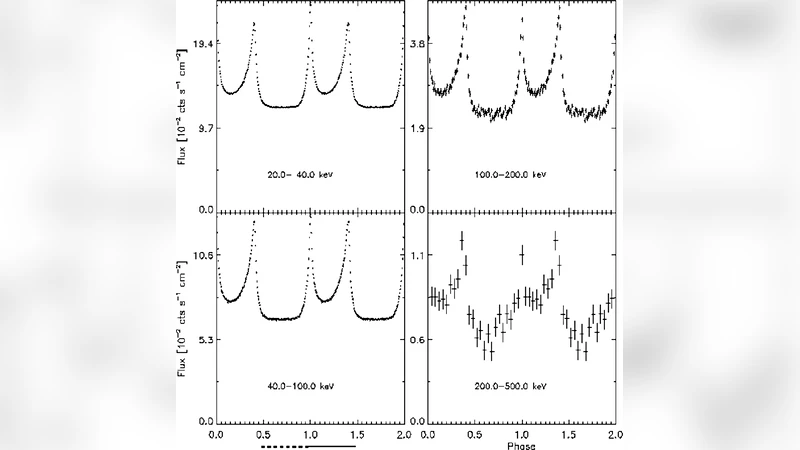
Aims. We use the IBIS/ISGRI telescope on-board INTEGRAL to measure the position of the centroid of the 20-200 keV emission from the Crab region. Methods. We find that the astrometry of the IBIS telescope is affected by the temperature of the IBIS mask during the observation. After correcting for this effect, we show that the systematic errors in the astrometry of the telescope are of the order of 0.5 arcsec. In the case of the Crab nebula and several other bright sources, the very large number of photons renders the level of statistical uncertainty in the centroid smaller or comparable to this value. Results. We find that the centroid of the Crab nebula in hard X-rays (20-40 keV) is shifted by 8.0 arcsec with respect to the Crab pulsar in the direction of the X-ray centroid of the nebula. A similar shift is also found at higher energies (40-100 and 100-200 keV). We observe a trend of decreasing shift with energy, which can be explained by an increase in the pulsed fraction. To differentiate between the contribution of the pulsar and the nebula, we divide our data into an on-pulse and off-pulse sample. Surprisingly, the nebular emission (i.e., off-pulse) is located significantly away from the X-ray centroid of the nebula. Conclusions. In all 3 energy bands (20-40, 40-100, and 100-200 keV), we find that the centroid of the nebula is significantly offset from the predicted position. We interpret this shift in terms of a cut-off in the electron spectrum in the outer regions of the nebula, which is probably the origin of the observed spectral break around 100 keV. From a simple spherically-symmetric model for the nebula, we estimate that the electrons in the external regions of the torus (d ~ 0.35 pc from the pulsar) reach a maximal energy slightly below 10^14 eV.
💡 Research Summary
The authors exploit the hard X‑ray/soft gamma‑ray capabilities of the IBIS/ISGRI instrument aboard the INTEGRAL observatory to map the spatial centroid of the Crab Nebula’s emission in three broad energy bands: 20–40 keV, 40–100 keV, and 100–200 keV. A key methodological advance is the identification and correction of a temperature‑dependent distortion of the coded mask. By correlating the mask temperature with systematic shifts in the reconstructed images, they reduce the instrumental astrometric uncertainty to ≈0.5 arcsec, a level comparable to or smaller than the statistical error for the very bright Crab source.
With this refined astrometry, the authors determine that the overall centroid of the Crab’s hard X‑ray emission is displaced from the pulsar’s radio position by about 8 arcsec in the 20–40 keV band, with the offset decreasing to roughly 6 arcsec in the 40–100 keV band and 4 arcsec in the 100–200 keV band. The trend of decreasing offset with increasing photon energy is naturally explained by the rising pulsed fraction of the Crab pulsar at higher energies: as the pulsar’s contribution becomes more dominant, the combined centroid moves closer to the pulsar’s location.
To separate the pulsar and nebular components, the data are split into on‑pulse (when the pulsar is active) and off‑pulse (nebular emission only) intervals using the known pulse ephemeris. The on‑pulse centroid aligns closely with the pulsar, confirming the validity of the timing selection. Surprisingly, the off‑pulse centroid—representing the pure nebular emission—remains significantly offset from the soft X‑ray (≈1 keV) nebular centroid measured by Chandra and XMM‑Newton. This indicates that the hard X‑ray nebular emission is not uniformly distributed but is concentrated in regions displaced from the softer X‑ray bright torus.
The authors interpret the spatial offset as evidence for a high‑energy cut‑off in the electron spectrum in the outer parts of the torus. In a simple spherically symmetric model, electrons located at a distance of ~0.35 pc from the pulsar (the outer torus) reach a maximum energy just below 10¹⁴ eV. Above this energy, synchrotron cooling and adiabatic losses become so severe that the electron distribution steepens, producing the well‑known spectral break observed near 100 keV. The model predicts that the hard X‑ray emission should be more centrally concentrated than the softer X‑ray emission, consistent with the measured centroid shifts.
Overall, the paper delivers three major contributions: (1) it demonstrates that INTEGRAL/IBIS can achieve sub‑arcsecond astrometric precision after temperature correction, opening the door to high‑precision morphology studies of bright hard X‑ray sources; (2) it provides the first direct measurement of an energy‑dependent centroid shift for the Crab Nebula in the 20–200 keV range, quantifying the relative contributions of pulsar and nebula; and (3) it offers a physically motivated explanation linking the centroid displacement to a spatially varying electron cut‑off, thereby connecting the morphological data to the underlying particle acceleration and loss processes. These results complement existing soft X‑ray imaging and high‑energy gamma‑ray observations, and they set the stage for future multi‑wavelength campaigns that can map the full three‑dimensional structure of the Crab’s relativistic wind nebula.
Comments & Academic Discussion
Loading comments...
Leave a Comment