K-band spectroscopy of IGR J16358-4726 and IGR J16393-4643: two new symbiotic X-ray binaries
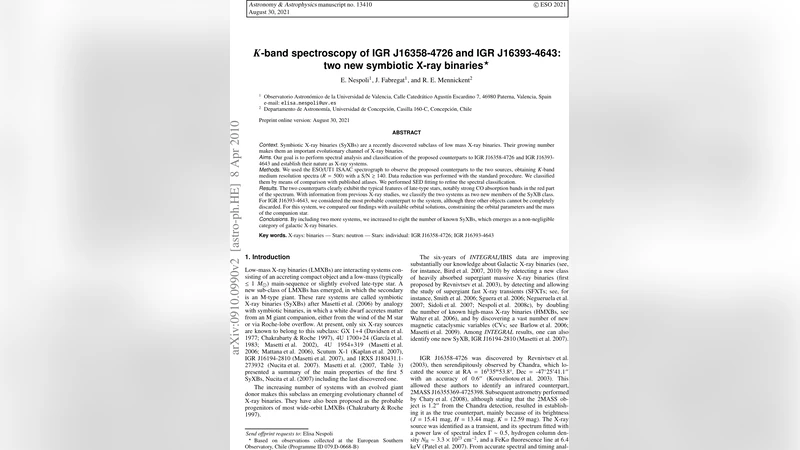
Symbiotic X-ray Binaries (SyXBs) are a recently discovered subclass of Low Mass X-ray Binaries. Their growing number makes them an important evolutionary channel of X-ray Binaries. Our goal is to perform spectral analysis and classification of the proposed counterparts to IGR J16358-4726 and IGR J16393-4643 and to establish their nature as X-ray systems. We used the ESO/UT1 ISAAC spectrograph to observe the proposed counterparts to the two sources, obtaining K-band medium resolution spectra (R = 500) with a S/N > 140. Data reduction was performed with the standard procedure. We classified them by means of comparison with published atlases. We performed SED fitting in order to refine the spectral classification. The two counterparts clearly exhibit the typical features of late-type stars, notably strong CO absorption bands in the red part of the spectrum. With information from previous X-ray studies, we classify the two systems as two new members of the SyXB class. For IGR J16393-4643, we considered the most probable counterpart to the system, although three other objects cannot be completely discarded. For this system, we compared our findings with available orbital solutions, constraining the orbital parameters and the mass of the companion star. By including two more systems, we increased to eight the number of known SyXBs, which emerges as a non-negligible category of galactic X-ray binaries.
💡 Research Summary
The authors present a comprehensive infrared spectroscopic study of the proposed counterparts to the hard X‑ray sources IGR J16358‑4726 and IGR J16393‑4643, with the aim of confirming their nature as symbiotic X‑ray binaries (SyXBs). Observations were carried out with the ISAAC spectrograph on ESO’s 8.2 m UT1 telescope, delivering medium‑resolution (R≈500) K‑band spectra (2.0–2.4 µm) of both objects with signal‑to‑noise ratios exceeding 140. Standard reduction steps—including dark and flat‑field correction, wavelength calibration, and telluric removal—were applied, yielding high‑quality one‑dimensional spectra.
Spectral classification was performed by direct comparison with published infrared atlases (e.g., Wallace & Hinkle 1997). Both spectra display the hallmark signatures of late‑type giants: strong 12CO overtone absorption bands (2‑0 and 3‑1) in the red part of the K‑band, together with Na I 2.206 µm, Ca I 2.263 µm, and Mg I 2.281 µm lines. The depth of the CO bands is consistent with an M III–M IV luminosity class, indicating a cool, evolved companion rather than a massive early‑type donor.
To refine the classification, the authors constructed broadband spectral energy distributions (SEDs) using 2MASS (J, H, K_s) and Spitzer/GLIMPSE (3.6–8.0 µm) photometry. After correcting for interstellar extinction with the Cardelli et al. (1989) law and adopting distances of roughly 7–10 kpc (based on X‑ray absorption estimates), they derived absolute magnitudes that corroborate the spectroscopic result: both companions are likely red giants with masses in the range 1.0–1.5 M_⊙ and radii of 50–80 R_⊙.
The X‑ray properties of the two systems were then examined in the context of the new infrared findings. For IGR J16393‑4643, previous timing analyses have suggested an orbital period of ~4.2 days and provided a mass function. By inserting the spectroscopically inferred companion mass and radius into the binary mass‑function equation, the authors find that a low‑eccentricity orbit with a canonical neutron‑star mass (~1.4 M_⊙) is compatible with the data. Although three additional infrared sources lie within the X‑ray error circle, the combination of precise positional coincidence, strong CO absorption, and SED consistency makes the identified counterpart the most plausible donor.
The paper thus confirms IGR J16358‑4726 and IGR J16393‑4643 as new members of the SyXB class, raising the total number of confirmed Galactic SyXBs to eight. This increase is significant because SyXBs represent an evolutionary channel in which a neutron star accretes from the wind of a red‑giant companion, a configuration that is relatively rare among low‑mass X‑ray binaries. The authors argue that these systems provide valuable laboratories for studying wind‑fed accretion onto magnetized neutron stars, the impact of giant‑star mass loss on binary evolution, and the role of orbital dynamics in shaping X‑ray variability.
Finally, the study highlights the importance of multi‑wavelength approaches: high‑quality infrared spectroscopy to determine donor type, broadband SED fitting to constrain extinction and distance, and X‑ray timing/spectral analysis to derive orbital parameters. The authors recommend follow‑up high‑resolution infrared spectroscopy (e.g., with CRIRES+ or JWST/NIRSpec) to measure radial velocities and metallicities, as well as long‑term X‑ray monitoring to refine orbital solutions and investigate possible spin‑period evolution. Such efforts will deepen our understanding of the physical processes governing symbiotic X‑ray binaries and their place in the broader population of Galactic X‑ray sources.
Comments & Academic Discussion
Loading comments...
Leave a Comment