Black hole mergers: the first light
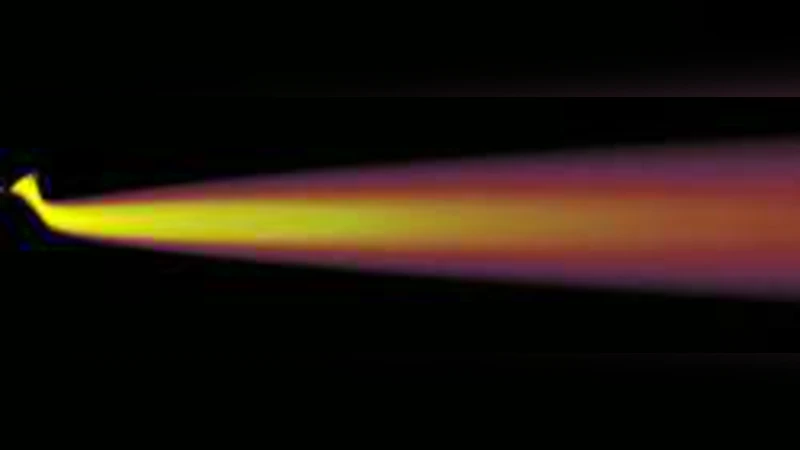
The coalescence of supermassive black hole binaries occurs via the emission of gravitational waves, that can impart a substantial recoil to the merged black hole. We consider the energy dissipation, that results if the recoiling black hole is surrounded by a thin circumbinary disc. Our results differ significantly from those of previous investigations. We show analytically that the dominant source of energy is often potential energy, released as gas in the outer disc attempts to circularize at smaller radii. Thus, dimensional estimates, that include only the kinetic energy gained by the disc gas, underestimate the real energy loss. This underestimate can exceed an order of magnitude, if the recoil is directed close to the disc plane. We use three dimensional Smooth Particle Hydrodynamics (SPH) simulations and two dimensional finite difference simulations to verify our analytic estimates. We also compute the bolometric light curve, which is found to vary strongly depending upon the kick angle. A prompt emission signature due to this mechanism may be observable for low mass (10^6 Solar mass) black holes whose recoil velocities exceed about 1000 km/s. Emission at earlier times can mainly result from the response of the disc to the loss of mass, as the black holes merge. We derive analytically the condition for this to happen.
💡 Research Summary
The paper investigates the electromagnetic signature that arises when a newly merged super‑massive black hole (SMBH) receives a recoil (“kick”) from anisotropic gravitational‑wave emission while being embedded in a thin circumbinary disc. Earlier studies estimated the energy dissipated in the disc by considering only the kinetic energy (KE) imparted to the gas by the kick. The authors demonstrate analytically that the dominant contribution often comes from the release of gravitational potential energy (PE) as gas from the outer disc moves inward and circularises at smaller radii. This PE term can exceed the KE term by more than an order of magnitude, especially when the kick direction lies close to the disc plane.
The analytic treatment separates two phases. First, the merger reduces the central mass by a few percent, causing a global expansion wave in the disc that injects a modest amount of heat. Second, the recoil displaces the SMBH relative to the disc; gas on initially circular orbits is forced onto eccentric trajectories and must lose energy to settle back onto circular orbits at new radii. The authors derive expressions for the total energy loss ΔE that depend on the kick velocity v_kick, the angle θ between the kick vector and the disc normal, and the disc surface density profile. They show that for θ≈0° (kick in the disc plane) the term proportional to the change in potential dominates, while for θ≈90° (kick perpendicular to the plane) the KE term is the only significant contribution.
To validate the theory, the authors perform three‑dimensional Smoothed Particle Hydrodynamics (SPH) simulations with ~10⁶ particles and two‑dimensional finite‑difference calculations on high‑resolution grids. Both numerical approaches reproduce the analytic scaling of ΔE with v_kick and θ, confirming that the potential‑energy release is indeed the primary energy reservoir. The simulations also reveal the formation of spiral shocks and a rapid inflow of outer disc material toward the black hole, consistent with the analytic picture.
Using a simple radiative efficiency η≈0.1–0.3, the authors convert the dissipated energy into a bolometric light curve. The light curve exhibits a sharp peak occurring tens to a few hundred years after the merger, followed by an exponential decline over thousands of years. The peak luminosity depends strongly on the kick angle: for a 10⁶ M⊙ SMBH with v_kick≈1000 km s⁻¹ and θ≈0°, L_peak reaches ≈10⁴³ erg s⁻¹, which is within the detection capabilities of current and upcoming optical, UV, and X‑ray surveys (e.g., LSST, eROSITA, JWST). For kicks directed perpendicular to the disc (θ≈90°), the peak drops by roughly an order of magnitude, making detection far more challenging.
The paper concludes that the “first light” from a recoiling SMBH is dominated by the gravitational potential energy released as the disc readjusts, not merely by the kinetic energy of the kick. This insight revises previous estimates of the electromagnetic counterpart’s brightness by up to a factor of ten. The strong dependence on kick geometry offers a potential diagnostic for inferring recoil parameters from observed transients. The authors suggest that future work should incorporate more realistic disc physics—magnetic fields, viscosity, and radiative transfer—to refine predictions and to explore the interplay between the recoil‑driven signal and the earlier, mass‑loss‑driven response of the disc.
Comments & Academic Discussion
Loading comments...
Leave a Comment