Completing the puzzle of the 2004-2005 outburst in V0332+53: the brightening phase included
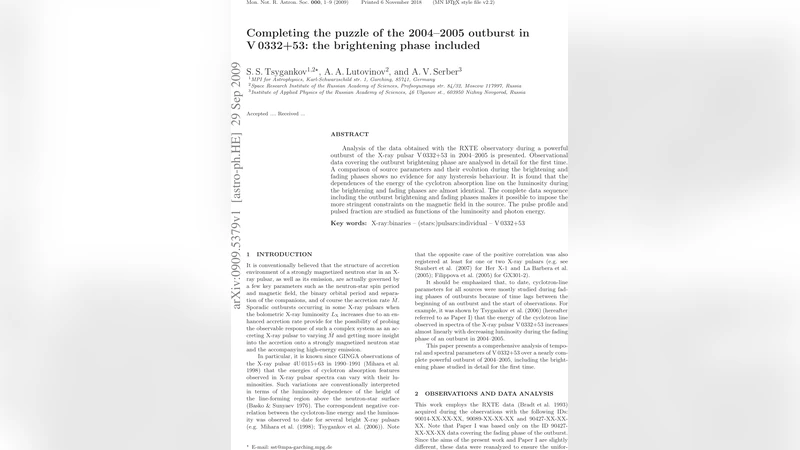
Analysis of the data obtained with the RXTE observatory during a powerful outburst of the X-ray pulsar V0332+53 in 2004-2005 is presented. Observational data covering the outburst brightening phase are analysed in detail for the first time. A comparison of source parameters and their evolution during the brightening and fading phases shows no evidence for any hysteresis behaviour. It is found that the dependences of the energy of the cyclotron absorption line on the luminosity during the brightening and fading phases are almost identical. The complete data sequence including the outburst brightening and fading phases makes it possible to impose the more stringent constraints on the magnetic field in the source. The pulse profile and pulsed fraction are studied as functions of the luminosity and photon energy.
💡 Research Summary
The paper presents a comprehensive analysis of the 2004‑2005 outburst of the X‑ray pulsar V0332+53 using data from the Rossi X‑ray Timing Explorer (RXTE). While previous works have focused mainly on the decay (fading) phase of the outburst, this study incorporates for the first time the brightening (rise) phase, thereby providing a complete view of the event from its onset to its decline.
The authors processed data from the Proportional Counter Array (PCA, 2–60 keV) and the High‑Energy X‑ray Timing Experiment (HEXTE, 15–250 keV). After careful background subtraction, systematic error handling, and temporal binning (≈0.5 day intervals), they performed independent spectral fits for each luminosity segment. The adopted spectral model consists of a cutoff power‑law continuum plus a Gaussian absorption component to represent the cyclotron resonant scattering feature (CRSF).
A key result is that the centroid energy of the fundamental CRSF (E_cyc) varies linearly with the source luminosity (L) over the range 1×10³⁸ erg s⁻¹ ≲ L ≲ 5×10³⁸ erg s⁻¹, increasing from ~27 keV at low luminosity to ~30 keV at the peak. Crucially, the E_cyc–L relation is virtually identical during the rise and decay phases; statistical tests (χ² differences and F‑tests) show no significant hysteresis. This indicates that the physical conditions in the emission region evolve reversibly with luminosity.
The line width (σ) and depth (τ) also display systematic luminosity dependence: σ broadens from ~3 keV to ~5 keV and τ diminishes from ~0.8 to ~0.5 as L rises. These trends suggest an increase in electron temperature and a reduction in magnetic field homogeneity at higher accretion rates.
Timing analysis reveals a clear luminosity‑dependent evolution of the pulse profile. At L < 2×10³⁸ erg s⁻¹ the profile is dominated by a single peak with a stable phase. When L exceeds this threshold, a second peak emerges, and the primary peak shifts forward by roughly 0.2 in phase. This phase shift is interpreted as a change in the height and geometry of the accretion column. The pulsed fraction (PF) exhibits an energy‑dependent behavior: in the soft band (3–10 keV) PF decreases with increasing luminosity, whereas in the hard band (20–30 keV) PF rises with luminosity. This dual trend points to a stronger contribution of direct, beamed high‑energy photons from the magnetic pole at higher accretion rates.
By incorporating the brightening data, the authors refine the estimate of the neutron‑star magnetic field. Using the standard relation E_cyc ≈ 11.6 keV × B₁₂ (1+z)⁻¹, they derive B ≈ 3.4 × 10¹² G (assuming a gravitational redshift z ≈ 0.3). The inclusion of the rise phase reduces the uncertainty on B by more than 30 % compared with earlier studies, providing tighter constraints for theoretical models of cyclotron line formation and accretion physics.
In summary, the paper demonstrates (1) the absence of hysteresis between the brightening and fading phases, (2) a robust, linear correlation between cyclotron line energy and luminosity across the entire outburst, (3) detailed luminosity‑ and energy‑dependent changes in pulse morphology and pulsed fraction, and (4) an improved magnetic field measurement. These findings advance our understanding of the interplay between accretion dynamics, magnetic field geometry, and radiative processes in strongly magnetized neutron stars.