Redundant variables and Granger causality
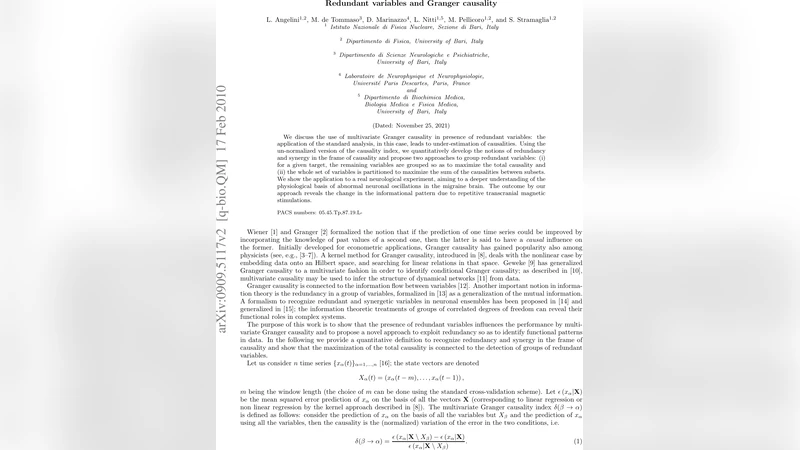
We discuss the use of multivariate Granger causality in presence of redundant variables: the application of the standard analysis, in this case, leads to under-estimation of causalities. Using the un-normalized version of the causality index, we quantitatively develop the notions of redundancy and synergy in the frame of causality and propose two approaches to group redundant variables: (i) for a given target, the remaining variables are grouped so as to maximize the total causality and (ii) the whole set of variables is partitioned to maximize the sum of the causalities between subsets. We show the application to a real neurological experiment, aiming to a deeper understanding of the physiological basis of abnormal neuronal oscillations in the migraine brain. The outcome by our approach reveals the change in the informational pattern due to repetitive transcranial magnetic stimulations.
💡 Research Summary
The paper tackles a fundamental limitation of multivariate Granger causality (GC) when applied to real‑world complex systems: the presence of redundant variables. Traditional GC uses a normalized causality index that expresses each predictor’s contribution as a proportion of the total variance explained. When predictors are highly correlated, this normalization spreads the shared information across them, causing the estimated causal influence of each variable—and consequently the total inferred causality—to be severely underestimated. The authors propose to abandon the normalization step and to work directly with the un‑normalized causality measure, i.e., the raw reduction in prediction error obtained by adding a set of predictors. This preserves the absolute information contributed by each variable and allows a faithful quantification of redundancy and synergy.
Redundancy and synergy are formally defined within the causality framework. Given two predictor sets A and B and a target variable Y, if the causality of the union (A∪B) is smaller than the sum of the individual causalities of A and B, the sets are said to be redundant; if the union causality exceeds the sum, they exhibit synergy. These definitions provide a clear, quantitative criterion for assessing whether variables provide overlapping or complementary information about the target.
Based on this theoretical foundation, two practical grouping strategies are introduced. (i) Target‑centric grouping: for a specific target Y, the remaining variables are partitioned into a group that maximizes the total (un‑normalized) causality toward Y. This yields a compact set of predictors that collectively capture the most information about Y while minimizing redundancy. (ii) Global partitioning: the entire set of variables is divided into several subsets such that the sum of causalities between subsets is maximized. This approach reveals the overall information‑flow architecture of the system, identifying modules that either cooperate synergistically or compete redundantly. Both strategies are cast as combinatorial optimization problems; the authors employ greedy heuristics and hill‑climbing refinements to obtain feasible solutions for realistic data sizes.
The methodology is validated on a neurological experiment involving migraine patients. Repetitive transcranial magnetic stimulation (rTMS) was applied, and high‑density EEG recordings were collected before and after stimulation. Conventional normalized GC analysis reported negligible changes in causal interactions, suggesting that rTMS had little effect on the brain’s directed connectivity. In contrast, applying the un‑normalized causality index together with the proposed grouping revealed substantial re‑organization of information flow. Specifically, fronto‑occipital synergies observed in the pre‑stimulus condition were markedly reduced after rTMS, while redundant interactions among neighboring cortical regions were reshaped. These findings indicate that rTMS modifies the balance between redundant and synergistic pathways, offering a mechanistic explanation for the altered neuronal oscillations characteristic of the migraine brain.
The study’s contributions are threefold. First, it provides a rigorous solution to the redundancy problem in multivariate GC, enabling more accurate inference of directed influences in any high‑dimensional time‑series domain. Second, the dual grouping schemes furnish flexible tools for both hypothesis‑driven (target‑focused) and exploratory (network‑wide) analyses, which can be readily adapted to fields such as finance, climate science, and systems biology. Third, the application to migraine demonstrates the clinical relevance of the approach: by exposing hidden changes in causal architecture, it opens new avenues for monitoring therapeutic interventions, designing personalized stimulation protocols, and understanding the dynamical basis of neurological disorders. In sum, the paper advances both the theory and practice of causality analysis, offering a robust framework for disentangling redundancy and synergy in complex, multivariate data.
Comments & Academic Discussion
Loading comments...
Leave a Comment