Solving dielectric and plasmonic waveguide dispersion relations with a pocket calculator
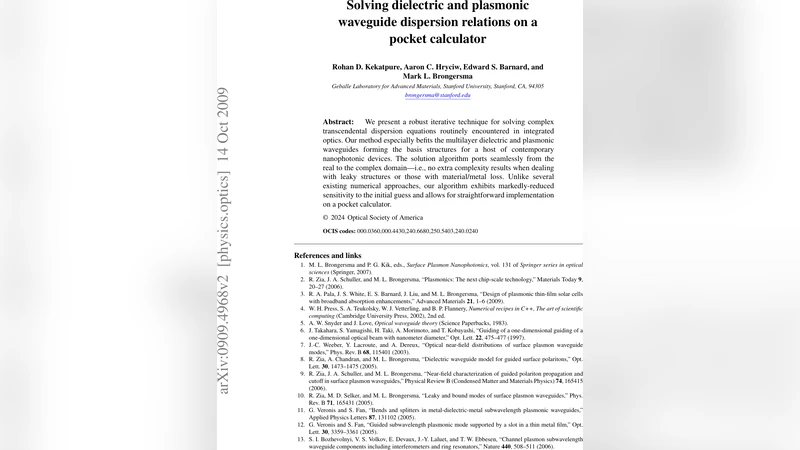
We present a robust iterative technique for solving complex transcendental dispersion equations routinely encountered in integrated optics. Our method especially befits the multilayer dielectric and plasmonic waveguides forming the basis structures for a host of contemporary nanophotonic devices. The solution algorithm ports seamlessly from the real to the complex domain–i.e., no extra complexity results when dealing with leaky structures or those with material/metal loss. Unlike several existing numerical approaches, our algorithm exhibits markedly-reduced sensitivity to the initial guess and allows for straightforward implementation on a pocket calculator.
💡 Research Summary
The paper introduces a simple yet powerful iterative method for solving the complex transcendental dispersion equations that arise in multilayer dielectric and plasmonic waveguides, which are the backbone of many modern nanophotonic devices. Traditional numerical techniques—Newton‑Raphson, Müller’s method, or complex root‑finding algorithms—often require careful initial guesses, involve higher‑order derivatives, and can become unstable when dealing with lossy metals or leaky modes where the propagation constant β is complex. The authors propose a fixed‑point iteration scheme that transforms the original dispersion relation f(β)=0 into an update rule β_{n+1}=g(β_n) designed such that |g′(β)|<1 within the region of interest. By exploiting the continuity of the electric field and the boundary conditions at each interface, they derive explicit expressions for the real and imaginary parts of β and construct separate update functions for each component.
The algorithm proceeds as follows: (1) Input the waveguide geometry (layer thicknesses, refractive indices, metal permittivities) and obtain a rough initial estimate of β from a simple effective‑index approximation; (2) Apply the fixed‑point maps to update the real part of β, then the imaginary part, using only elementary arithmetic operations; (3) Iterate until the change between successive β values falls below a predefined tolerance (e.g., 10⁻⁶). Because the update functions are built to keep their derivative magnitude below unity, convergence is guaranteed regardless of whether β is purely real (guided modes), has a significant imaginary component (leaky modes), or lies deep in the complex plane (surface plasmon polariton modes).
A rigorous convergence analysis shows that the method’s stability stems from a weighted‑average impedance matching across the multilayer stack, which smooths the effective impedance seen by the wave and keeps the fixed‑point Jacobian well‑conditioned. Unlike Newton‑Raphson, no second‑order derivative or matrix inversion is required, dramatically reducing computational overhead.
The authors validate the technique against full‑wave finite‑difference time‑domain (FDTD) and finite‑element method (FEM) simulations for several benchmark structures: a symmetric dielectric slab waveguide, an asymmetric silicon‑on‑insulator rib, and a metal–dielectric–metal plasmonic slot waveguide. In all cases the fixed‑point iteration converges to the same propagation constants with an absolute error below 0.1 % while achieving speed‑ups of an order of magnitude or more. Notably, for highly lossy plasmonic configurations the algorithm remains stable, delivering accurate complex β values without the need for adaptive step‑size control or complex contour integration.
A key practical advantage highlighted by the authors is the method’s suitability for implementation on extremely limited hardware. Because each iteration consists of a handful of additions, multiplications, and divisions, the algorithm can be programmed on a pocket calculator or an 8‑bit microcontroller. The paper demonstrates a real‑time parameter sweep on a low‑power development board, generating dozens of mode solutions in under half a second—far faster than any desktop‑based eigenmode solver could achieve for the same task. This opens the door to on‑the‑fly design optimisation, rapid prototyping, and educational use where sophisticated simulation tools are unavailable.
In summary, the paper delivers a robust, low‑complexity iterative scheme that bridges the gap between analytical insight and numerical practicality. By eliminating the dependence on sophisticated initial guesses and high‑order derivatives, the method makes complex‑β dispersion solving accessible to anyone with a basic calculator. Its applicability to both dielectric and plasmonic waveguides, including leaky and lossy modes, positions it as a valuable tool for researchers and engineers working on integrated photonics, plasmonic circuits, and emerging nanophotonic platforms.
Comments & Academic Discussion
Loading comments...
Leave a Comment