Empirical analysis of web-based user-object bipartite networks
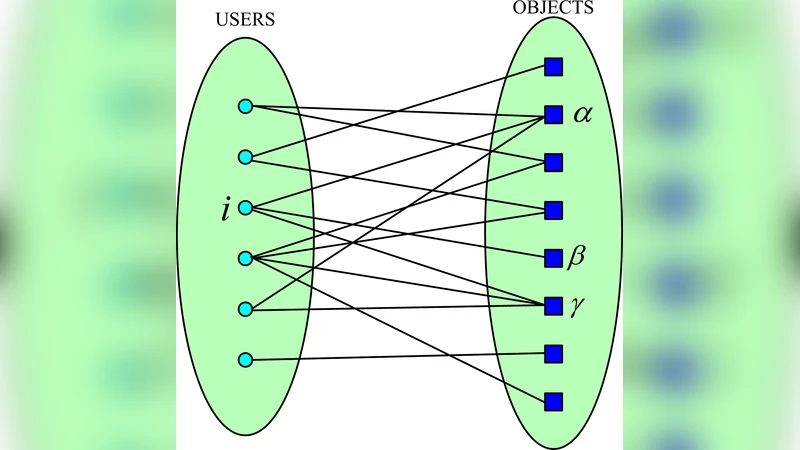
Understanding the structure and evolution of web-based user-object networks is a significant task since they play a crucial role in e-commerce nowadays. This Letter reports the empirical analysis on two large-scale web sites, audioscrobbler.com and del.icio.us, where users are connected with music groups and bookmarks, respectively. The degree distributions and degree-degree correlations for both users and objects are reported. We propose a new index, named collaborative clustering coefficient, to quantify the clustering behavior based on the collaborative selection. Accordingly, the clustering properties and clustering-degree correlations are investigated. We report some novel phenomena well characterizing the selection mechanism of web users and outline the relevance of these phenomena to the information recommendation problem.
💡 Research Summary
The paper conducts an empirical study of two large‑scale user‑object bipartite networks: the music‑sharing site audioscrobbler.com (users linked to music groups) and the social bookmarking service del.icio.us (users linked to bookmarks). By extracting the full bipartite graphs from these platforms, the authors analyze fundamental structural properties—degree distributions for both sides of the network, degree‑degree correlations, and a newly introduced metric called the collaborative clustering coefficient (CCC).
First, the degree distributions are examined. In the audioscrobbler network, user degrees follow a power‑law tail, indicating that a small fraction of highly active users connect to many music groups, while most users have modest activity. The degree distribution of music groups, however, is closer to a log‑normal shape with a heavy tail, reflecting a few extremely popular groups and many niche groups. In del.icio.us, user degrees are more homogeneous, but bookmark degrees display a pronounced heavy‑tail, showing that a handful of bookmarks attract a large number of users. These differences are attributed to the distinct content types (audio vs. web pages) and to varying user engagement patterns.
Second, the authors investigate degree‑degree correlations across the bipartite edges. Contrary to a random bipartite graph, a positive correlation is observed: users with higher degree tend to connect to objects with higher degree. This “rich‑get‑richer” effect suggests that active users preferentially select popular items, and popular items are disproportionately linked to active users, creating a core‑periphery structure on both sides of the network.
Because traditional clustering coefficients based on triangles are meaningless in bipartite graphs, the paper proposes the collaborative clustering coefficient. A “collaborative triangle” is defined as a pair of objects that are co‑selected by the same user. For each object, CCC is the ratio of such collaborative triangles to the maximum possible number given its degree. The analysis reveals two contrasting trends: (1) Object degree and CCC are negatively correlated—high‑degree (popular) objects have low CCC because their selections are spread across many diverse users, reducing the chance that any two objects are jointly chosen by the same user. (2) User degree and CCC are positively correlated—high‑activity users tend to concentrate on a limited set of objects, leading to many co‑selections among those objects and thus higher CCC values.
These findings have direct implications for recommender systems. Objects with high CCC represent niche or expert‑curated content; collaborative filtering can reliably recommend them to users who share similar tastes. Conversely, low‑CCC objects are mainstream items whose co‑selection patterns are weak, suggesting that pure collaborative filtering may be insufficient and that hybrid approaches incorporating content similarity are needed. Users with high degree and high CCC can be identified as “expert users,” whose preferences may be weighted more heavily in recommendation algorithms.
To validate that the observed patterns are not artifacts of random connections, the authors generate degree‑preserving random bipartite graphs. In these null models, CCC values collapse to near zero and the degree‑CCC correlations disappear, confirming that the real networks possess non‑trivial collaborative structures driven by user preferences and social influence.
The paper also discusses temporal evolution. Both user and object degrees tend to increase over time but eventually saturate, while CCC rises sharply during early growth (when new collaborative triangles form rapidly) and then stabilizes as the network matures. This dynamic suggests that early‑stage data are especially valuable for detecting emerging communities and for bootstrapping recommendation engines.
In summary, the study provides a comprehensive quantitative characterization of web‑based user‑object bipartite networks, introducing a novel clustering metric tailored to bipartite data, uncovering core‑periphery and collaborative selection mechanisms, and linking these structural insights to practical recommendation strategies. The work bridges network science and information retrieval, offering a solid empirical foundation for designing more effective, socially aware recommendation algorithms.
Comments & Academic Discussion
Loading comments...
Leave a Comment