Advection-Dominated Accretion Disks: Geometrically Slim or Thick?
We revisit the vertical structure of black hole accretion disks in spherical coordinates. By comparing the advective cooling with the viscous heating, we show that advection-dominated disks are geometrically thick, i.e., with the half-opening angle >…
Authors: Wei-Min Gu, Li Xue, Tong Liu
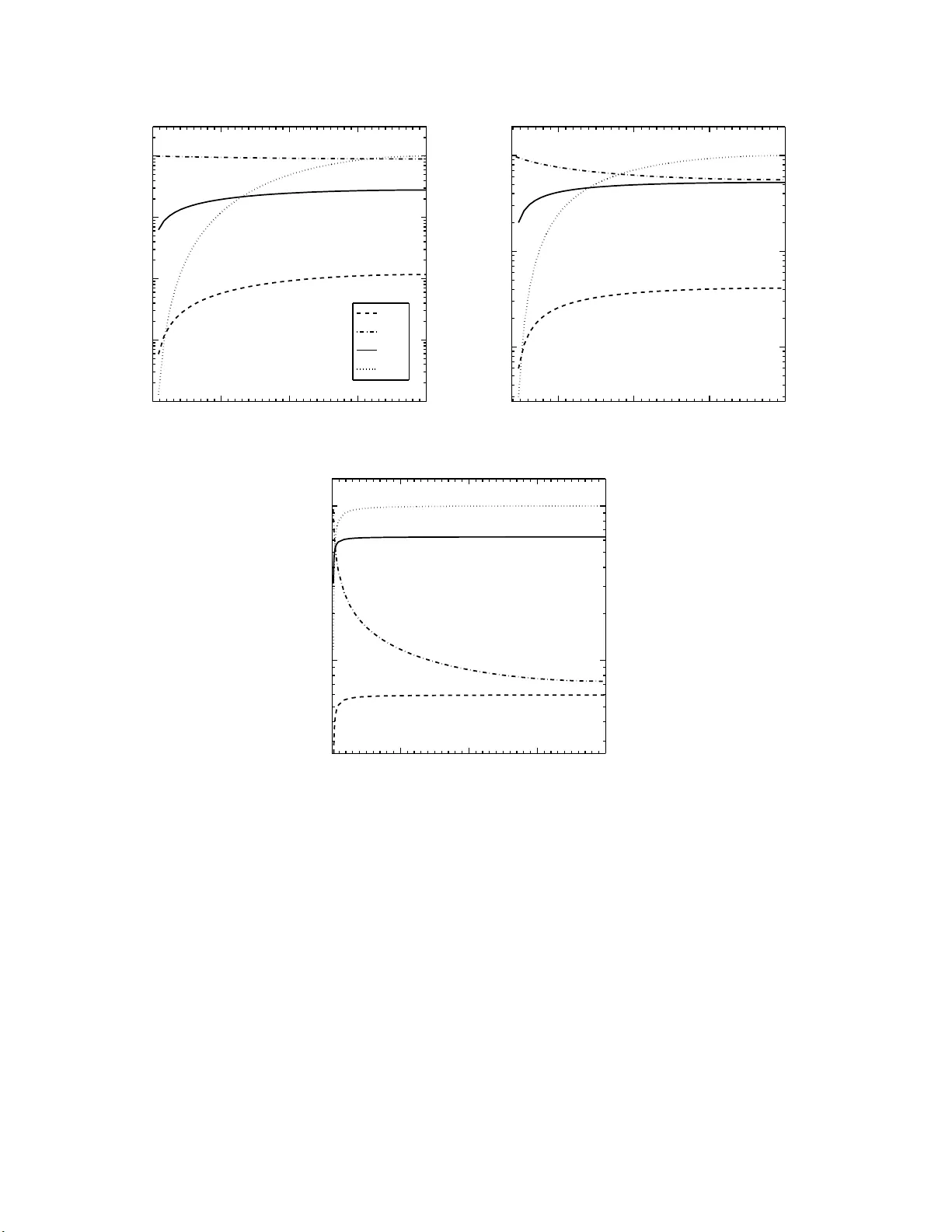
Adv ection- Dominated Accretio n Disks: Geometrically Slim or Thic k? W ei-Min Gu , 1 Li Xue , 1 T ong Liu , 1,2 and Ju-F u Lu 1 1 Dep ar tment of Physics and Institute of The o r etic a l Physics and Astr oph ysics, X iamen University, Xiamen, F ujian 361005, China lujf@xmu.e du.cn 2 Dep ar tment of Astr on omy, Nanjing University, Nanjing, Jiangsu 210093, China (Receiv ed ; accepted ) Abstract W e revisit the v ertical structure of blac k hole accretion disks in spherical co ordi- nates. By comparing the adv ectiv e co oling with the viscous heating , w e show that adv ection-dominated disks are geometrically thic k, i.e., with the half-op ening angle ∆ θ > 2 π / 5, ra ther than slim as supp osed previously in the literature. Key w ords: accretion, accretion disks — blac k hole phy sics — h ydro dynamics 1. In tro duction It was know n long since tha t the v ery ba sic assumption of the Shakura- Sun y aev disk (SSD, Shakura & Sun y aev 1973) , that is, the geometrical thinness of the disk, H /R ≪ 1, where H is the half thic kness of the disk and R is the radius in cylindrical co ordinates, would break do wn for the inner regio n of the disk in some sp ecific situations. F or example, when the mass accretion rate ˙ M approaches and surpasses its critical v alue corresponding t o the Eddington luminosit y , radia t ion pressure will act to h uff the inner region of the disk in the vertical direction; or when the co oling mec hanism is inefficien t, so that the temp erature in the disk b ecomes very high, then ga s pressure will act in a similar w ay . In either of these t w o situations, the inner region of the disk will get geometrically thic k, i.e., with H/R ∼ 1 (e.g., F rank et al. 2002, p.98). Based o n these understandings, t w o t yp es of mo dels w ere prop osed more than tw en t y y ears a go, namely the optically thic k, radiation pressure-supp o rted thic k disk (Abramo wicz et al. 1 9 78; Pac zy ´ nski & Wiita 1980; Madau 1988) and the optically thin, ion pressure-supported thic k disk (Rees et a l. 1982). T o a v oid mathematical difficulties, in these mo dels the disk was assumed to b e pure ly rotating, i.e., with no mass accretion. How ev er, the v ery ex istence of non- accreting thic k disk s w as thro wn in to doubt b y the disc ov ery of P apaloizou & Pringle (19 84) that suc h disk s are dynamically unstable to global non-axisymmetric mo des. Since the w ork of 1 Blaes (1987) , it had b een recognized tha t it is accretion, i.e., radial matter motion and energy adv ection in to the central blac k hole, that can sufficie ntly stabilize all mo des. Accordingly , the concept of adv ection dominance was in tro duced and t w o new t yp es of mo dels w ere constructed, namely the o ptically thic k, radiation pressure-supp orted slim disk (Abramowic z et al. 198 8) and the optically thin, ion pressure-supp orted, advec tion-do minat ed accretion flow (ADAF, Nara y an & Yi 1994 ; Abramowicz et al. 1995). Both these t w o ty p es of mo dels are p opular no w aday s. Slim disks and AD AFs w ere supp osed to b e g eometrically slim, i.e., with H /R < ∼ 1, neither thin nor thick. T he reason for this restriction is the follo wing. As argued b y Abramo wicz et al. (1995), the adv ection factor f adv ≡ Q adv /Q vis , where Q adv is the adv ectiv e co oling rat e p er unit area and Q vis is the viscous heating rate p er unit area, should satisfy the relatio n f adv > ∼ H R 2 . (1) Ob viously , adv ection can b e imp ortant only for disk s that are not thin. But the disk cannot b e thic k either, b ecause the v alue of f adv cannot exceed 1. Recen tly , Gu & L u (2007, hereafter G L07) addressed a problem in the slim disk mo del of Abramo wicz et al. (1 988, see also Kato et al. 1998). In this mo del, the gra vitational p otential w as approximated in the form suggested b y H¯ oshi (197 7 ), i.e., ψ ( R , z ) ≃ ψ ( R , 0) + 1 2 Ω 2 K z 2 , (2) where Ω K is the Keple rian angular v elo city . As sho wn b y GL07, suc h an appro ximation is v alid only for geometrically t hin disks with H /R < ∼ 0 . 2, and for a la rger thic knes s it w ould greatly magnify the gra vitational fo r ce in the v ertical direction. Accordingly , t he widely adopted relationship H Ω K /c s = constan t can approximately hold only for thin disks as well. Since form ula (1) was deriv ed b y using this relationship, its v alidit y for thic k er disks has not b een justified. GL07 noted t ha t, when the ve rtical gravitational force is correctly calculated with the explicit pot ential ψ ( R, z ), “ slim” disks are m uch thic ke r than previously thought. Ho w ev er, the w ork of GL07 w as still within t he framew ork of the slim disk mo del in some sense. In particular, those authors did not consider the v ertical distribution of velocities, but instead k ept the assumption of ve rtical h ydrostatic equilibrium, 1 ρ ∂ p ∂ z + ∂ ψ ∂ z = 0 , (3) whic h is a simplification o f the more general v ertical momen tum equation 1 ρ ∂ p ∂ z + ∂ ψ ∂ z + v R ∂ v z ∂ R + v z ∂ v z ∂ z = 0 (4) (e.g., Abramowicz et al. 1997), where ρ is the mass densit y , p is the pressure, and v R and v z are the cylindrical radial and v ertical v elo cities, resp ectiv ely . While the terms con taining v z in equation (4) can b e reasonably dropp ed fo r thin disks b ecause in this case v z m ust b e 2 negligibly small, it needs a careful consideration whether t he same can b e done for not thin disks (Abramow icz et a l. 19 97, also see b elo w in § 2). Also regarding to the tw o main features of adve ction-dominat ed disks, i.e., the adv ection dominance and the slimness, an imp ortant differen t approac h w as made earlier b y Naray an & Yi (199 5, hereafter NY95). NY95 considered r otating spherical accretion flo ws ra ng ing from the equatorial plane to the rotation axis, i.e., with H/R → ∞ and with no free surfaces. They assumed self-similarit y in the radial direction and solv ed differen tial equations describing the v ertical structure of the flo w, and show ed t ha t, comparing to their exact solutions, the solu- tions obtained previously with the v ertical integration approac h are v ery go o d approx imations, pro vided “vertical” means the spherical p olar angle θ , rather than t he cylindric al heigh t z . This seeme d to indicate t ha t advec tion- dominated disks are not necessarily limited to be slim. Ho w ev er, those authors did not calculate the adv ection factor f ′ adv (they defined f ′ adv ≡ q adv /q vis , with q adv and q vis b eing the adv ectiv e co oling rat e and the v iscous heating rat e p er unit v olume, resp ectiv ely), but rather set it a priori to be a constant. It is still not answ ered how their f ′ adv v aries with θ , or how f adv p er unit area v aries with the thic kness o f the disk, and what is required for adve ction to b e dominan t. In this work w e try to mak e some compleme ntarit y to NY95 and some refinemen ts to GL07. W e consider the v ertical structure of accretion flows with free surfaces and sho w that adv ection-dominated disks m ust b e geometrically thic k ra ther than slim. Our r esults may suggest to recall the historical thic k disk mo dels men tioned ab ov e, but with improv emen ts that they ha v e to include accretion no w. 2. Equations W e consider a steady state axisymmetric accretion flo w in spheric al coo rdinates ( r , θ , φ ) and use the Newtonian p oten tial ψ = − GM /r since it is con v enien t for t he self-similar formalization adopted b elo w, where M is t he black hole ma ss. The basic equations of con tin uity and momen ta a re 1 r 2 ∂ ∂ r ( r 2 ρv r ) + 1 r sin θ ∂ ∂ θ (sin θ ρv θ ) = 0 , (5) v r ∂ v r ∂ r + v θ r ∂ v r ∂ θ − v θ ! − v 2 φ r = − GM r 2 − 1 ρ ∂ p ∂ r , (6) v r ∂ v θ ∂ r + v θ r ∂ v θ ∂ θ + v r ! − v 2 φ r cot θ = − 1 ρr ∂ p ∂ θ , (7) v r ∂ v φ ∂ r + v θ r ∂ v φ ∂ θ + v φ r ( v r + v θ cot θ ) = 1 ρr 3 ∂ ∂ r ( r 3 t r φ ) (8) (e.g., Xue & W ang 200 5), where v r , v θ , and v φ are the three v elo cit y comp onents. W e assume that only the r φ -comp o nen t of the viscous stress tensor is imp ort a n t, whic h is t r φ = ν ρr ∂ ( v φ /r ) /∂ r , where ν = αc 2 s r /v K is the kinematic viscosit y co efficien t, α is the con- 3 stan t visc osity parameter, c s is the sound sp eed defined as c 2 s = p/ ρ , and v K = ( GM /r ) 1 / 2 is the Keplerian v elo city . W e do not simply assume ve rtical h ydrostatic equilibrium (eq. [3 ]). Equation (7 ) is the general v ertical momen tum equation in spherical co ordinates, corresp onding to equation (4 ) in cylindrical co ordinates. Abramo wicz et al. (1997) ha v e giv en sev eral reasons wh y spherical co ordinates are a m uc h b etter c hoice. W e only men t io n one of these reasons that is partic- ularly imp ortant for our study here. The stationary accretion disks calculated in realistic t w o-dimensional (2D) and three-dimensional (3D ) sim ulations resem ble quasi-spherical flo ws, i.e., in spherical co ordinates t he half-o p ening angle of the flow ∆ θ ≈ constan t, or in cylindrical co ordinates the relativ e thic kness H/ R ≈ constan t, mu ch more than quasi-horizon ta l flo ws, i.e., H ≈ constant (e.g., P apalo izou & Sz uszkiewicz 1994; NY95). If no outflow pro duction from the surface of the disk is assumed, then o b viously v θ = 0 is a reasonable a ppro ximation for disks with an y thic kness (Xue & W ang 2005); but v z cannot b e neglected for not thin disks because there is a relation v z /v R ∼ H / R for quasi-spherical flows , making equation (4) difficult t o deal with. Similar to NY95, w e assume self-similarit y in the radial direction v r ∝ r − 1 / 2 ; v θ = 0; v φ ∝ r − 1 / 2 ; ρ ∝ r − 3 / 2 ; c s ∝ r − 1 / 2 . The ab ov e relation auto matically satisfies the contin uity equation (5). By substituting the relation, the momen tum equations (6-8) are reduced to b e 1 2 v 2 r + 5 2 c 2 s + v 2 φ − v 2 K = 0 , (9) c 2 s p dp dθ = v 2 φ cot θ , (10) v r = − 3 2 αc 2 s v K . (11) F our unkno wn quan tities, namely v r , v φ , c s and p , app ear in t hese three equations. This is b ecause w e do not write the energy equation, whose general form is q vis = q adv + q rad , where q rad is the radiativ e co oling rate p er unit volume. In principle, the general energy equation should b e solv ed, and then f ′ adv is obtained as a v ariable, as done, e.g., b y Manmot o et al. (1997) for AD AFs and by Abramowic z et a l. (1988) and W atara i et al. (2000) fo r slim disks. But due to complications in calculating the radiation pr o cesses, in NY95 and ev en in w orks on glo bal ADAF solutions (e.g., Naray an et al. 19 97), q adv = f ′ adv q vis or Q adv = f adv Q vis w as used instead as an energy equation and f ′ adv or f adv w as giv en a s a constan t. Since our purp ose here is to in v estigate t he v aria t io n of f adv with the thickn ess of the disk , w e wish to calculate Q adv and Q vis resp ectiv ely , and then estimate f adv . T o do this, w e further assume a p o lytropic relation, p = K ρ γ , in the v ertical direction, whic h is often a dopted in the v ertically integrated mo dels of geometrically slim disks (e.g., Kato et al. 1998, p.241). W e admit that the p olytropic 4 assumption is a simple w ay to close the system, and then enables us to calculate the dynamical quan tities a nd ev alua t e f adv self-consisten tly . With the p olytropic relatio n and the definition of the sound sp eed c 2 s = p/ρ , equation (10) b ecomes dc 2 s dθ = γ − 1 γ v 2 φ cot θ , (12) whic h along with eq uations ( 9 ) and (11) can b e solv ed for v r , v φ , and c s . A b oundary condition is required for solving the differen tial equation (12 ), whic h is set to be c s = 0 (accordingly ρ = 0 and p = 0) at the surface of the disk. The quan tities q adv = pv r ( ∂ ln p/∂ r − γ ∂ ln ρ/∂ r ) / ( γ − 1) and q vis = ν ρr 2 [ ∂ ( v φ /r ) /∂ r ] 2 are expressed in the self-similar forma lism as q adv = − 5 − 3 γ 2( γ − 1) pv r r , (13) q vis = 9 4 αpv 2 φ r v K , (14) then Q adv and Q vis are giv en b y the v ertical in tegration, Q adv = Z π 2 +∆ θ π 2 − ∆ θ q adv r sin θ dθ , (15) Q vis = Z π 2 +∆ θ π 2 − ∆ θ q vis r sin θ dθ , (16) and f adv ≡ Q adv /Q vis is obtained. In our calculations α = 0 . 1 is fixed. 3. Numerical results W e first study the v aria tion of dynamical quan tit ies with the polar angle θ f or a g iv en disk’s half-op ening angle ∆ θ . Figure 1 sho ws the profiles of v r (the dashed line), v φ (the dot- dashed line), c s (the solid line), and ρ (the dotted line) for three pairs of parameters, i.e., γ = 4 / 3 and ∆ θ = 0 . 25 π f or Fig. 1 a , γ = 4 / 3 and ∆ θ = 0 . 45 π for Fig. 1 b , and γ = 1 . 65 a nd ∆ θ = 0 . 498 π for Fig. 1 c . The para meters are marke d in Figure 3 b y filled stars, whic h clearly sho w the corresp onding v alues of the adv ection factor f adv . Ob viously , adv ection is not significan t for case a ( f adv < 0 . 1), but is dominan t for cases b and c (0 . 5 < f adv < 1 ). Comparing our results with Fig. 1 of NY95, it is see n that the profiles of v r and ρ are similar, i.e., v r (the absolute v alue) a nd ρ increase with increasing θ and ac hiev e the maximal v alue a t the equatorial pla ne ( θ = π / 2). On the con t rary , t he t w o profiles of c s are significantly differen t. In their Fig. 1, the v alue of c s decreases with increasing θ and achie v es the minimal v alue at the equatorial pla ne; in our Fig. 1, how ev er, c s increases with increasing θ a nd ac hiev es the maximal v alue at the equatorial plane. In our opinion, the difference results from different assumptions, i.e., NY95 assumed an energy adv ection factor f ′ adv in adv ance, whereas w e solve for the energy advec tion factor f adv self-consisten tly based on a p olytropic relation in the v ertical direction. W e think that our profile for c s is reasonable for disk-lik e accretion. F or example, in the standard thin 5 disk, the direction of the radiativ e flux is fro m the equatorial plane to the surface, whic h means that the temp erature (or the sound sp eed) decreases fro m t he equatorial plane to the surface. Suc h a picture agr ees with our Fig . 1 but conflicts with Fig. 1 of NY95. Figure 2 shows the v aria t io n of f adv with ∆ θ for the ratio of sp ecific heats γ = 4 / 3. Adv ection dominance means 0 . 5 < f adv ≤ 1. W e first explain the tw o dashed lines and the dotted line tha t corresp ond to previous works in the slim disk mo del, then the solid line that represen ts our results here, and lea v e the dot - dashed line lat er. Both the tw o dashed lines a re obtained b y assuming v ertical h ydrostatic equilibrium (eq. [3]) and using the H¯ oshi form of p oten tial (eq. [2]), th us the relation H Ω K /c s = constan t is adopted. The difference b et w een these t w o lines is the follo wing. F or line a , the simple one-zone treatment in the v ertical direction is made as in the SSD mo del; then in equation (3), ∂ p/∂ z ≈ − p/H , ∂ ψ /∂ z ≈ Ω 2 K H , and H Ω K /c s = 1 is obtained (e.g., Kato et al. 1998, p.80) . F or line b , there is some improv emen t in the sense that the vertical structure of the disk is considered. By assuming a p o lytropic relation, the v ertical integration of equation (3) give s H Ω K /c s = 3 (e.g., Kato et al. 1998, p.242). Because of these differen t treatmen ts in the v ertical direction, these t w o lines sho w differen t v aria t io ns of f adv with ∆ θ and different maximum v alues of ∆ θ . The upp er limit of f adv is 1 (full adv ection dominance), b eyond whic h there w o uld b e no thermal equilibrium solutions. It can b e analytically deriv ed tha t for the case of line a , the maximum v a lue of ∆ θ corresp onding to f adv = 1 is ∆ θ max = arctan( q 2 / 7), or in cylindrical co ordinates the maxim um relativ e thic kness ( H /R ) max = q 2 / 7; and for the case of line b it is ∆ θ max = arctan(3 / 2) or ( H /R ) max = 3 / 2. As mentioned in § 1, the thic kness of the disk in the slim disk mo del had b een underestimated b ecause the v ertical gra vitational force w as o v erestimated b y the H¯ oshi form of p otential. Ev en so, according to the more sophisticated ve rsion of the slim disk mo del (line b ), adv ection dominance f adv > 0 . 5 w ould require H /R > 1 (∆ θ > π / 4), and full adv ection dominance w ould require H /R = 3 / 2, in con tradiction with H /R < ∼ 1, the supp osed feature of the mo del. The dotted line in Figure 2 is for the results of G L07. The p oin t made in that w ork w as that the explic it p oten tial ψ ( R , z ), rather than its H¯ o shi appro ximation (eq. [2]), w as used, so that t he v ertical g ra vitational force w as correctly calculated. But GL07 still k ept the assumption of v ertical h ydrostatic equilibrium (eq. [3]), i.e., the terms containing v z in equation (4) w ere incorrectly ignored. Because of this, the thic kness of the disk w as o v erestimated; and accordingly , it seemed that adv ection dominance can nev er b e p ossible, since eve n for the extreme thic kness ∆ θ = π / 2 (or H /R → ∞ ) the v alue of f adv can only marginally reac h to 0.5. W e make improv emen ts o v er G L07. W e use spherical co ordinates with the assumption v θ = 0, whic h is b etter than v z = 0 in cylindric al co ordinates; and then calculate the ve rtical distribution of v elo cities ( v r and v φ ) and thermal quan tities ( ρ , p , and c s ). O ur results are sho wn b y the solid line in Figure 2 . It is seen that advec tion dominance ( f adv > 0 . 5) is p ossible, but only for ∆ θ > 2 π / 5 (or 72 ◦ ). Therefore, adv ection-dominated disks mus t b e geometrically 6 thic k, rather than slim as previously supp osed. It is also seen that line b , the dotted line, and the solid line in Fig ure 2 almost coincide with eac h other for thin disk s with ∆ θ < ∼ 0 . 1 π . This is natural, since for thin disks b oth the H¯ oshi appro ximation of p o ten tial and the a ssumption of v ertical h ydrostatic equilibrium are v alid, and the three approac hes represen ted b y the three lines mak e no significan t difference. But the one-zone treatmen t, i.e., total ignorance of the v ertical structure of the disk, seems to b e t o o crude, making the resulting line a deviate from the other three lines ev en for thin disks. The v alue γ = 4 / 3 in Figure 2 corresp o nds to the optically thic k and radiation pressure- dominated case, to whic h the historical radiation pressure-supported thic k disk and the slim disk b elong; while it is γ → 5 / 3 for the optically thin and gas pressure-dominated case, to whic h the historical ion pressure-supp orted thick disk and the AD AF belong. In Figure 3, the four solid lines sho w v a riations of ∆ θ with γ for four g iven v alues of f adv . It is seen that adv ection dominance ( f adv > 0 . 5) requires ∆ θ to b e la r ge for an y v alue of γ ; and tha t fo r a fixed f adv (the same degree of a dv ection), the required ∆ θ incre ases with increasing γ , that is, for adve ction to b e dominan t, o ptically thin disk s m ust get ev en geometrically thic ker than optically thic k ones. F or the geometrically thin case, ∆ θ ≪ 1, the T a ylor expansion of equations (9), (11 ) , and (12) w ith resp ect to ∆ θ can b e p erfo rmed, and w e deriv e an appro ximate analytic relation: f adv ≈ (5 − 3 γ )(2 γ − 1 ) 3 γ (5 γ − 3) · ∆ θ 2 , (17) whic h is similar to equation (1) in cylindrical co ordinates. The dot-dashed lines in Fig ures 2 and 3 corr esp o nd to equation (17) for a fixed γ = 4 / 3 and for a fixed f adv = 0 . 01, resp ectiv ely . It is seen from Fig ure 2 that, as exp ected, the analytic approx imation of equation (17) agrees w ell with the correct n umerical results (the solid line) for small ∆ θ , but deviates a lot for large ∆ θ . In Figure 3 a go o d agreemen t b etw een equation (17) and the n umerical results (the lo w est solid line) is seen again, esp ecially for small v a lues of γ . The limitat io n that equation (17) is v alid only for small ∆ θ , and accordingly only fo r small f adv , should also apply t o equation (1), b ecause that equation is deriv ed with the H¯ oshi form of p otential. 4. Discussion The k ey concept of t he slim and ADAF disk mo dels is adv ection dominance. This concept w as in tro duced rather as an assum ption, whether and under what ph ysical conditions can it be realized ha ve not been clarified. The main result of our w ork is to ha v e sho wn that, in order for adv ection to b e dominant, the disk m ust b e geometrically thic k with the half-op ening angle ∆ θ > 2 π / 5, rather than slim as suggested previously in the s lim disk and ADAF mo dels. Th us, adv ection-dominated disks are geometrically similar to the historical thic k disks metioned in § 1. This result is ob vious b ecause, as rev ealed in GL07, in the slim disk and ADAF mo dels the v ertical gravitational force w as o ve restimated by using the H¯ oshi’s approx imate p oten tial, and 7 accordingly the disk’s thic kness w as underestimated. NY95 considered accretion flows with no free surfaces a nd found that when the giv en adve ctiv e factor f ′ adv ( ≡ q adv /q vis ) → 1 (full adve ction dominance), t heir solutions approach nearly spherical accretion. If “nearly spherical” can be regarded as extremely thic k, then their results and ours agree with eac h other, but w e take a differen t approac h. W e do not giv e the v alue of f adv ( ≡ Q adv /Q vis ) in adv ance, but instead consider accretion flo ws with f ree surfaces, i.e., accretion disks. The b oundary condition is set to b e p = 0 , whic h is usually adopted in the literature (e.g., Kato et al. 1998). Then the thic kness of the disk, ∆ θ , mak es sense, and w e calculate f adv to see ho w it relates to ∆ θ . Man y 2D and 3D n umerical sim ulations of viscous radiativ ely inefficien t accretion flo ws (RIAFs) rev ealed the existence of conv ection-dominated accretion flows (CDAFs), while AD AFs could not be obtained (e.g., Stone e t al. 1999; Igumenshc hev & Abramowicz 2000; M cKinney & Gammie 2002; Igumenshc hev et al. 2003). W e think that this fact proba bly indicates that the existing analytic AD AF models migh t hav e hidden inconsistenc ies, and the incorrect t reatmen t of the v ertical structure migh t b e one suc h inconsistency , as addressed in our w o rk. Moreo v er, the recen t radiatio n-MHD sim ulations (Ohsuga et al. 200 9 ) sho we d that the disk is geomet- rically thic k in their models A a nd C (corresponding to slim disk s and ADAFs, resp ective ly), whic h is in agreemen t with our results. Apart from the conv ectiv e motion, the o ut flow is found in 2D and 3D MHD sim ulations of non-radiative accretion flo ws ( e.g., Stone & Pringle 2001; Haw ley & Balbus 2002 ) . F or optically thic k flo ws, the circular motion and the outflo w are found in 2D radiat ion-HD sim ulations (e.g., Ohsuga et al. 2005; Ohsu ga 20 06). The assumption v θ = 0 w ould break do wn when the conv ectiv e motion or the outflow ing motion is significant, thus w e hav e to p oint out the limitation of our solutions, whic h are based on the self-similar a ssumption in the ra dial direction and particularly fo r v θ = 0. In this pap er w e ha ve not shown the exact thermal equilibrium solution for a certain mass accretion rate. W e wish to stress that our ma in concern here is the relationship betw een the energy adv ection factor and the t hickne ss of the disk. The w ell-kno wn form ula (1 ), whic h was previously b eliev ed to b e v a lid for b oth optically thick and thin disks, implied that adv ection- dominated accretion disks are geometrically slim. As sho wn in Figures 2 and 3, how eve r, form ula (1) is inaccurate for disks that are not geometrically thin. W e think that the new relationship b et w een f adv and ∆ θ , shown in Figures 2 and 3, should also work for b oth optically thick and thin cases. Ev en without the exact solutio ns, w e can predict that a dv ection-dominated accretion disks ought to b e geometrically thic k r a ther than slim. Our next work will concen tr a te on the optically thic k disks and tak e the radiativ e co oling in to consideration. In the vertical direction, w e will solv e the dynamical equations com bined with the radiativ e tr a nsfer equations, th us the p olytropic assumption will b e relaxed. A t that step, w e will b e able to calculate the thermal equilibrium solutions with giv en mass accretion rates and sho w the optical depth, pressure, and luminosit y o f the disks. 8 W e thank Marek A. Abramo wicz, Ramesh Naray an, and Ken Ohsuga for b eneficial discussions and the referee for helpful commen ts. This w ork w as supp orted b y t he National Basic Research Program of China under Gran t No. 2009CB8248 00, the National Natural Science F oundation of China under Grants No. 107787 11 and 10 833002, the Program for New Cen tury Excellen t T alen ts in Univ ersit y under Grant No. 0 6-0559, and the China Postdoctoral Science F oundation funded pro ject 20080441 038. References Abramo wicz, M. A., Ch en, X., Kato, S., Lasota, J.-P ., & Regev, O. 1995, ApJ, 438, L37 Abramo wicz, M. A., Czerny , B., Lasota, J.-P ., & Szuszkiewicz, E. 1988, ApJ, 332, 646 Abramo wicz, M. A., Jaroszy ´ nski, M., & Siko ra, M. 1978, A&A, 63, 221 Abramo wicz, M. A., Lanza, A., & Pe rciv al, M. J. 1997, ApJ , 479, 179 Blaes, O. M. 1987, MNRAS, 227, 975 F rank, J., King, A., & Raine, D. 2002, Accretion P o we r in Astr op hysics (Cambridge: Cambridge Univ. Press) Gu, W.-M., & Lu, J.-F. 200 7, ApJ, 660, 541 (GL07) Ha wley J. F., & Balbus, S. A. 200 2, ApJ, 573, 738 H¯ oshi, R. 1977, Prog. T heor. Phys., 58, 1191 Igumenshchev, I. V., & Abramo wicz, M. A. 2000 , ApJS , 130, 463 Igumenshchev, I. V., Nara ya n, R., & Abramo wicz, M. A. 2003, Ap J, 592, 1042 Kato, S ., F ukue, J., & Mineshige, S. 1998, Blac k-Hole Accretion Disks (Ky oto: Ky oto Univ. Press) Madau, P . 1988, ApJ, 327, 116 Manmoto, T., Mineshige, S., & Kusunose, M. 1997, ApJ, 489, 791 McKinney , J. C., & Gammie, C. F. 20 02, ApJ, 573, 728 Nara y an, R., Kato, S., & Honma, F. 1997, ApJ, 476, 49 Nara y an, R., & Yi, I. 1994, Ap J , 428, L13 Nara y an, R., & Yi, I. 1995, Ap J , 444, 231 (NY95) Ohsuga, K. 2006 , ApJ, 640, 923 Ohsuga, K., Mineshige, S., Mori, M., & Kato, Y. 2009, P AS J, 61 (3), 7 Ohsuga, K., Mori, M., Nak amoto, T., & Minesh ige, S . 200 5, ApJ, 628, 368 P aczy ´ nski, B., & Wiita, P . J. 1980, A&A, 88, 23 P apaloizou, J. C., & Pringle, J. E. 1984, MNRAS, 208, 721 P apaloizou, J., & S zuszkiewicz, E. 199 4, MNRAS, 268, 29 Rees, M. J ., Begelman, M. C., Blandf ord, R. D., & Phinney , E. S. 1982, Nature, 295, 17 Shakura, N. I., & Suny aev, R. A. 197 3, A&A, 24, 337 Stone, J. M., & Pr ingle, J. E. 200 1, MNRAS, 322, 46 1 Stone, J. M., Pringle, J. E., & Begelman, M. C. 1999, MNRAS, 310, 1002 W atarai, K ., F uku e, J., T ak euc hi, M., & Min esh ige, S . 2000, P ASJ , 52, 133 Xue, L., & W ang, J.-C. 2005 , ApJ, 623, 372 9 10 −4 10 −3 10 −2 10 −1 10 0 θ |v r |/v K v φ /v K c s /v K ρ / ρ 0 π /4 5 π /16 π /2 7 π /16 (a) 3 π /8 10 −2 10 −1 10 0 θ π /2 π /8 π /4 3 π /8 (b) 10 −1 10 0 θ (c) 0 π /2 3 π /8 π /4 π /8 Fig. 1. V ariations of v r , v φ , c s , and ρ with the polar angle θ for three pairs of parameters: (a) γ = 4 / 3 and ∆ θ = 0 . 25 π ; (b) γ = 4 / 3 and ∆ θ = 0 . 45 π ; (c) γ = 1 . 65 and ∆ θ = 0 . 4 98 π . 10 0 10 −3 10 −2 10 −1 10 0 ∆θ f adv a b π /10 π /5 3 π /10 2 π /5 π /2 Fig. 2. V ariation of the adv ection factor f adv with the disk’s half-opening angle ∆ θ for the ratio of sp ecific heats γ = 4 / 3. The solid line shows our nu merica l results. The do t-dashed line corre sp onds to the analytic approximation of equation (17). The tw o dashed lines ar e for the previous results in the slim disk mo del with the H¯ oshi form of potential, and the dotted line is for the previous r esults in GL07. 11 1.35 1.4 1.45 1.5 1.55 1.6 1.65 γ ∆θ f adv =1 f adv =0.5 f adv =0.1 f adv =0.01 π /2 2 π /5 3 π /10 π /5 π /10 0 Fig. 3. V ariation o f ∆ θ with γ for giv en v alues o f f adv . The so lid lines s how numerical r esults, and the dot-dashed line corr esp onds to equation (17). The three filled stars denote the parameters c hose n in Figure 1. 12
Original Paper
Loading high-quality paper...
Comments & Academic Discussion
Loading comments...
Leave a Comment