Discovery of Precursor LBV Outbursts in Two Recent Optical Transients: The Fitfully Variable Missing Links UGC 2773-OT and SN 2009ip
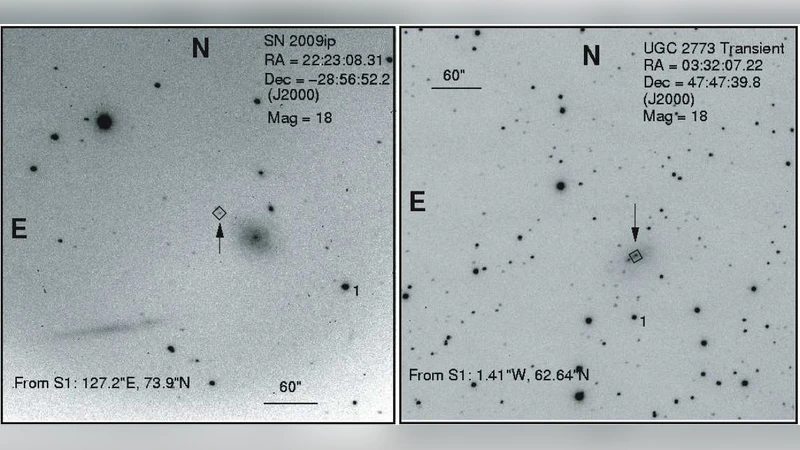
We present progenitor-star detections, light curves, and optical spectra of SN2009ip and the 2009 optical transient in UGC2773 (U2773-OT), which were not genuine SNe. Precursor variability in the decade before outburst indicates that both of the progenitor stars were LBVs. Their pre-outburst light curves resemble the S Doradus phases that preceded giant eruptions of eta Carinae and SN1954J (V12 in NGC2403), with intermediate progenitor luminosities. HST detections a decade before discovery indicate that the SN2009ip and U2773-OT progenitors were supergiants with likely initial masses of 50-80 Msun and $\ga$20 Msun, respectively. Both outbursts had spectra befitting known LBVs, although in different physical states. SN 2009ip exhibited a hot LBV spectrum with characteristic speeds of 550 km/s, plus faster material up to 5000 km/s, resembling the slow Homunculus and fast blast wave of eta Carinae. U2773-OT shows a forest of narrow absorption and emission lines comparable to that of S Dor in its cool state, plus [CaII] emission and an IR excess indicative of dust, similar to SN2008S and N300-OT. [CaII] emission is probably tied to a dusty pre-outburst environment, and not the outburst mechanism. SN2009ip and U2773-OT may provide a critical link between historical LBV eruptions, while U2773-OT may provide a link between LBVs and SN2008S and N300-OT. Future searches will uncover more examples of precursor LBV variability of this kind, providing key clues that may help unravel the instability driving LBVs.
💡 Research Summary
The paper presents a comprehensive study of two recent optical transients—SN 2009ip and the 2009 transient in UGC 2773 (U2773‑OT)—demonstrating that neither event was a genuine supernova but rather a luminous blue variable (LBV) eruption. By mining archival Hubble Space Telescope images, the authors directly detect the progenitor stars a decade before outburst. Photometric analysis places the SN 2009ip progenitor at an absolute magnitude corresponding to an initial mass of roughly 50–80 M⊙, while U2773‑OT’s progenitor is estimated to be ≥20 M⊙. Both stars therefore occupy the high‑mass regime typical of LBVs.
A key result is the reconstruction of pre‑outburst light curves spanning ~10 years. Both objects exhibit irregular, multi‑magnitude variability reminiscent of the S Doradus phases that preceded the giant eruptions of η Carinae and SN 1954J (V12 in NGC 2403). This “precursor” variability provides strong evidence that the eruptions were preceded by a prolonged instability phase, rather than being isolated explosive events.
Spectroscopically, the two transients occupy opposite ends of the LBV temperature spectrum. SN 2009ip displays a hot LBV spectrum (T≈10⁴ K) with classic P Cygni profiles in Hα and Fe II, indicating a wind speed of ~550 km s⁻¹. Notably, the line wings extend to ~5000 km s⁻¹, revealing a fast component analogous to the blast wave that co‑exists with the slow Homunculus nebula in η Carinae. U2773‑OT, by contrast, shows a cool‑state LBV spectrum rich in narrow metal absorption and emission lines, a forest of Fe I, Ti II, and other low‑ionization features. It also exhibits strong
Comments & Academic Discussion
Loading comments...
Leave a Comment