Remarkable symmetries in the Milky Way disks magnetic field
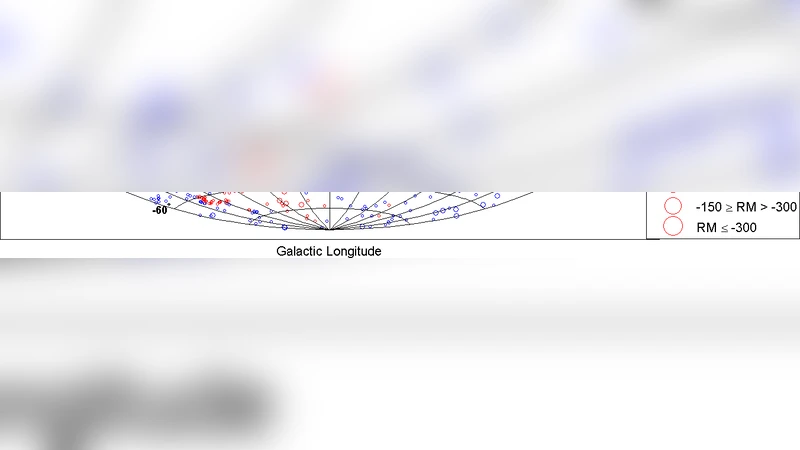
Using a new, expanded compilation of extragalactic source Faraday rotation measures (RM) we investigate the broad underlying magnetic structure of the Galactic disk at latitudes $|b|$ $\lesssim 15^{\circ}$ over all longitudes $l$, where our total number of RM’s in this low-latitude range of the Galactic sky is comparable to those in the combined Canadian Galactic Plane Survey(CGPS) at $|b| < 4^{\circ}$ and the Southern Galactic Plane (SGPS) $|b| < 1.5^{\circ}$ survey. We report newly revealed, remarkably coherent patterns of RM at $|b|$ $\lesssim 15^{\circ}$ from $l \sim 270^{\circ}$ to $\sim 90^\circ$ and RM($l$) features of unprecedented clarity that replicate in $l$ with opposite sign on opposite sides of the Galactic center. They confirm a highly patterned bisymmetric field structure toward the inner disc, an axisymmetic pattern toward the outer disc, and a very close coupling between the CGPS/SGPS RM’s at $|b| \lesssim 3^{\circ}$ (“mid-plane”) and our new RM’s up to $|b| \sim 15^{\circ}$ (“near-plane”). Our analysis also shows the approximate $z$-height – the vertical height of the coherent component of the disc field above the Galactic disc’s mid-plane – to be $\sim 1.5$kpc out to $\sim 6$ kpc from the Sun. This identifies the approximate height of the transition layer to the halo field structure. We find no RM sign change across the plane within $|b| \sim 15^{\circ}$ in any longitude range. The prevailing {\it disc} field pattern, and its striking degree of large scale ordering confirm that our side of the Milky Way has a very organized underlying magnetic structure, for which the inward spiral pitch angle is $5.5^{\circ}, \pm 1^{\circ}$ at all $|b|$ up to $\sim 12^{\circ}$ in the inner semicircle of Galactic longitudes. It decreases to $\sim 0^{\circ}$ toward the anticentre.
💡 Research Summary
The authors present an extensive new compilation of extragalactic Faraday rotation measures (RMs) that expands the low‑latitude coverage of the Milky Way’s magnetic field to |b| ≲ 15°. By combining these data with the existing Canadian Galactic Plane Survey (CGPS) and Southern Galactic Plane Survey (SGPS) measurements, they obtain a uniformly dense RM sample across all longitudes, comparable in total number to the combined CGPS+SGPS datasets but extending three to four times farther from the Galactic mid‑plane.
Analysis of the RM distribution reveals a strikingly coherent pattern from Galactic longitude l ≈ 270° to l ≈ 90°. In the inner Galaxy (the “inner semicircle”), the RM sign reverses on opposite sides of the Galactic centre, producing a bisymmetric (m = 1) spiral pattern that is remarkably regular in both longitude and latitude. This bisymmetric signature persists up to |b| ≈ 15°, demonstrating that the inner‑disc magnetic field is not confined to the thin mid‑plane but extends vertically as a coherent structure.
In contrast, the outer Galaxy shows an axisymmetric (m = 0) pattern: the RM retains the same sign on both sides of the centre, indicating a different large‑scale symmetry beyond the solar circle. The transition between these regimes is smooth, suggesting that the Milky Way’s disc field is composed of at least two distinct symmetry components that dominate at different radii.
A key quantitative result is the vertical scale of the coherent disc field. By examining the latitude dependence of the RM amplitude, the authors infer that the coherent component remains roughly constant up to a height of ~1.5 kpc above the mid‑plane, out to heliocentric distances of ~6 kpc. Beyond this height the RM signal weakens and changes sign, marking the transition to the halo magnetic field. Notably, no sign reversal is observed across the plane within |b| ≈ 15° at any longitude, implying that the disc field does not flip polarity across the Galactic mid‑plane in the surveyed region.
The spiral pitch angle of the disc field is measured directly from the RM sinusoid as a function of longitude. In the inner disc the pitch angle is tightly constrained to 5.5° ± 1°, essentially independent of latitude up to |b| ≈ 12°. Toward the anticentre the pitch angle declines smoothly to ≈ 0°, indicating that the field becomes increasingly azimuthal at large radii. This uniform pitch angle across a wide latitude range reinforces the picture of a globally ordered spiral magnetic field.
Finally, the study demonstrates a strong coupling between the high‑density CGPS/SGPS mid‑plane RMs (|b| ≲ 3°) and the newly added “near‑plane” RMs (|b| ≈ 3°–15°). The same large‑scale patterns appear in both datasets, confirming that the magnetic structure observed in the thin disc extends coherently into the lower halo.
Overall, the paper provides compelling evidence that the Milky Way’s near‑side disc possesses a highly ordered magnetic field with distinct bisymmetric and axisymmetric components, a well‑defined vertical coherence height of ~1.5 kpc, and a nearly constant inner‑disc pitch angle of ~5.5°. These constraints are essential for dynamo theory, cosmic‑ray propagation models, and for interpreting future high‑resolution polarization surveys.
Comments & Academic Discussion
Loading comments...
Leave a Comment