An alternative scenario for the formation of specialized protein nano-domains (cluster phases) in biomembranes
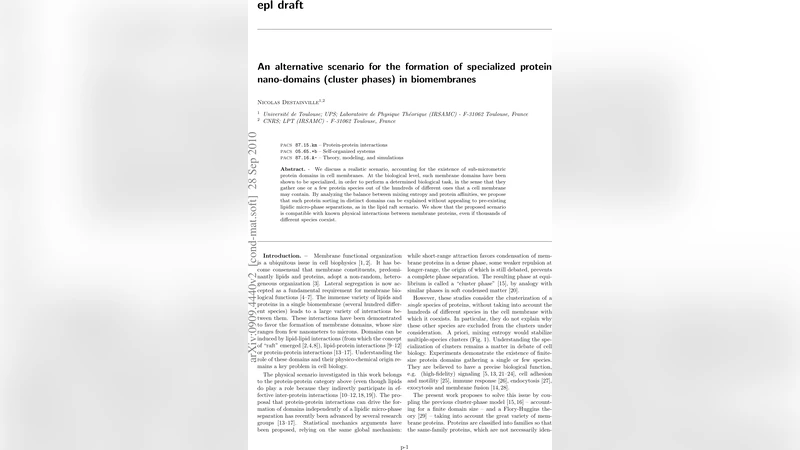
We discuss a realistic scenario, accounting for the existence of sub-micrometric protein domains in cell membranes. At the biological level, such membrane domains have been shown to be specialized, in order to perform a determined biological task, in the sense that they gather one or a few protein species out of the hundreds of different ones that a cell membrane may contain. By analyzing the balance between mixing entropy and protein affinities, we propose that such protein sorting in distinct domains can be explained without appealing to pre-existing lipidic micro-phase separations, as in the lipid raft scenario. We show that the proposed scenario is compatible with known physical interactions between membrane proteins, even if thousands of different species coexist.
💡 Research Summary
The paper proposes a physically grounded scenario for the emergence of sub‑micrometric, specialized protein nano‑domains (often called “cluster phases”) in cellular membranes without invoking pre‑existing lipid micro‑phase separations such as lipid rafts. The authors start from the observation that many membrane proteins coexist—often thousands of distinct species—yet certain biological functions require that only a few specific proteins gather together in small, dynamic domains. To explain this selective gathering, they construct a statistical‑mechanical model that balances two competing contributions to the free energy of a protein assembly: (1) the mixing entropy that favors a homogeneous distribution of all protein species, and (2) the pairwise interaction energy that captures specific attractive forces between certain protein pairs (electrostatic, hydrogen‑bonding, steric complementarity, etc.).
The total free energy is written as F = F_entropy + F_interaction, where F_entropy decreases with the size n of a cluster (because larger clusters reduce the number of ways proteins can be mixed) and F_interaction provides a negative contribution that grows with n but eventually saturates because each protein can only interact with a limited number of neighbors. By minimizing F with respect to n, the authors identify a critical cluster size n* at which the interaction term overtakes the entropic penalty. For clusters smaller than n*, entropy dominates and proteins remain dispersed; for clusters larger than n*, attractive interactions dominate, stabilizing a nano‑domain.
Crucially, the interaction matrix ε_ij is heterogeneous: only a subset of protein pairs have large ε values, while the majority have negligible attraction. In a system containing thousands of species, the model predicts that only those proteins that share strong mutual affinities will co‑assemble into the same cluster, while all other proteins stay essentially monomeric or form only transient, weak aggregates. This naturally yields “specialized” domains composed of a limited protein repertoire, exactly as observed experimentally.
To test the theory, the authors perform Monte‑Carlo simulations on a two‑dimensional lattice representing the membrane. They place 10⁴ protein particles with randomly assigned species identities and a randomly generated ε_ij matrix that mimics realistic heterogeneity. Energy‑minimizing moves are iterated until equilibrium is reached. The simulations reproduce the analytical predictions: small, stable clusters appear, each enriched in a specific high‑affinity protein subset; the cluster size distribution peaks around the analytically derived n*. Moreover, when the authors artificially lower the ε values for a particular protein (simulating a mutation that reduces its affinity), the corresponding clusters shrink or disappear, confirming the central role of the interaction‑entropy balance.
The model stands in contrast to the lipid‑raft hypothesis, which attributes protein clustering to pre‑existing lipid domains enriched in sphingolipids and cholesterol. By assuming a homogeneous lipid background, the present scenario shows that protein clustering can be an emergent property of protein‑protein interactions alone. This has several important implications: (i) it explains why protein clusters are observed even in membranes where raft markers are absent; (ii) it predicts that altering protein affinity (through post‑translational modifications, pH changes, or mutations) can dynamically remodel nano‑domains without the need to reorganize the lipid matrix; (iii) it suggests a mechanistic link between disease‑associated mutations that affect protein interaction surfaces and the dysregulation of membrane signaling platforms.
Finally, the authors outline experimental strategies to validate their predictions. Förster resonance energy transfer (FRET) can monitor distance changes between labeled proteins inside and outside clusters, providing a read‑out of interaction strength. High‑speed atomic force microscopy (AFM) can directly image the size and distribution of clusters on living cells. Site‑directed mutagenesis to modulate specific ε_ij values, combined with quantitative clustering analysis (e.g., Ripley’s K‑function), would test the model’s central claim that reducing affinity eliminates the corresponding nano‑domain.
In summary, the paper delivers a coherent, quantitative framework that explains how specialized protein nano‑domains can self‑assemble in complex, multi‑component membranes purely from the competition between mixing entropy and selective protein‑protein attractions. The theory is supported by analytical calculations, computational simulations, and a clear roadmap for experimental verification, offering a compelling alternative to lipid‑raft‑centric views of membrane organization.
Comments & Academic Discussion
Loading comments...
Leave a Comment