Infinitely many shape invariant discrete quantum mechanical systems and new exceptional orthogonal polynomials related to the Wilson and Askey-Wilson polynomials
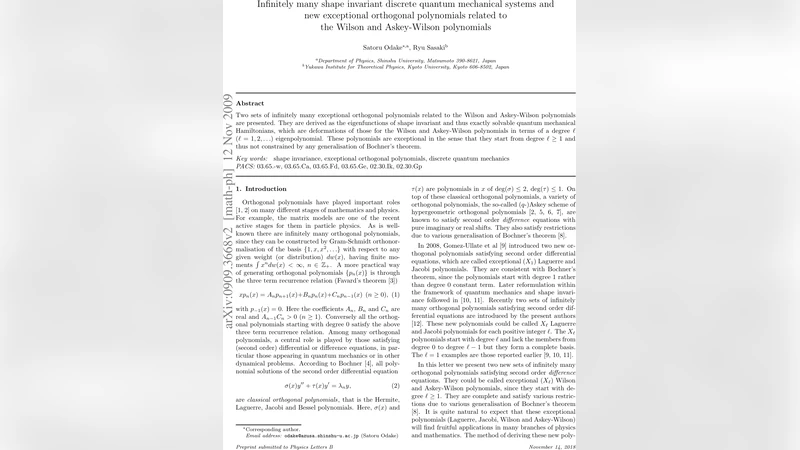
Two sets of infinitely many exceptional orthogonal polynomials related to the Wilson and Askey-Wilson polynomials are presented. They are derived as the eigenfunctions of shape invariant and thus exactly solvable quantum mechanical Hamiltonians, which are deformations of those for the Wilson and Askey-Wilson polynomials in terms of a degree \ell (\ell=1,2,…) eigenpolynomial. These polynomials are exceptional in the sense that they start from degree \ell\ge1 and thus not constrained by any generalisation of Bochner’s theorem.
💡 Research Summary
The paper presents two infinite families of exceptional orthogonal polynomials (EOPs) associated with the Wilson and Askey‑Wilson polynomials. These EOPs arise as eigenfunctions of shape‑invariant discrete quantum‑mechanical (dQM) Hamiltonians that are obtained by deforming the original Wilson/Askey‑Wilson systems through a Darboux‑Crum transformation based on a seed eigenpolynomial of degree ℓ (ℓ = 1, 2, …).
The authors begin by recalling that classical orthogonal polynomials (Hermite, Laguerre, Jacobi, Wilson, Askey‑Wilson) satisfy Bochner‑type classification theorems: they are the only families that are eigenfunctions of second‑order differential or difference operators and start at degree zero. Exceptional orthogonal polynomials break this rule by missing the lowest ℓ − 1 degrees, thereby evading Bochner’s constraints while retaining orthogonality and completeness.
In the discrete setting, the Hamiltonian is a second‑order difference operator H that acts on a function ψ(x) as
(Hψ)(x) = V(x)ψ(x + iγ) + V*(x)ψ(x − iγ) + U(x)ψ(x),
with V, V* built from the parameters (a,b,c,d) of the Wilson or Askey‑Wilson system. Shape invariance means that after a parameter shift (a→a+½, etc.) the partner Hamiltonian H₁ has exactly the same functional form as H up to an additive constant. This property guarantees exact solvability: the entire spectrum and eigenfunctions can be generated algebraically.
The key construction proceeds as follows. Choose a non‑trivial eigenpolynomial φℓ(x) of degree ℓ for the original Hamiltonian H. Using φℓ(x) as a seed, define first‑order intertwining operators Aℓ and Aℓ† that factorize H − εℓ = Aℓ†Aℓ, where εℓ is the eigenvalue of φℓ. The deformed Hamiltonian is then Hℓ = AℓAℓ† + εℓ. By a careful choice of the parameter shift, Hℓ remains shape invariant. Consequently, the eigenfunctions of Hℓ are obtained by acting with Aℓ on the original eigenfunctions, except for the ℓ seed states that have been removed. The resulting eigenfunctions are polynomials Eℓ,n(x) of degree n + ℓ, with n = 0,1,2,…; they start at degree ℓ rather than zero, which is the hallmark of exceptional families.
For the Wilson case, the weight function w(x) of the original orthogonal system is multiplied by φℓ(x)², producing a new weight wℓ(x) = w(x) φℓ(x)². Orthogonality then reads
∫ Eℓ,m(x) Eℓ,n(x) wℓ(x) dx = h_n δ_{mn}.
A similar construction holds for the Askey‑Wilson case, where the q‑difference operator replaces the ordinary shift and the weight becomes a q‑analogue wℓ^{(q)}(x).
The paper derives explicit three‑term recurrence relations, second‑order difference equations, and Rodrigues‑type formulas for both families. The recurrence coefficients depend on ℓ and on the shifted parameters, reflecting the non‑standard spectral structure. The authors also verify that the deformed systems retain completeness: the set {Eℓ,n}_{n≥0} spans the same Hilbert space as the original polynomials, despite the missing low‑degree members.
Beyond the technical derivations, the authors discuss several implications. First, the existence of infinitely many shape‑invariant deformations shows that the landscape of exactly solvable discrete quantum models is far richer than previously thought. Second, the exceptional Wilson and Askey‑Wilson polynomials provide new examples of orthogonal systems that can be used in approximation theory, spectral methods, and stochastic processes where the underlying measure is modified by a polynomial factor. Third, the construction suggests natural extensions to multivariate settings (e.g., Koornwinder polynomials) and to other members of the Askey scheme.
In conclusion, the work establishes a systematic method to generate infinite families of exceptional orthogonal polynomials linked to the most general hypergeometric families (Wilson and Askey‑Wilson). By exploiting shape invariance and Darboux‑Crum transformations, the authors produce exactly solvable deformed Hamiltonians whose eigenfunctions break the traditional Bochner constraints while preserving orthogonality, completeness, and the algebraic solvability that makes them valuable both in mathematical physics and in the broader theory of special functions.
Comments & Academic Discussion
Loading comments...
Leave a Comment