Sound propagation in a Bose-Einstein condensate at finite temperatures
We study the propagation of a density wave in a magnetically trapped Bose-Einstein condensate at finite temperatures. The thermal cloud is in the hydrodynamic regime and the system is therefore described by the two-fluid model. A phase-contrast imagi…
Authors: R. Meppelink, S.B. Koller, P. van der Straten
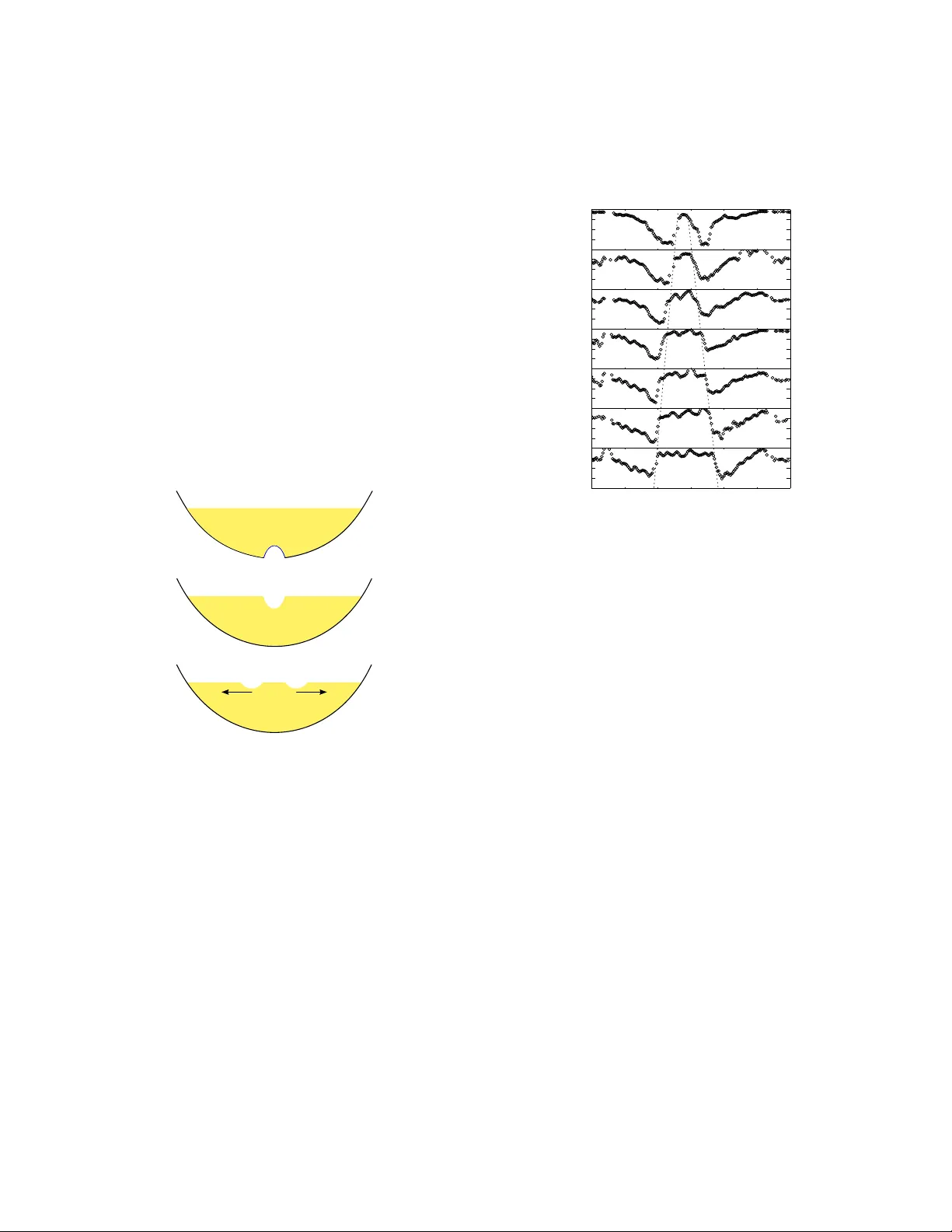
Sound propagation in a Bose-Einstein condensate at finite temp eratures R. Mepp elink, S. B. Koller, and P . v an der Straten 1 1 Atom Optics and Ultr afast Dynamics, Utr e cht University, P.O. Box 80,000, 3508 T A Utr e cht, The Netherlands (Dated: Octob er 22, 2018) W e study the propagation of a density w a v e in a magnetically trapp ed Bose-Einstein condensate at finite temp eratures. The thermal cloud is in the h ydro dynamic regime and the system is therefore describ ed by the t w o-fluid mo del. A phase-contrast imaging technique is used to image the cloud of atoms and allo ws us to observe small densit y excitations. The propagation of the density w a v e in the condensate is used to determine the sp eed of sound as a function of the temp erature. W e find the sp eed of sound to be in go od agreement with calculations based on the Landau tw o-fluid mo del. P ACS num bers: 05.30.Jp, 47.37.+q, 67.25.dm INTR ODUCTION Long wa v elength excitations of a Bose-Einstein con- densate (BEC) with repulsiv e in teractions exhibit a phononlik e, linear disp ersion, causing these excitations to mov e at a finite sp eed c , the sp eed of sound. Exci- tations with a wa v elength comparable to the size of the cloud result in collectiv e shap e oscillations of the system [1]. The dispersion relation is linear up to w a v e v ectors of the order of the in verse of the healing length. P ertur- bations with a w a v elength muc h shorter than the axial size of the cloud and larger than the healing length there- fore giv e rise to the excitation of a hydrodynamic mo de propagating at the sp eed of sound. In the case of liquid helium sound excitations hav e b een extensiv ely studied below the λ -p oint, where a sup erfluid and a normal fluid co exist. In this regime tw o sound mo des can be distinguished: the first mo de, first sound, consists of an in-phase oscillation of the sup erfluid and normal fluid component, while the second mode, second sound, consists of an out-of-phase oscillation of the su- p erfluid and normal fluid comp onen t. The o ccurrence of t w o distinct mo des is caused b y the presence of both a superfluid densit y and normal fluid density , which are coupled. One of the drawbac ks of liquid helium is that the interactions are so strong that a clear distinction b e- t w een the t w o comp onen ts is difficult which complicates the interpretation of the phenomena. In the dilute gaseous BEC studied here a t w o-fluid system exists b elow T c , analogous to the case of liquid helium. In our setup the thermal cloud is in the h y- dro dynamic regime, where collisions b etw een atoms are rapid enough to establish a state of dynamic lo cal equilib- rium in the non-condensed atoms. In contrast to Bose- condensed liquid helium, the sup erfluid in the gaseous BEC corresp onds directly to the Bose-condensed atoms and the normal comp onen t directly to the thermal, non- condensed atoms, since the in teractions are m uc h weak er. First and second sound in a Bose gas exhibit different features than those in a Bose liquid [2]. In liquid he- lium, the coupling b et w een the densit y and temp erature is w eak, since C p ' C v , with C p,v the sp ecific heat for constan t pressure and constant v olume, resp ectiv ely . As a result, in liquid helium first sound is mainly a density w a v e, while second sound is an almost pure temp erature w a v e. In con trast, in a Bose gas, the densit y and temp er- ature fluctuations are strongly coupled, since C p /C v 6' 1. The first sound mo de in a Bose gas is largely an oscil- lation of the densit y of the thermal cloud (the normal fluid) and second sound is largely an oscillation of the densit y of the condensate (the sup erfluid) [3]. In sup er- fluid helium, only the first sound mo de can b e excited b y a density perturbation. In contrast, second sound has a significant w eigh t in the density resp onse function in sup erfluid Bose gases at finite temp eratures and can b e excited by a lo cal p erturbation of the densit y . Since w e can directly image BECs and make a clear dis- tinction b et w een b oth comp onen ts, it allows for a direct comparison with theoretical descriptions of the tw o-fluid system mo deling the in teractions b etw een b oth comp o- nen ts. Th us the research using weakly interacting Bose gases promises results that will go b eyond the results ob- tained using liquid helium. In a pioneering pap er by Lee and Y ang the sp eed of first and second sound is deriv ed for a dilute Bose gas, although there is no coupling b etw een b oth sound mo des [4]. This in teraction is tak en in to accoun t in the t w o-fluid mo del developed by Landau for liquid helium [5] and in a h ydrodynamic mo del dev eloped by Zaremba, Griffin, and Nikuni for trapp ed Bose gases [6]. In these papers it is shown that the hydrodynamic second sound mo de at finite temperature extrap olates to the T = 0 Bogoliub ov phonon mo de. The propagation of sound in a harmonically trapp ed, almost pure BEC in the collisionless regime has b een ob- serv ed experimentally in a pioneering exp eriment by the MIT group [7, 8] and studied theoretically by v arious authors [4, 5, 9, 10, 11, 12]. After the first exp eriment, sound propagation has b een observed for a BEC in an op- tical lattice, the excitation sp ectrum of a BEC has b een measured and the excitation of sho c k wa v es is observed [13, 14, 15]. 2 The work presented here describ es the exp erimental observ ation of a propagating sound wa v e in an elongated BEC at finite temp eratures and extends the study by the MIT group in tw o w a ys. First, in the work presen ted here the propagation of a sound w a v e is observed at fi- nite temp eratures. The thermal cloud is in the h ydro- dynamic regime ab ov e T c and the cloud is therefore a t w o-fluid system b elow T c : a sup erfluid BEC co exists with a normal fluid of thermal atoms. If the thermal cloud is already close to the hydrodynamic regime abov e T c , it will b e deeply in the h ydrodynamic regime when the BEC forms, since the collision rate γ is dominated b y the collisions b etw een the condensed and the thermal atoms determined by the rate γ 12 [16]. In the tw o-fluid system interactions b et w een the sup erfluid and the nor- mal comp onent are exp ected to play an imp ortant role. Second, the high signal-to-noise ratio of our imaging tech- nique allows us to make smaller excitations than is used in the MIT exp eriments, thereby limiting non-linear ef- fects. The large atom n um ber BECs in combination with the weak axial confinement results in typical axial BEC lengths of more than 2 mm. This allows for the determi- nation of the sp eed of sound with a high accuracy , since the propagation distance can b e large before the sound w a v e reac hes the edge of the BEC. SOUND PR OP A GA TION IN A DILUTE BOSE-CONDENSED GAS Since second sound at finite temperatures extrap olates to the T = 0 Bogoliub o v phonon mo de, we start this discussion in the T = 0 limit. The sp eed of second sound in the absence of a thermal cloud can b e derived using the Gross-Pitaevskii equation (GPE). Re form ulated as a pair of hydrodynamic equations, neglecting the quantum pressure and after linearization, the GPE can b e written in the simplified, hydrodynamic form [12] ∂ 2 δ n ∂ t 2 = ∇ c 2 ( ~ r ) ∇ δ n , (1) where the departure of the density from its equilibrium densit y n eq is given by δ n ( ~ r , t ) = n ( ~ r , t ) − n eq ( ~ r ) and the lo cal speed of sound c ( ~ r ) is defined by mc 2 ( ~ r ) = µ − V ext ( ~ r ) , (2) where µ is the c hemical p oten tial, V ext is the external confinemen t and m is the mass. In a uniform Bose gas, V ext = 0, the sp eed of second sound is given by c = p µ/m = p g n c /m , with n c the condensate densit y . This result was first derived by Lee and Y ang [4] based on theory developed by Bogoliubov [17] and is therefore often referred to as the Bogoliub o v speed of sound, whic h w e will refer to as c B in this pap er. c B only dep ends on temp erature through the BEC density and is indepen- den t of the thermal density . The exp eriments are conducted in an elongated 3D trap where the external confinemen t in the radial (sub- script rad) and axial (subscript ax) direction is given b y V ext ( x, y , z ) = 1 2 m ω 2 rad x 2 + ω 2 rad y 2 + ω 2 ax z 2 , (3) with ω rad ω ax , and the density dep ends on the p o- sition. Although the confinemen t is highly anisotropic, the BEC is not fully in the 1D regime, since µ ~ ω rad . F or the radial av erage density we use the Thomas-F ermi (TF) v alue ¯ n ( z ) = n (0 , 0 , z ) / 2, where n (0 , 0 , z ) is the cen- tral axial density . The lo cal Bogoliub ov sp eed of sound is given in terms of the radial av erage densit y b y c B ( z ) = r g ¯ n ( z ) m = r g n (0 , 0 , z ) 2 m , (4) a result confirmed using different methods [8, 10, 11, 12]. In our exp erimen t the axial confinemen t is weak and the densit y v aries slowly along the axial direction. T o our knowledge t w o theoretical descriptions are a v ailable in whic h the effect of the in teraction betw een the normal and the sup erfluid comp onen t on the sp eed of sound is taken into accoun t. Zarem ba, Griffin, and Nikuni ha v e deriv ed the t w o-fluid h ydrodynamic equa- tions for weakly interacting Bose gases [6] and use them to discuss first and second sound for a uniform Bose gas [18]. W e refer to this description as the ZGN mo del. In the same pap er, they derive the Landau tw o-fluid equa- tions for a dilute gas in a complete lo cal equilibrium and use these equations to calculate the first and sec- ond sound velocities. W e refer to this description as the Landau mo del. In Ref. [9] it is sho wn the ZGN mo del is v alid in the limit in which collisions b etw een the con- densed and the non-condensed atoms are ignored on the timescale of the collective excitation γ µ /ω → 0. The Lan- dau mo del developed for dense fluids such as sup erfluid helium is v alid for dilute Bose gases in the opposite limit of complete lo cal equilibrium γ µ /ω → ∞ [9]. Here, γ µ is the relaxation rate for c hemical p otential differences b et w een the condensate and the thermal cloud as given in Ref. [9] and ω is the excitation frequency . W e introduce a measure for the hydrodynamicity of the thermal cloud in the axial direction ¯ γ ≡ γ 22 /ω ax , where the collision rate γ 22 = n eff σ v rel is the av erage n um ber of collisions in the thermal cloud. Here, the rel- ativ e velocity v rel = √ 2 ¯ v ex , where ¯ v ex = p 8 k B T /mπ is the thermal velocity at temperature T and m is the mass and σ = 8 π a 2 is the isotropic cross-section of t w o b osons with s -wa v e scattering length a . F urthermore, n eff = R n 2 ex ( r ) d V / R n ( r ) d V = n 0 ex / √ 8 for an equilibrium distribution in a harmonic potential, where n 0 ex is the p eak density . W ritten in terms of the n um ber of thermal atoms N ex = n 0 ex 2 π k B T / m ¯ ω 2 3 / 2 and the geomet- ric mean of the angular trap frequencies ¯ ω 3 ≡ ω 2 rad ω ax , this results in γ 22 = N ex mσ ¯ ω 3 / (2 π 2 k B T ) ≈ 90s − 1 for 3 the highest n um ber of atoms and corresponds to a hy- dro dynamicit y of ¯ γ . 10 in the axial direction. W e hav e observ ed the transition from the collisionless regime to the hydrodynamic regime by studying a thermal dip ole mo de ab ov e T c [19]. F urthermore, it is noted in Ref. [16] that the thermal cloud is deep er in the h ydro dynamic regime when a BEC forms due to collisions with con- densed atoms. As a result, the thermal cloud is even more hydrodynamic b elo w T c than it is ab ov e the tran- sition temp erature. Both mo dels are used to calculate the speed of first and second sound as solutions of an equation of the form u 4 − Au 2 + B = 0, where A and B are co effi- cien ts which are giv en for both mo dels in Ref. [9]. These co efficien ts dep end on the condensate density n c , the non-condensate density n ex and the temp erature T . In Ref. [9] the differences b etw een both mo dels for constant densit y n = n c + n ex are found to b e very small in the case of a weakly in teracting Bose gas. As a result, the transfer of atoms required to equilibrate the condensed and non-condensed atoms is found to pla y a minor role in the determination of the sp eed of first and second sound [18]. The sp eed of first and second sound for both mo dels is shown in Fig. 1, where close to T c the first (second) sound mo de mainly corresponds to the densit y wa v e in the thermal (condensed) fraction. The figure shows the coupling b et w een b oth sound mo des cause the sp eed of second sound to b e smaller than the Bogoliub o v sp eed of sound. Around T = 0 . 15 T c this coupling results in an a v oided crossing. Note that the p osition of the a v oided crossing in Fig. 1 is outside the region of v alidity of the mo del, whic h is v alid for k B T µ [9]. EXPERIMENT The exp erimental setup used to create large n um ber BECs is describ ed in Ref. [20]. In short, 23 Na atoms are co oled and trapped in a dark-sp ot MOT and transferred to a magnetic trap (MT) after b eing spin-p olarized [21]. F orced ev aporative cooling on these atoms yields roughly 1 · 10 9 thermal atoms around T = T c . In order to preven t three-b ody losses, which limit the density , as w ell as to increase the collision rate with resp ect to the axial trap frequency , we work with axially decompressed traps and ha v e reached the h ydro dynamic regime in the thermal cloud [22]. The resulting elongated, cigar-shap ed clouds used for the experiments describ ed here hav e an aspect ratio ω rad /ω ax ≈ 65. The experiments are conducted on clouds at v arious temp eratures b elo w T c . The num ber of condensed atoms, sligh tly dep ending on the temp erature, is roughly N c = 1 . 7 · 10 8 and the BEC density is ab out 2 . 5 · 10 20 m − 3 . A t the lo w est temperatures, the BEC has a radial TF radius of roughly 22 µ m and an axial TF radius of 1.4 mm. 0.0 0.2 0.4 0.6 0.8 0.90 0.95 1.00 1.05 1.10 0.0 0.2 0.4 0.6 0.8 0.0 0.5 1.0 1.5 2.0 2.5 Ratio speed of sound T / T c I I II II I I II II FIG. 1: (Color online) The sp eed of first (I) and second (I I) sound calculated in the Landau mo del (solid lines) and the ZGN mo del (dashed lines), normalized to c B (0) (Eq. (4)) as a function of the reduced temp erature T /T c . The inset sho ws the same temp erature range on a larger vertical scale. The densities and temp erature used for the calculations for 0 . 2 < T /T c < 0 . 9 corresp ond to the intrapolated exp erimen- tal v alues. F or T /T c < 0 . 2 n c is kept constant, and n ex is extrap olated to n ex = 0 for T = 0. The clouds are imaged using phase-con trast imaging, the details of whic h are describ ed in Ref [23]. Briefly , the atoms are imaged in situ and in contrast to other implemen tations of the phase-con trast imaging tec hnique [24], our implemen tation does not aim at non-destructiv e imaging, but uses the p eriodicity of the intensit y of the phase con trast imaging tec hnique as a function of the accum ulated phase of a prob e b eam that propagates through a cloud of atoms. Therefore, the intensit y sig- nal for large enough accumulated phase sho w rings in the in tensit y profile. The num ber of rings is a sensitive mea- sure for the atomic density and allo ws us to determine the BEC density , the thermal density and the temp era- ture within a few p ercent. The lens setup used results in a diffraction limited resolution of roughly 4 µ m. F or the exp erimen ts we ev aporatively co ol the atoms in the presence of a blue-detuned fo cused laser b eam aimed at the center of the trap, which acts as a repulsive opti- cal dip ole trap. The b eam is fo cused using a cylindrical lens yielding a sheet of light with a (1 / e)-width of the in tensit y of 127 ± 20 µ m. The non-fo cused direction has a (1 / e)-width of roughly 5 mm. The light of the dip ole b eam is detuned 20 nm b elo w the 23 Na D 2 transition and the p o w er adjusted in suc h a wa y that the repulsive p oten tial has a height of (0 . 24 ± 0 . 04) µ , where µ is the c hemical potential. Due to the large detuning heating caused by light scattering is negligible. The laser p o w er of the dip ole b eam is contin uously measured and used in an electronic feedback circuit controlling the efficiency of the acousto-optical modulator (AOM) that deflects laser 4 ligh t into an optical fiber whose output is used for the dip ole b eam. Using this pro cedure the stabilized inten- sit y has a RMS fluctuation of 0.1%. T ypically , the p ow er is adjusted on the order of milliseconds and the p ow er is therefore not stabilized instantaneously , mainly due to heating of the optical fib ers. How ev er, the height of the p otential is not critical during the first stages of the ev ap oration (tens of seconds), where the thermal energy k B T is large with resp ect to the dip ole p oten tial, ensur- ing the stability of the height of the potential long b efore the BEC is formed. An alternative wa y of exciting a sound wa v e is by turning on the repulsiv e p otential after the BEC is formed. Since this pro cedure is immediately sensitiv e to the height of the p oten tial this alternative re- sults in less repro ducible excitations than the pro cedure used in our exp eriments. T urning the dip ole b eam sud- denly off ((1/e)-time ∼ 250 ns) causes a lo cal dip of the BEC density . This p erturbation splits up in tw o w a v es propagating symmetrically outw ard, b oth with half the amplitude of the initial perturbation. A sc hematic repre- sen tation of the excitation pro cedure is sho wn in Fig. 2. t < 0 t = 0 t > 0 FIG. 2: (Color online) Schematic representation of the exci- tation of a sound w av e, where the trapping p oten tial, heigh t and width of the p erturbation are roughly on scale. At t < 0 a BEC is formed in the presence of a blue-detuned repulsive dip ole b eam which adjusts the trapping p otential. At t = 0 the dip ole b eam is suddenly turned off and the inflicted den- sit y perturbation causes t wo density dips to mov e out w ard for t > 0, propagating at the sp eed of sound. Clouds are imaged at about ten differen t times after the dipole b eam is switched off, where for each shot a new cloud is prepared, since the imaging scheme used is destructiv e. The initial conditions of the newly prepared clouds show only a small v ariation, since the densit y in the final stage of the ev ap orative co oling pro cess is lim- ited by three-b o dy losses. The densit y as a function of the axial p osition is determined b y making 1D fits of the radial profile for all axial p ositions. The fit function used is a bimo dal distribution whic h is the sum of a Maxw ell- Bose distribution describing the thermal cloud and a TF distribution describing the BEC. Each propagation time for a series is mostly measured twice. The total accumu- lated phase as well as the radial width of the BEC can b e used as a measure for the lo cal density , although the width is exp ected to yield inferior results due to lensing effects and the limited resolution in the radial direction. t = 50 ms t = 60 ms t = 70 ms t = 80 ms t = 90 ms t = 100 ms t = 110 ms Density di ff erence (arb. units) z / R tf -0.9 -0.6 -0.3 0 + 0.3 + 0.6 + 0.9 FIG. 3: Density profiles sho wing the p eak densit y of the BEC as a function of the axial p osition for seven different propa- gation times. The unp erturb ed density profile is subtracted from p erturbed ones to increase the visibility of the density dips. The dotted line is a guide to the ey e following the trail- ing edge of the dip. The horizontal scale is given in terms of the axial TF radius R tf , where R tf ≈ 1 . 4 mm. RESUL TS & DISCUSSION The resulting axial density profiles of the condensate, sho wn in Fig. 3 for v arious propagation times, clearly sho ws the outw ard trav eling density dips. In the densit y profiles of the thermal cloud these dips are absent, and no propagation is observed. The propagation of sound in the thermal cloud is discussed at the end of this section and for now w e consider only the density p erturbation of the condensed fraction of the cloud. The density profiles shown in Fig. 3 sho w that the shap e of the p erturbation, which is initially appro xi- mately Gaussian, deforms during the propagation. The deformation is caused by the dep endence of the sp eed of sound on the densit y and its effect will b e estimated using Eq. (4). The estimated change of the sound velocity cor- resp onding to a c hange in density ∆ n is appro ximated b y ∆ c = ( c/ 2)∆ n/n . The dep endence of the sound velocity on the density causes the cen ter of the dip to mo v e slo wer than the edges. F urthermore, this effects results in the trailing edge to ’o v ertak e’ the cen ter, while the leading 5 t = 0 ms t = 60 ms t = 30 ms t = 90 ms W eak Experiment × 1 2 × 1 2 ∆ n n z / R tf z / R tf -1 -1 -0.5 -0.5 0 0 + 0.5 + 0.5 + 1 + 1 FIG. 4: Simulation of the normalized density profiles ∆ n/n along the axial axis in terms of the axial TF radius R tf for differen t times t after the sound w a v e is excited. The left column corresponds to a w eak p erturbation ∆ n/n = 10 − 4 , the right column corresp onds to the p erturbation applied in the exp erimen t, ∆ n/n = 0 . 25 and therefore b oth columns are on a different vertical scale. Note that the t = 0 figures (top ro w) hav e a v ertical scale twice as large as the other figures in the same column. The dashed lines in the figures indicate ∆ n/n = 0. edge outruns the cen ter part. The resulting high density gradien t leads to the formation of sho c k wa v es when the densit y gradient is of the order of 1/ ξ , where ξ is the healing length [15]. F ormation of sho c k w a v es compli- cates the propagation due to strong non-linear b ehavior. The typical time for the formation of sho ck w a v es is esti- mated by considering the difference in trav eled distance ∆ z of the tailing edge (densit y n ) with respect to the cen- ter (density n − ∆ n ) after τ propagation time, yielding ∆ z ≈ − ( cτ / 2)∆ n/n [11]. The edge will reach the cen ter when ∆ z ∼ σ , where σ is the width of the p erturbation, resulting in τ & σ n/ (∆ n c ) which is the time for sho c k w a v es to form. F or our t ypical parameters this yields τ & 200 ms. In the exp eriments propagation times are less than 110 ms. F or times less than τ w e already see that the prop- agating wa v e deforms. W e hav e made a simulation of the Gross-Pitaevskii (GPE) equation whic h describes the BEC at T = 0 to analyze the effect the deformation has on the propagation of the condensate density w a v e. The GPE is n umerically solv ed using the time-splitting sp ec- tral metho d describ ed in Ref. [25]. Since the exp erimen ts are done on very elongated, cigar-shap ed BECs and all effects are found in the axial directions, the calculation time can b e reduced by solving an effective 1D equation in the limit of strong coupling [26]. Man y experiments on b oth the statics and dynamics of BECs ha v e shown that exp erimen ts can be mo deled accurately b y numerically solving the GPE, for example in exp eriments on interfer- ometry [27] and sup erfluidity [28]. Note that we assume that the temp erature dep endence on the deformation of the condensate density wa v e can b e neglected. The simulated density profiles are shown in Fig. 4, where the p erturbation is excited by gro wing the BEC in the presence of an additional Gaussian shap ed p otential. A t t = 0 this extra p oten tial is suddenly switc hed off, but the harmonic confinemen t remains. Two situations are sho wn; a small initial p erturbation and a perturbation corresp onding to the situation in the experiments. The sim ulations sho w the deformation of the initial shap e of the p erturbation and the steep ening of the trailing edge of the condensate densit y wa v e under the exp erimental conditions. After about 200 ms the sim ulations indeed sho w the formation of sho ck wa v es. W e ha v e run sim ulations for larger perturbations ∆ n/n ≈ 0 . 5 and find sho ck wa v es to form within a few te ns of milliseconds. Comparing these results to the sound propagation exp erimen ts b y the MIT group [7, 8], where applied p erturbations are rep orted as large as ∆ n/n = 1, suggests sho c k wa ves ha v e formed in their exp erimen ts shortly after the sound wa v e is excited. The MIT group has measured the condensate density w a v e to propagate at c B (0), even though strong non-linear effects are exp ected to influence the propagation, as already re- mark ed by Kav oulakis et al. [11]. In our exp erimen t sound wa v es are excited in elongated cigar-shap ed BECs allowing us to mak e a perturbation m uc h longer than the radial size to ensure the excitation of a one-dimensional motion, while it remains small with resp ect to the axial size. In the exp erimen t rep orted b y the MIT group the size of the excitation is of the order of the radial size of the BEC. The simulations for small density p erturbations (∆ n/n = 10 − 4 ) confirm the minimum of the density dip mo v es with c B (0) as given by Eq. (4) and shows the v a- lidit y of the simulation. F or the p erturbation used in the exp erimen t the simulations sho w the minimum of the dip propagates ab out 8% slow er than the sp eed of sound, in agreemen t with the estimate ∆ c = − ( c/ 2)∆ n/n . This is disadv an tageous for the determination of the sp eed of sound from the measured density profiles, since the p osi- tion of the minim um of the dip is the easiest parameter to deriv e. In order to derive the appropriate sp eed of sound from the de nsit y profiles, not only the p osition of mini- m um is determined, but also the amount of deformation is taken into account by determining the asymmetry of the propagating wa v e. The simulations suggest the density at the (1 / e)-heigh t of the dips is a go od approximation of the unp erturbed densit y ( cf. Fig. 4). W e therefore use the deformation at (1 / e)-heigh t in addition to the position of the center of the p erturbation in these simulations as the measure of 6 the distance the perturbation has trav eled. The sp eed of sound is now found to remain constant within 2% for a broad range of p erturbation amplitudes (10 − 5 –0 . 3), only to show larger deviations when sho c k wa v es are formed. F or typical propagation time used in the exp eriment, the sim ulations show the decrease of the propagation sp eed due to the axial density dep endence remains b elow 2% as well. Returning to the results of the exp erimen t, the mea- sured density profiles are fitted to an asymmetric func- tion, yielding b oth the deformation and p osition of the propagating condensate density wa v e. T aking the same com bined measure for the tra v eled distance as used in the sim ulations, the propagation distance v aries linear with the propagation time, the slop e of which is used to determine the sp eed of sound. This pro cedure is rep eated for different temp eratures, whic h are created by adjusting the final rf-field frequency . Eac h series, consisting of ab out ten shots, is used to de- termine the propagation sp eed for that temp erature. Rf- induced ev aporative co oling do es not allow to co ol to temp eratures b elo w k B T ≈ µ , since around this temp er- ature b oth thermal atoms and condensed atoms are re- mo v ed from the trap by the rf-field, setting a lo w er limit to the temperature reached in the exp eriment. The high- est temp erature used in the measurements corresp onds to T /T c = 0 . 72 ± 0 . 04. F or higher temp eratures the axial length of the BEC b ecomes more than 15 % shorter than the typical BEC length. By c hoosing this upp er limit for the temp erature prev en ts the need to accoun t for the axial density dep endence. An unp erturb ed cloud in each series is used to derive the temp erature, thermal densit y and BEC densit y for that series. In these measurements the chemical p otential based on the axial size of the BEC and the total accu- m ulated phase agree within 5%. The measured speeds are normalized to c B (0) based on the measured BEC densit y . The resulting normalized sp eed of sound as a function of reduced temp erature and thermal density is sho wn in Fig. 5 (a). F rom these measurements w e con- clude that, ev en though the thermal density is v aried ov er more than an order of magnitude, the effect of the ther- mal cloud app ears to be constant within the accuracy of the measuremen t. F urthermore, the measured sp eeds are found to b e approximately 7% low er than c B (0) given by Eq. (4). Note that since the condensate densit y is limited b y three-b ody losses, the v ariation of n c as a function of the temp erature is mo dest. In Fig. 5 (b) the measured sp eeds are normalized us- ing the sp eed of second sound calculated using the Lan- dau and ZGN model. W e find the measured propagation sp eed to b e in excellent agreement with the speed of sec- ond sound giv en by b oth the Landau and ZGN mo del within the accuracy of the measuremen ts. This result sho ws we hav e measured the effect of the thermal cloud on the propagation of a sound wa ve in the BEC. How- 0.85 0.90 0.95 1.00 1.05 5 10 15 20 25 30 0.70 0.47 0.51 0.64 0.72 0.30 0.39 0.44 0.58 Normalized spee d of sound Normalized to B ogoliubov speed of sound T / T c a Thermal density ( 10 18 m − 3 ) 0.85 0.90 0.95 1.00 1.05 5 10 15 20 25 30 0.70 0.47 0.51 0.64 0.72 0.30 0.39 0.44 0.58 Normalized spee d of sound T / T c b Normalized to L andau & ZGN speed of sound Thermal density ( 10 18 m − 3 ) FIG. 5: The normalized sp eed of sound as a function of the thermal density . The upp er axis gives the reduced temp era- ture T /T c for the corresponding data p oint. Figure (a) sho ws the speed of sound normalized to c B (0) (Eq. (4)) based on the measured BEC density . Figure (b) sho ws the same measure- men ts normalized to the sp eed of sound based on the Landau mo del (diamonds) and ZGN model (squares) based on the measured BEC and thermal densities. The main contribution to the error bars is the uncertaint y in the measured densities. ev er, the dependence of the sp eed of second sound on the temp erature is mo dest in the exp erimen tally accessi- ble temp erature range. F urthermore, since the difference b et w een the Landau and the ZGN mo del is smaller than the experimental uncertaint y we cannot distinguish be- t w een b oth mo dels in the current exp eriment. W e hav e not b een able to observe a sound wa v e in the thermal cloud (first sound) in this exp erimen t. F or the higher temp eratures this can b e explained by the mo derate p erturbation depth with respect to the thermal energy . A t the low est temp eratures, still ab o v e k B T = µ , the thermal density is small and the thermal cloud spatially barely extends further than the BEC, causing the signal-to-noise to b e insufficien t to see small density 7 p erturbations in the thermal cloud in this regime. Ab ov e T c w e are able to observe a density p erturbation when the excitation is of the order k B T , but the excited wa v e damps to o fast to b e able to observe its propagation. CONCLUSION In conclusion, we hav e excited a hydrodynamic mo de in a BEC: a propagating sound wa ve. W e measure its propagation sp eed, which is used to determine the sp eed of sound in the BEC as a function of the temp erature. The com bination of the phase-con trast imaging technique and elongated large atom num ber BECs allows us to mak e a mo derate densit y excitation in the BEC and ob- serv e the propagation of a sound wa v e. Numerical sim- ulations are conducted to mo del the non-linear propaga- tion. W e find the speed of sound to b e in go o d agreement with b oth the Landau mo del and ZGN mo del in which the coupling betw een the first and second sound mo des is incorp orated and thus we hav e observed the effect of the thermal cloud on the sp eed of sound in the BEC. How- ev er, the effect do es not v ary within the accuracy of the measuremen ts with the temp erature for our exp erimen- tal conditions. The Bogoliubov sp eed of sound, in which this coupling betw een the tw o sound mo des is absen t, de- viates significan tly from the measured sp eeds reported in this pap er. This work is supp orted by the Stich ting voor F un- damen teel Onderzo ek der Materie “FOM” and by the Nederlandse Organisatie v oor W etenschaplijk Onderzoek “NW O”. [1] D. M. Stamper-Kurn, H.-J. Miesner, S. Inouye, M. R. Andrews, and W. Ketterle, Phys. Rev. Lett. 81 , 500 (1998). [2] A. Griffin, in Pr o c e e dings of the 13th Physics Summer Scho ol: Bose-Einstein Condensation , edited by C. M. Sa v age and M. P . Das, pp. 65–116, W orld scien tific, 2000. [3] T. Nikuni and A. Griffin, Phys. Rev. A 58 , 4044 (1998). [4] T. D. Lee and C. N. Y ang, Phys. Rev. 113 , 1406 (1959). [5] L. D. Landau, Journal of Physics V , 71 (1941). [6] E. Zarem ba, A. Griffin, and T. Nikuni, Phys. Rev. A 57 , 4695 (1998). [7] M. R. Andrews et al. , Ph ys. Rev. Lett. 79 , 553 (1997). [8] M. R. Andrews et al. , Phys. Rev. Lett. 80 , 2967 (1998). [9] E. Zaremba, T. Nikuni, and A. Griffin, Journal of Low T emperature Physics 116 , 277 (1999). [10] E. Zaremba, Phys. Rev. A 57 , 518 (1998). [11] G. M. Ka voulakis and C. J. Pethic k, Phys. Rev. A 58 , 1563 (1998). [12] S. Stringari, Phys. Rev. A 58 , 2385 (1998). [13] C. Menotti, M. Kr¨ amer, A. Smerzi, L. Pitaevskii, and S. Stringari, Phys. Rev. A 70 , 023609 (2004). [14] J. Steinhauer, R. Ozeri, N. Katz, and N. Da vidson, Ph ys. Rev. Lett. 88 , 120407 (2002). [15] J. J. Chang, P . Engels, and M. A. Ho efer, Phys. Rev. Lett. 101 , 170404 (2008). [16] T. Nikuni and A. Griffin, Ph ys. Rev. A 65 , 011601 (2001). [17] N. N. Bogoliub ov, J. Phys. USSR 11 , 23 (1947). [18] A. Griffin and E. Zarem ba, Phys. Rev. A 56 , 4839 (1997). [19] R. Mepp elink, R. v an Rooij, J. M. V ogels, and P . v an der Straten, Ph ys. Rev. Lett. 103 , 095301 (2009). [20] K. M. R. v an der Stam, E. D. v an Ooijen, R. Mepp elink, J. M. V ogels, and P . v an der Straten, Review of Scien tific Instrumen ts 78 , 013102 (2007). [21] K. M. R. v an der Stam, A. Kuijk, R. Mepp elink, J. M. V ogels, and P . v an der Straten, Phys. Rev. A 73 , 063412 (2006). [22] K. M. R. v an der Stam, R. Mepp elink, J. M. V ogels, and P . v an der Straten, Phys. Rev. A 75 , 031602 (2007). [23] R. Mepp elink, R. A. Rozendaal, S. B. Koller, J. M. V o- gels, and P . v an der Straten, (to b e published). [24] M. R. Andrews et al. , Science 273 , 84 (1996). [25] W. Bao, D. Jaksch, and P . Marko wic h, Journal of Com- putational Physics 187 , 318 (2003). [26] L. Salasnich, A. Parola, and L. Reatto, Phys. Rev. A 65 , 043614 (2002). [27] D. Ananikian and T. Bergeman, Phys. Rev. A 73 , 013604 (2006). [28] F. Dalfov o, S. Giorgini, L. P . Pitaevskii, and S. Stringari, Rev. Mo d. Phys. 71 , 463 (1999).
Original Paper
Loading high-quality paper...
Comments & Academic Discussion
Loading comments...
Leave a Comment