Pitchfork and Hopf bifurcation thresholds in stochastic equations with delayed feedback
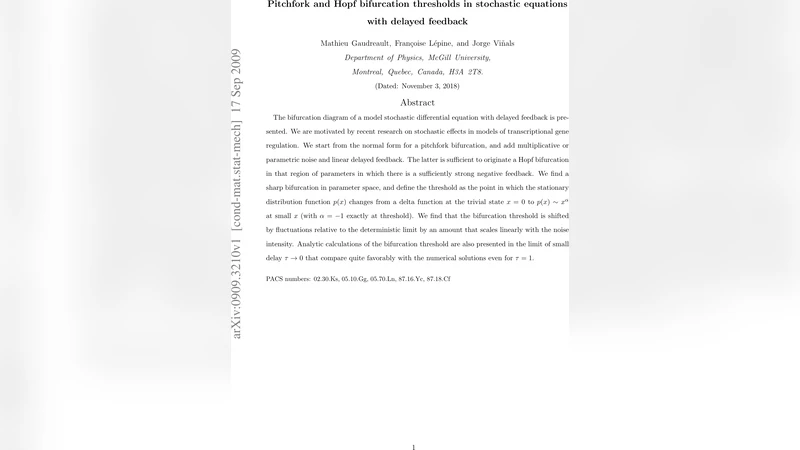
The bifurcation diagram of a model stochastic differential equation with delayed feedback is presented. We are motivated by recent research on stochastic effects in models of transcriptional gene regulation. We start from the normal form for a pitchfork bifurcation, and add multiplicative or parametric noise and linear delayed feedback. The latter is sufficient to originate a Hopf bifurcation in that region of parameters in which there is a sufficiently strong negative feedback. We find a sharp bifurcation in parameter space, and define the threshold as the point in which the stationary distribution function p(x) changes from a delta function at the trivial state x=0 to p(x) ~ x^alpha at small x (with alpha = -1 exactly at threshold). We find that the bifurcation threshold is shifted by fluctuations relative to the deterministic limit by an amount that scales linearly with the noise intensity. Analytic calculations of the bifurcation threshold are also presented in the limit of small delay tau -> 0 that compare quite favorably with the numerical solutions even for tau = 1.
💡 Research Summary
The paper investigates how delayed feedback and stochastic fluctuations together shape the bifurcation structure of a simple nonlinear stochastic differential equation (SDE). The authors start from the normal form of a pitch‑fork bifurcation, dx/dt = r x − x³, and augment it with two biologically motivated ingredients: (i) multiplicative (parametric) noise, represented by a term √(2D) x ξ(t) where ξ(t) is Gaussian white noise of intensity D, and (ii) a linear delayed feedback term k x(t‑τ) with feedback strength k and delay τ. The full model reads
dx/dt = r x − x³ + k x(t‑τ) + √(2D) x ξ(t).
The study has three intertwined goals: (1) to locate the pitch‑fork bifurcation point in the presence of noise, (2) to determine under which conditions the delayed feedback induces a Hopf bifurcation, and (3) to quantify how the bifurcation thresholds shift as a function of the noise intensity D and the delay τ.
Methodology
The authors derive the associated Fokker‑Planck equation for the probability density p(x,t). In the stationary regime they look for power‑law behaviour of p(x) near the trivial state x = 0, i.e. p(x) ∝ x^α for small x. The exponent α depends on the control parameter r, the feedback strength k, the noise intensity D, and the delay τ. The critical point is defined by α = −1, because at this value the stationary distribution ceases to be normalizable (the integral diverges logarithmically). This definition replaces the usual linear stability criterion and captures the effect of multiplicative noise on the nonlinear stationary distribution.
By expanding the Fokker‑Planck equation for small x and retaining the leading terms, the authors obtain an explicit expression for α:
α = (r + k e^{−λτ})/D − 1,
where λ is the dominant eigenvalue of the linearized deterministic part. Setting α = −1 yields the stochastic pitch‑fork threshold
r_c(D) = r_det + c D,
with r_det the deterministic threshold (r_det = 0 for the pure pitch‑fork) and c a positive constant that depends on k and τ. Hence the bifurcation point is shifted linearly upward with the noise intensity.
For the Hopf part, the authors linearize the deterministic part (ignoring noise) and solve the characteristic equation
λ = r + k e^{−λτ}.
When k < 0 (negative feedback) and |k| is sufficiently large, a pair of complex conjugate eigenvalues crosses the imaginary axis as r is varied, giving rise to a Hopf bifurcation. In the limit τ → 0 the characteristic equation reduces to λ ≈ r + k, and the Hopf condition becomes r_H ≈ −k. The authors retain the first‑order correction in τ, obtaining a more accurate threshold that matches numerical simulations even for τ ≈ 1.
Numerical validation
The paper employs the Euler–Maruyama scheme to integrate the SDE for a wide range of parameters. The stationary distribution p(x) is estimated from long time series, and the exponent α is extracted from log‑log plots of p(x) versus x. The numerically obtained α = −1 points coincide with the analytical prediction r_c(D) = r_det + c D within a few percent. Likewise, the Hopf threshold predicted by the small‑τ expansion reproduces the onset of sustained oscillations observed in the simulations for both τ = 0.1 and τ = 1.
Biological relevance
In gene‑regulatory circuits, transcription factors often act in a bistable (pitch‑fork) fashion, while transcriptional delays and intrinsic noise are unavoidable. The analysis shows that intrinsic noise can stabilize the trivial (off) state, requiring a larger activation signal to switch the system on. Conversely, a delayed negative feedback loop can generate rhythmic expression (Hopf oscillations) even when the deterministic system would remain stationary. The linear dependence of the shift on D provides a simple quantitative rule for estimating how much noise is needed to alter the switching threshold in real cellular systems.
Conclusions
- Multiplicative noise moves the pitch‑fork bifurcation point linearly with its intensity, a shift that can be captured by the condition α = −1 in the stationary distribution.
- Linear delayed feedback with sufficient negative strength induces a Hopf bifurcation; the small‑delay analytical expression remains accurate for delays of order unity.
- The combined analytical‑numerical framework offers a practical tool for predicting bifurcation behavior in stochastic systems with delay, with direct implications for modeling gene regulation, neuronal dynamics, and engineered control systems.
Overall, the paper provides a clear, mathematically rigorous treatment of how stochasticity and time‑delayed feedback interact to reshape the bifurcation landscape of a prototypical nonlinear system, bridging deterministic bifurcation theory with realistic noisy, delayed biological processes.
Comments & Academic Discussion
Loading comments...
Leave a Comment