Buoyancy Instabilities in Degenerate, Collisional, Magnetized Plasmas
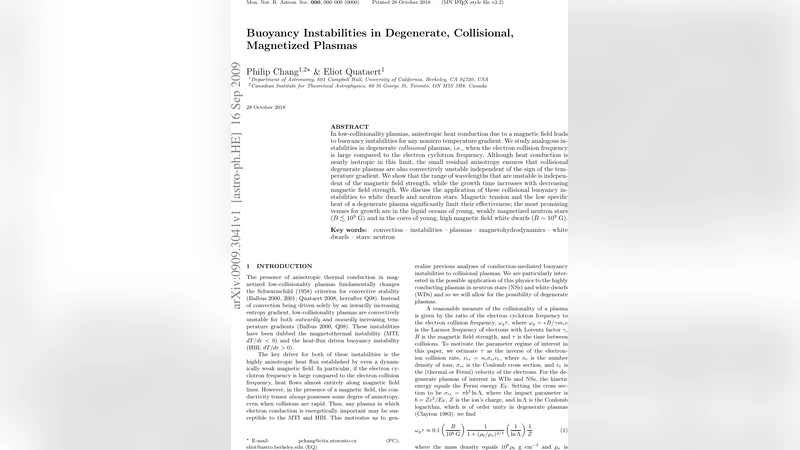
In low-collisionality plasmas, anisotropic heat conduction due to a magnetic field leads to buoyancy instabilities for any nonzero temperature gradient. We study analogous instabilities in degenerate {\it collisional} plasmas, i.e., when the electron collision frequency is large compared to the electron cyclotron frequency. Although heat conduction is nearly isotropic in this limit, the small residual anisotropy ensures that collisional degenerate plasmas are also convectively unstable independent of the sign of the temperature gradient. We show that the range of wavelengths that are unstable is independent of the magnetic field strength, while the growth time increases with decreasing magnetic field strength. We discuss the application of these collisional buoyancy instabilities to white dwarfs and neutron stars. Magnetic tension and the low specific heat of a degenerate plasma significantly limit their effectiveness; the most promising venues for growth are in the liquid oceans of young, weakly magnetized neutron stars ($B \lesssim 10^9$ G) and in the cores of young, high magnetic field white dwarfs ($B \sim 10^9$ G).
💡 Research Summary
The paper investigates buoyancy-driven convective instabilities in dense, degenerate plasmas where electron collisions dominate over cyclotron motion (νe ≫ ωc). In low‑collisionality plasmas, anisotropic heat conduction along magnetic field lines gives rise to the magnetothermal instability (MTI) and heat‑flux‑driven buoyancy instability (HBI), which operate for any non‑zero temperature gradient regardless of its sign. The authors extend this concept to the opposite limit—highly collisional, degenerate matter such as that found in white dwarf interiors and neutron‑star oceans.
In the collisional regime the electron thermal conductivity becomes nearly isotropic, but a residual anisotropy of order (ωc/νe)² persists. By retaining this tiny term in the heat‑flux tensor, they derive a linear dispersion relation for perturbations in a stratified medium with a uniform magnetic field. The growth rate γ satisfies
γ² ≈ (g α ΔT/k) · (ωc²/νe²) − (k·B)²/(4πρ),
where g is gravity, α the thermal expansion coefficient, ΔT the background temperature gradient, k the wavenumber, B the magnetic field, and ρ the density. The first term represents the buoyancy drive supplied by the anisotropic component of heat conduction; the second term is magnetic tension that suppresses motion across field lines. Crucially, the range of unstable wavelengths (set by the balance of buoyancy and magnetic tension) does not depend on B, while the magnitude of the growth rate scales inversely with B because the tension term grows with B².
Applying this framework to astrophysical objects, the authors consider two promising environments.
-
Liquid oceans of young neutron stars – In the outer layers of a newly born neutron star, temperatures can be 10⁸–10⁹ K with steep radial gradients, electron densities ≳10³⁴ cm⁻³, and magnetic fields of order 10⁸–10⁹ G. Here νe is enormous, making ωc/νe ≈ 10⁻³, so the anisotropy is tiny (∼10⁻⁶) but the product g α ΔT is large enough that the buoyancy term overwhelms magnetic tension for B ≲ 10⁹ G. The resulting growth times are ≤10⁴ yr, shorter than the cooling age of a young neutron star, allowing the instability to mix heat and composition in the ocean.
-
Cores of high‑field white dwarfs – Young, massive white dwarfs may possess interior magnetic fields around 10⁹ G. Electron densities are ∼10³⁰ cm⁻³ and temperature gradients are milder than in neutron‑star oceans, but the degenerate plasma’s specific heat is extremely low, enhancing the buoyancy response. The instability can operate only when B is near 10⁹ G; stronger fields make magnetic tension dominant, while weaker fields reduce the anisotropic heat‑flux term, limiting growth.
The analysis shows that magnetic tension and the low specific heat of degenerate matter strongly constrain the effectiveness of these collisional buoyancy instabilities. Nevertheless, in the identified regimes they can provide a novel mechanism for turbulent mixing, potentially influencing thermal evolution, magnetic field redistribution, and chemical stratification in compact objects. The authors conclude that future work should incorporate realistic magnetic‑field geometries, nonlinear saturation, and coupling to other transport processes to fully assess the astrophysical impact.
Comments & Academic Discussion
Loading comments...
Leave a Comment