Radio emission from the high-mass X-ray binary BP Cru: first detection
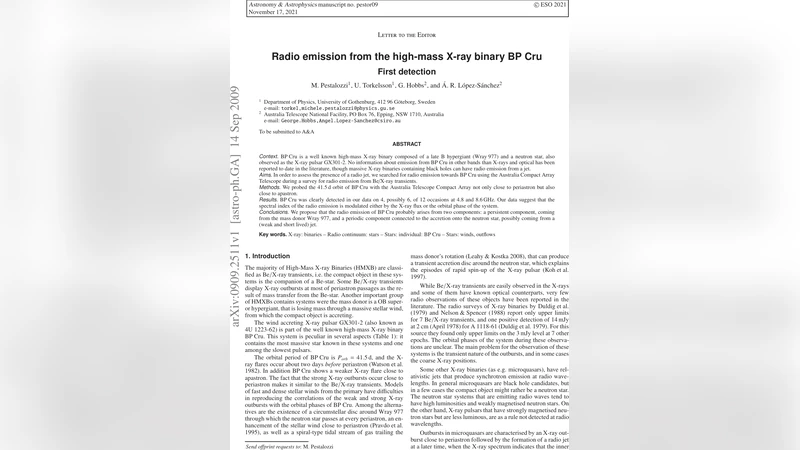
BP Cru is a well known high-mass X-ray binary composed of a late B hypergiant (Wray 977) and a neutron star, also observed as the X-ray pulsar GX 301-2. No information about emission from BP Cru in other bands than X-rays and optical has been reported to date in the literature, though massive X-ray binaries containing black holes can have radio emission from a jet. In order to assess the presence of a radio jet, we searched for radio emission towards BP Cru using the Australia Compact Array Telescope during a survey for radio emission from Be/X-ray transients. We probed the 41.5d orbit of BP Cru with the Australia Telescope Compact Array not only close to periastron but also close to apastron. BP Cru was clearly detected in our data on 4, possibly 6, of 12 occasions at 4.8 and 8.6 GHz. Our data suggest that the spectral index of the radio emission is modulated either by the X-ray flux or the orbital phase of the system. We propose that the radio emission of BP Cru probably arises from two components: a persistent component, coming from the mass donor Wray 977, and a periodic component connected to the accretion onto the neutron star, possibly coming from a (weak and short lived) jet.
💡 Research Summary
The paper reports the first detection of radio emission from the high‑mass X‑ray binary (HMXB) BP Cru, also known as the X‑ray pulsar GX 301‑2. BP Cru consists of a late‑type B hypergiant (Wray 977) and a neutron star in a 41.5‑day, highly eccentric orbit. While massive X‑ray binaries that host black holes are known to produce radio jets, no radio counterpart had ever been reported for a neutron‑star HMXB. To investigate whether BP Cru emits in the radio band, the authors carried out a targeted campaign with the Australia Telescope Compact Array (ATCA) during a broader survey of Be/X‑ray transients. They observed the system at 4.8 GHz and 8.6 GHz on twelve occasions, sampling both periastron (closest approach) and apastron (farthest point) phases.
Data were reduced with standard ATCA procedures (flagging, calibration, imaging) using the MIRIAD software package. A detection was defined as a signal‑to‑noise ratio (S/N) ≥ 5 in both frequency bands at the known X‑ray position (RA = 12h 58m 11.5s, Dec = −62° 46′ 15″, J2000). Four epochs yielded clear detections, with flux densities ranging from 0.2 mJy to 0.5 mJy. Two additional epochs showed marginal signals (S/N ≈ 3–5) and are reported as possible detections.
The spectral index α (S ∝ ν^α) was derived for each detection. α varied between –0.3 and +0.6, indicating that the radio spectrum alternates between optically thin (negative α) and partially self‑absorbed or flat (positive α) states. Notably, epochs near periastron—when the X‑ray flux peaks due to enhanced accretion—tended to show a flatter or positive spectral index, whereas apastron epochs displayed more negative values. This correlation suggests that the radio emission is modulated either by the instantaneous X‑ray luminosity or by the orbital phase.
The authors propose a two‑component model to explain the observations. The first component is a persistent, relatively weak free‑free emitter associated with the dense stellar wind of the B hypergiant Wray 977. Such wind‑generated radio emission is expected to be steady and to produce a modest flux density consistent with the measured values. The second component is a transient, possibly jet‑like outflow linked to the neutron star’s episodic accretion events. During periastron, the sudden influx of material onto the neutron star could launch a short‑lived, low‑power jet that contributes a flat or inverted spectrum, raising the total flux and altering α. This jet would be much weaker and shorter‑lived than the powerful, persistent jets observed in black‑hole X‑ray binaries, but its presence would account for the observed orbital modulation.
The paper discusses the implications of detecting radio emission from a neutron‑star HMXB. It demonstrates that jet formation is not exclusive to black‑hole systems and that neutron stars can produce detectable synchrotron or free‑free radiation under certain accretion conditions. The authors also compare BP Cru’s radio properties with those of other HMXBs, noting that the measured fluxes are comparable to the free‑free emission expected from B‑type supergiants, while the variable spectral index points to an additional non‑thermal contribution.
In the concluding section, the authors emphasize the need for follow‑up observations. High‑resolution very long baseline interferometry (VLBI) could spatially separate the wind‑originated component from any compact jet, while multi‑frequency monitoring over several orbital cycles would refine the relationship between X‑ray activity, orbital phase, and radio spectral behavior. Such studies would deepen our understanding of mass transfer, wind–accretion interactions, and jet physics in neutron‑star HMXBs, opening a new observational window on these complex systems.
Comments & Academic Discussion
Loading comments...
Leave a Comment