Nonthermal Radiation of Young Supernova Remnants
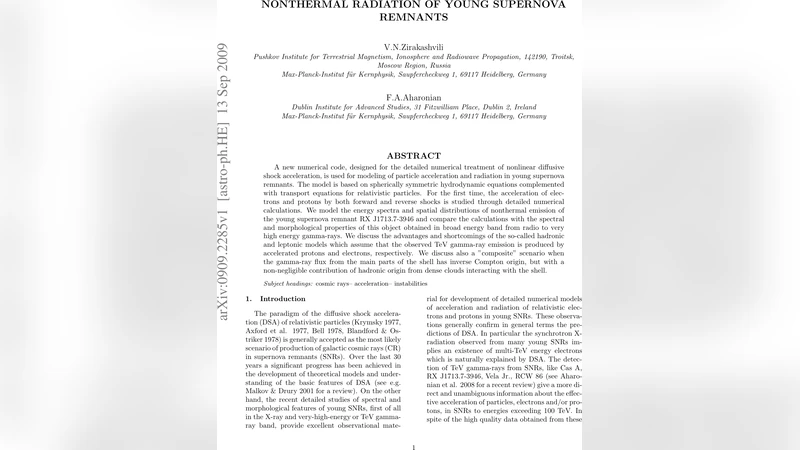
A new numerical code, designed for the detailed numerical treatment of nonlinear diffusive shock acceleration, is used for modeling of particle acceleration and radiation in young supernova remnants. The model is based on spherically symmetric hydrodynamic equations complemented with transport equations for relativistic particles. For the first time, the acceleration of electrons and protons by both forward and reverse shocks is studied through detailed numerical calculations. We model the energy spectra and spatial distributions of nonthermal emission of the young supernova remnant RX J1713.7-3946 and compare the calculations with the spectral and morphological properties of this object obtained in broad energy band from radio to very high energy gamma-rays. We discuss the advantages and shortcomings of the so-called hadronic and leptonic models which assume that the observed TeV gamma-ray emission is produced by accelerated protons and electrons, respectively. We discuss also a “composite” scenario when the gamma-ray flux from the main parts of the shell has inverse Compton origin, but with a non-negligible contribution of hadronic origin from dense clouds interacting with the shell.
💡 Research Summary
This paper presents a newly developed numerical framework for the fully nonlinear treatment of diffusive shock acceleration (DSA) in young supernova remnants (SNRs) and applies it to the well‑studied object RX J1713.7‑3946. The code solves spherically symmetric hydrodynamic equations coupled with transport equations for relativistic electrons and protons, explicitly including the back‑reaction of accelerated particles on the shock structure. Unlike most previous works that focus solely on the forward shock (FS), the authors incorporate both the forward and the reverse shock (RS) as sites of particle injection and acceleration, allowing a self‑consistent calculation of the spatial and spectral distribution of non‑thermal particles.
Key physical ingredients of the model are: (1) a nonlinear feedback loop where the pressure of accelerated particles modifies the compression ratio and velocity profile of the shock; (2) magnetic‑field amplification parameterised to enhance synchrotron losses and reduce the diffusion coefficient; (3) separate injection efficiencies and minimum energies for electrons and protons at each shock; and (4) radiative processes including synchrotron emission, inverse‑Compton (IC) scattering on the cosmic microwave background and interstellar radiation fields, and neutral‑pion (π⁰) decay from proton‑nucleus collisions.
The authors explore a realistic parameter space (explosion energy ~10⁵¹ erg, ejecta mass ~3 M⊙, ambient density 0.01–0.1 cm⁻³, magnetic amplification factor 5–10) and adjust electron/proton injection fractions (10⁻⁴–10⁻³) to reproduce the observed broadband spectrum from radio to TeV γ‑rays. Their simulations show that electrons accelerated at the FS produce the bulk of the radio and X‑ray synchrotron emission, while IC scattering by these electrons can account for a substantial part of the TeV γ‑ray flux. However, the IC component alone underestimates the hardest part of the γ‑ray spectrum. Adding electrons accelerated at the RS steepens the high‑energy tail of the IC spectrum, bringing it into agreement with H.E.S.S. and CTA data.
Pure hadronic scenarios, in which π⁰‑decay dominates the γ‑ray output, can reproduce the TeV flux but require proton injection efficiencies that over‑predict the synchrotron X‑ray flux or demand unrealistically high ambient densities. Moreover, such models struggle to match the observed thin X‑ray rims, which are naturally explained by rapid synchrotron cooling in amplified magnetic fields at the FS and RS.
To reconcile these discrepancies, the authors propose a “composite” model. In this picture, the majority of the shell emits γ‑rays via IC scattering (leptonic origin), while dense clumps or molecular clouds embedded in the shell provide localized targets for accelerated protons. Interactions of protons with these high‑density regions generate additional π⁰‑decay γ‑rays, producing a modest but non‑negligible hadronic contribution. This hybrid scenario naturally explains the observed spatial variations in γ‑ray brightness, especially enhancements coincident with known molecular cloud locations, and it preserves the consistency of the synchrotron X‑ray morphology.
The paper also conducts a sensitivity analysis, showing how variations in shock speed, compression ratio, and magnetic‑field amplification affect the particle spectra and radiative output. The nonlinear feedback reduces the effective compression ratio, limiting the maximum particle energy to a few tens of TeV for protons, consistent with the lack of a clear PeV signature. Electron acceleration remains efficient enough to generate X‑ray filaments of sub‑parsec width, matching Chandra observations.
In conclusion, the study demonstrates that a fully nonlinear DSA model incorporating both forward and reverse shocks is essential for a realistic description of young SNRs. It highlights the limitations of pure leptonic or hadronic interpretations of the TeV emission from RX J1713.7‑3946 and argues that a composite leptonic‑hadronic picture, with a dominant IC component supplemented by localized π⁰‑decay from dense clouds, best fits the multi‑wavelength data. The authors suggest that future high‑resolution γ‑ray imaging and deeper molecular‑line surveys will be crucial to test the predicted cloud‑associated hadronic hotspots and to further constrain the microphysics of particle acceleration in SNRs.
Comments & Academic Discussion
Loading comments...
Leave a Comment