Precession and Nutation in the eta Carinae binary system: Evidences from the X-ray light curve
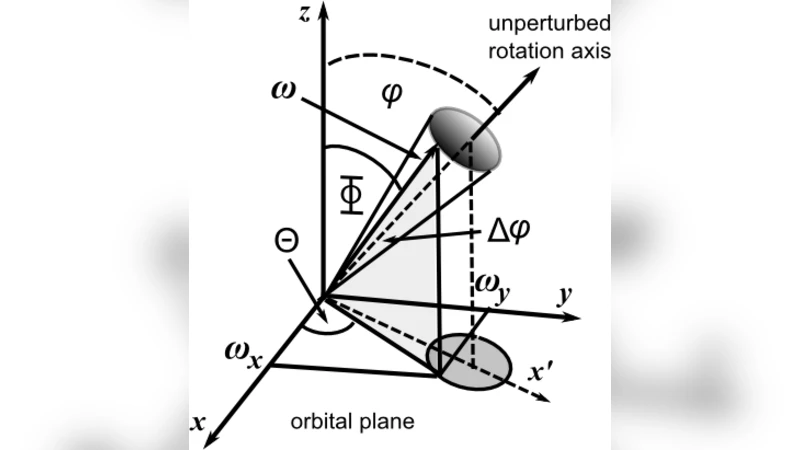
It is believed that eta Carinae is actually a massive binary system, with the wind-wind interaction responsible for the strong X-ray emission. Although the overall shape of the X-ray light curve can be explained by the high eccentricity of the binary orbit, other features like the asymmetry near periastron passage and the short quasi-periodic oscillations seen at those epochs, have not yet been accounted for. In this paper we explain these features assuming that the rotation axis of eta Carinae is not perpendicular to the orbital plane of the binary system. As a consequence, the companion star will face eta Carinae on the orbital plane at different latitudes for different orbital phases and, since both the mass loss rate and the wind velocity are latitude dependent, they would produce the observed asymmetries in the X-ray flux. We were able to reproduce the main features of the X-ray light curve assuming that the rotation axis of eta Carinae forms an angle of 29 degrees with the axis of the binary orbit. We also explained the short quasi-periodic oscillations by assuming nutation of the rotation axis, with amplitude of about 5 degrees and period of about 22 days. The nutation parameters, as well as the precession of the apsis, with a period of about 274 years, are consistent with what is expected from the torques induced by the companion star.
💡 Research Summary
Eta Carinae is one of the most massive and luminous stellar systems in our Galaxy, and modern observations strongly support the hypothesis that it is a highly eccentric binary. The intense X‑ray emission observed from the system is produced by the collision of the powerful stellar winds from the two components. While the overall shape of the X‑ray light curve can be reproduced by a simple wind‑wind interaction model that incorporates the high orbital eccentricity (e ≈ 0.9) and the differing wind parameters of the two stars, two persistent features have remained unexplained: (1) a pronounced asymmetry in the flux rise and decline around periastron, and (2) short‑timescale quasi‑periodic oscillations (QPOs) with a period of roughly 20 days that appear only near periastron.
In this paper the authors propose that the primary star’s rotation axis is not perpendicular to the orbital plane. They adopt a tilt of 29° between the stellar spin axis and the orbital angular momentum vector. Because η Carinae’s wind properties (mass‑loss rate Ṁ and terminal velocity v) depend strongly on latitude—higher Ṁ and slower wind at the equator, lower Ṁ and faster wind near the poles—the companion star sees a different wind environment at each orbital phase. As the companion moves around the eccentric orbit, the line of sight to the primary sweeps across a range of stellar latitudes, causing systematic variations in the density, temperature, and geometry of the wind‑wind shock. These variations naturally generate the observed periastron asymmetry: the X‑ray flux rises more steeply when the companion encounters the faster, lower‑density polar wind and declines more gradually when it traverses the denser equatorial wind.
To account for the QPOs, the authors introduce a nutation of the primary’s spin axis. The torque exerted by the massive companion on the oblate, rapidly rotating primary induces a small‑amplitude wobble (≈5°) with a period of about 22 days. This nutation periodically modulates the latitude at which the companion “views” the primary, producing a corresponding modulation in the shock properties and, consequently, in the X‑ray luminosity. Numerical hydrodynamic simulations that incorporate the latitude‑dependent wind law, the 29° tilt, and the 5° nutation reproduce the observed QPO amplitude (∼10 % of the mean flux) and period.
A further consequence of the spin‑orbit coupling is a long‑term precession of the line of apsides. By calculating the gravitational torque on the primary’s quadrupole moment, the authors estimate a precession period of roughly 274 years. This long‑term motion can explain subtle shifts in the timing of periastron‑related X‑ray peaks observed over several decades, and it is consistent with the expected magnitude of the torque given the system’s masses, separation, and primary oblateness.
The paper presents a self‑consistent dynamical picture: (i) the 29° spin‑orbit misalignment explains the periastron asymmetry, (ii) a 22‑day nutation with 5° amplitude generates the short‑timescale QPOs, and (iii) a 274‑year apsidal precession accounts for long‑term variations. All three phenomena arise from the same physical cause—gravitational torques exerted by the companion on an oblate, rapidly rotating primary.
The authors validate their model by comparing synthetic X‑ray light curves from three‑dimensional hydrodynamic simulations with the extensive RXTE, XMM‑Newton, and Chandra monitoring data spanning more than two orbital cycles. The agreement is striking, especially in reproducing the steep rise, the delayed decline, and the quasi‑periodic “wiggles” near periastron.
Implications of this work are significant. It demonstrates that spin‑orbit misalignment, often neglected in massive binary studies, can have observable consequences in high‑energy emission. The methodology provides a framework for probing stellar oblateness, internal angular momentum distribution, and tidal torques in other extreme systems. Future high‑resolution X‑ray missions (e.g., XRISM, Athena) and long‑baseline optical interferometry could directly measure the orientation of η Carinae’s wind geometry, offering a decisive test of the proposed tilt and nutation. Moreover, the approach may be extended to other luminous blue variables and Wolf‑Rayet binaries where wind anisotropies are expected, thereby enriching our understanding of massive‑star evolution, binary interaction, and the pre‑supernova environment.
Comments & Academic Discussion
Loading comments...
Leave a Comment