An Fe XXVI Absorption Line in the Persistent Spectrum of the Dipping Low Mass X-ray Binary 1A 1744-361
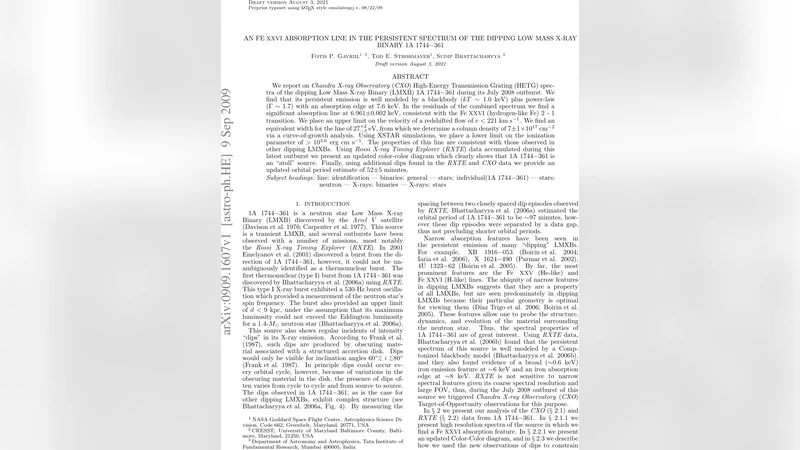
We report on Chandra X-ray Observatory (CXO) High-Energy Transmission Grating (HETG) spectra of the dipping Low Mass X-ray Binary (LMXB) 1A 1744-361 during its July 2008 outburst. We find that its persistent emission is well modeled by a blackbody (kT ~ 1.0 keV) plus power-law ($\Gamma$ ~ 1.7) with an absorption edge at 7.6 keV. In the residuals of the combined spectrum we find a significant absorption line at 6.961+/-0.002 keV, consistent with the Fe XXVI (hydrogen-like Fe) 2 - 1 transition. We place an upper limit on the velocity of a redshifted flow of v < 221 km/s. We find an equivalent width for the line of 27^+2_-3 eV, from which we determine a column density of 7+/-1x10^17 cm^-2 via a curve-of-growth analysis. Using XSTAR simulations, we place a lower limit on the ionization parameter of > 10^3.6 erg cm/s. The properties of this line are consistent with those observed in other dipping LMXBs. Using Rossi X-ray Timing Explorer (RXTE) data accumulated during this latest outburst we present an updated color-color diagram which clearly shows that 1A 1744-361 is an “atoll” source. Finally, using additional dips found in the RXTE and CXO data we provide an updated orbital period estimate of 52+/-5 minutes.
💡 Research Summary
In this work the authors present a comprehensive X‑ray spectroscopic and timing study of the dipping low‑mass X‑ray binary (LMXB) 1A 1744‑361 during its July 2008 outburst. Using the Chandra X‑ray Observatory’s High‑Energy Transmission Grating (HETG), they obtained a high‑signal‑to‑noise combined spectrum of the source’s persistent emission. The continuum is best described by a two‑component model consisting of a blackbody with a temperature of kT ≈ 1.0 keV and a power‑law with photon index Γ ≈ 1.7, together with an absorption edge at 7.6 keV. After fitting this baseline model, the residuals reveal a statistically significant narrow absorption feature at 6.961 ± 0.002 keV. The line energy matches the Fe XXVI (hydrogen‑like iron) Lyα transition (2 → 1), establishing the first detection of this ion in the persistent spectrum of 1A 1744‑361.
The equivalent width of the line is measured to be 27 eV (+2/‑3 eV). By applying a curve‑of‑growth analysis the authors infer a column density for Fe XXVI of N ≈ 7 × 10¹⁷ cm⁻² with an uncertainty of about ±1 × 10¹⁷ cm⁻². The line centroid shows no significant shift from the laboratory value; the authors therefore place an upper limit on any bulk motion of the absorbing plasma of v < 221 km s⁻¹ (red‑shifted flow). This limit is well below the several hundred km s⁻¹ outflows commonly reported in other dipping LMXBs, suggesting that the absorber is either a relatively static, highly ionized atmosphere above the accretion disc or a very slow wind.
To constrain the ionization state, the authors performed XSTAR photo‑ionization simulations. The simulations require an ionization parameter ξ > 10³·⁶ erg cm s⁻¹ to produce the observed Fe XXVI strength while keeping lower‑ionization species weak, consistent with a plasma temperature exceeding 10⁶ K. The presence of the Fe XXVI line in the persistent (non‑dip) spectrum indicates that the highly ionized material is not confined to the dipping structures but pervades the line of sight throughout the outburst.
Complementary timing analysis was carried out with Rossi X‑ray Timing Explorer (RXTE) data collected over the same outburst. A color–color diagram constructed from the RXTE PCA data shows the classic atoll track, confirming that 1A 1744‑361 behaves as an atoll source rather than a Z‑source. The source moves between hard and soft branches, and the spectral parameters derived from the Chandra data (blackbody temperature, power‑law index) are consistent with the positions on the atoll diagram.
The authors also revisited the orbital period using dip timings identified in both the RXTE and Chandra light curves. By measuring the intervals between successive dips and applying a linear ephemeris fit, they obtain an updated orbital period of 52 ± 5 minutes. This value refines earlier estimates (≈53 min) and reduces the uncertainty, providing a tighter constraint for binary evolution models.
In summary, the paper delivers several key contributions: (1) the first robust detection of an Fe XXVI absorption line in the persistent emission of 1A 1744‑361, (2) quantitative measurements of the line’s equivalent width, column density, ionization parameter, and velocity limit, (3) confirmation of the source’s atoll nature via an updated color–color diagram, and (4) a refined orbital period based on a larger sample of dip events. The results reinforce the picture that dipping LMXBs host a highly ionized, relatively static plasma component that can imprint narrow Fe XXVI features even outside of dip intervals. The study also demonstrates the power of combining high‑resolution spectroscopy with long‑term timing monitoring to dissect the geometry and physical conditions of accretion flows in neutron‑star binaries. Future missions with improved spectral resolution (e.g., XRISM, Athena) will be able to resolve line profiles in greater detail, potentially revealing subtle velocity structures, turbulence, or multiple ionization zones within the disc atmosphere.
Comments & Academic Discussion
Loading comments...
Leave a Comment