Computation and Dynamics: Classical and Quantum
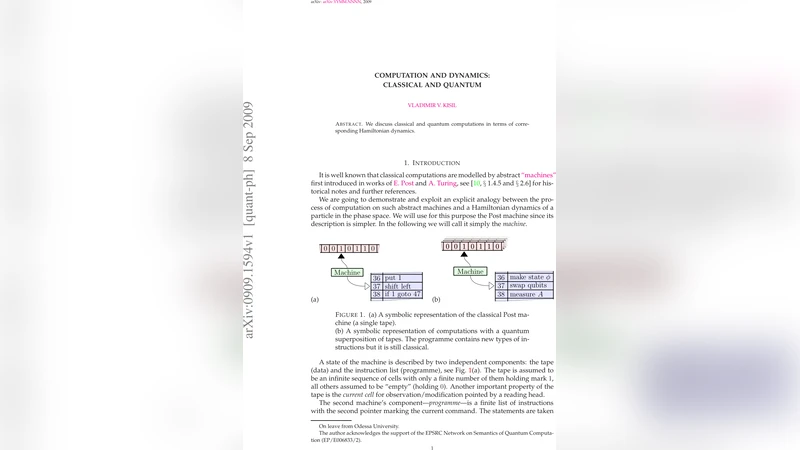
We discuss classical and quantum computations in terms of corresponding Hamiltonian dynamics. This allows us to introduce quantum computations which involve parallel processing of both: the data and programme instructions. Using mixed quantum-classical dynamics we look for a full cost of computations on quantum computers with classical terminals.
💡 Research Summary
The paper proposes a unified framework that recasts both classical and quantum computation in the language of Hamiltonian dynamics, thereby offering a physically grounded perspective on algorithmic processes and their resource requirements. It begins by mapping classical digital logic onto phase‑space flows: each binary variable is treated as a discrete coordinate, and logical gates correspond to canonical (symplectic) transformations that preserve the underlying Hamiltonian structure. This representation naturally incorporates reversibility and energy conservation, linking reversible computing concepts with thermodynamic efficiency and suggesting that the cost of classical computation can be expressed in terms of Hamiltonian energy exchange.
Building on this foundation, the authors extend the formalism to quantum computing. Qubits are represented as vectors in a Hilbert space, and quantum gates arise from unitary evolutions generated by time‑dependent Hamiltonians. The novel contribution lies in treating the program itself as a quantum state rather than a fixed sequence of classical instructions. In this “quantum‑program” model, both data and instruction registers can be placed in superposition, enabling a form of parallelism that goes beyond conventional quantum data parallelism. Consequently, the computational process is described as a joint evolution of data and program Hilbert spaces under a composite Hamiltonian, opening the door to algorithms that exploit interference between different program branches.
The third part of the work addresses the inevitable hybrid nature of real quantum machines, which require classical control and read‑out interfaces. The authors model the classical‑quantum interface as a coupling term in the total Hamiltonian, capturing how classical control pulses drive quantum dynamics and how measurement back‑action feeds back into classical registers. Recognizing that measurement is a non‑unitary, irreversible operation, they propose a strategy of partial, deferred measurements combined with classical feedback loops to minimize decoherence and reduce the overhead of error correction.
A detailed cost model is then introduced. The total computational cost is decomposed into four contributions: (1) the energetic cost of Hamiltonian evolution per logical step, (2) the coherence time required to maintain entanglement across the data‑program system, (3) the overhead associated with decoherence and error correction during classical‑quantum transitions, and (4) a newly defined “instruction parallelism” term that quantifies the resource impact of having the program itself in a superposed state. This instruction parallelism scales with the size of the program Hilbert space and the depth of entanglement, and if left unchecked can dominate the overall resource budget, outweighing the traditional gate‑count complexity.
In the concluding discussion, the authors argue that their Hamiltonian‑centric viewpoint provides a rigorous basis for designing algorithms that simultaneously optimize data and program structures, and for engineering hardware‑software co‑design strategies that minimize the hybrid overhead. By quantifying the full cost of quantum computation—including the often‑neglected classical terminal interactions—the paper lays a theoretical foundation for realistic assessments of quantum advantage and guides future research toward more efficient, physically consistent quantum architectures.
Comments & Academic Discussion
Loading comments...
Leave a Comment