X- and Gamma-Ray Flashes from Type Ia Supernovae?
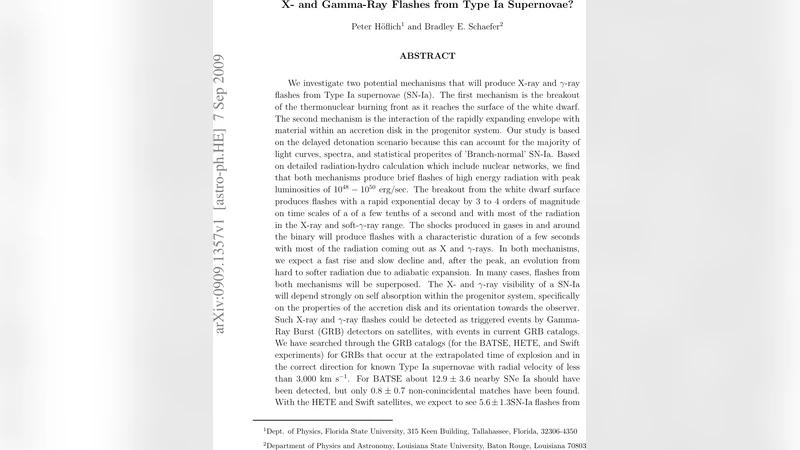
We investigate two potential mechanisms that will produce X-ray and gamma-ray flashes from Type Ia supernovae (SN-Ia). The mechanisms are the breakout of the thermonuclear burning front as it reaches the surface of the white dwarf and the interaction of the rapidly expanding envelope with an accretion disk. Based on the delayed-detonation scenario and detailed radiation-hydro calculation which include nuclear networks, we find that both mechanisms produce ~1 second flashes of high energy radiation with peak luminosities of 10^48 to 10^50 erg/sec with fast rises and exponential declines. The X- and gamma-ray visibility of a SN-Ia will depend strongly on self absorption within the progenitor system, specifically on the properties of the accretion disk and its orientation towards the observer. Such X-ray and gamma-ray flashes could be detected as triggered events by Gamma-Ray Burst (GRB) detectors on satellites, with events in current GRB catalogs. We have searched through the GRB catalogs (for the BATSE, HETE, and Swift experiments) for GRBs that occur at the extrapolated time of explosion and in the correct direction for known Type Ia supernovae with radial velocity of less than 3,000 km/s. For BATSE about 12.9+-3.6 nearby SNe Ia should have been detected, but only 0.8+-0.7 non-coincidental matches have been found. With the HETE and Swift satellites, we expect to see 5.6+-1.3 SN-Ia flashes from known nearby SNe Ia but, yet, no SN-Ia flashes were detected. These place observational limits that the bolometric peak luminosity of SN-Ia Flashes must be less ~10^46 erg/s. We attribute the difference between theory and observational limits to the absorption of the X- and gamma-rays by the accretion disk of large scale height or common envelope that would be smothering the white dwarf.
💡 Research Summary
The paper investigates whether Type Ia supernovae (SNe Ia) can produce brief, intense flashes of X‑ray and gamma‑ray radiation, and if such flashes might already be present in existing gamma‑ray burst (GRB) catalogs. Two physical mechanisms are considered. The first is the breakout of the thermonuclear flame front when it reaches the surface of the exploding white dwarf. As the sub‑sonic deflagration transitions to a detonation and the burning front propagates outward, the surface layers are suddenly heated to temperatures of order 10⁹ K, producing a burst of high‑energy photons that can escape if the overlying column density is low enough. The second mechanism involves the interaction of the rapidly expanding supernova envelope with a surrounding accretion disk or common envelope. When the ejecta collide with this dense circumstellar material, a strong shock forms, heating the gas to relativistic temperatures and generating a short, hard X‑ray/gamma‑ray flash.
To quantify these processes the authors performed one‑dimensional radiation‑hydrodynamics simulations that include a detailed nuclear reaction network, realistic opacity tables, and a treatment of photon diffusion. The calculations are based on the delayed‑detonation model, which reproduces the observed optical light curves of normal SNe Ia. Both mechanisms produce flashes lasting roughly one second, with rise times of a few hundred milliseconds and exponential decays thereafter. The peak bolometric luminosities range from 10⁴⁸ to 10⁵⁰ erg s⁻¹, depending on the white dwarf radius, the density structure of the outer layers, and the geometry and mass of the surrounding disk. In the breakout case the flash peaks at ≈0.2 s after ignition; in the disk‑collision case the peak occurs later, around 0.5–1 s, when the ejecta first encounter the disk.
Having established the theoretical expectations, the authors turned to observational data. They compiled a list of nearby (recession velocity < 3000 km s⁻¹) SNe Ia with well‑constrained explosion dates, then searched the GRB catalogs of BATSE, HETE‑2, and Swift/BAT for triggers that occurred within ±30 s of the estimated explosion time and within the positional error circles of the supernovae. For BATSE, the model predicts that about 12.9 ± 3.6 such flashes should have been detected, yet only 0.8 ± 0.7 coincidences are found, a number consistent with random background matches. For HETE‑2 and Swift, the expected numbers are 5.6 ± 1.3 each, but no matches are present. These non‑detections translate into an empirical upper limit on the bolometric peak luminosity of a SN Ia flash of roughly 10⁴⁶ erg s⁻¹, two to four orders of magnitude below the theoretical predictions.
The discrepancy is interpreted as evidence that the high‑energy photons are largely absorbed before escaping the progenitor system. The authors argue that a thick, high‑scale‑height accretion disk or a residual common envelope surrounding the white dwarf can provide sufficient column density (≫10 g cm⁻²) to attenuate the flash via Compton scattering and photo‑electric absorption. In such a configuration the flash would be re‑processed into lower‑energy radiation, possibly contributing to the early optical/UV emission but remaining invisible to current GRB detectors.
The paper concludes that while SN Ia explosions are capable of generating powerful X‑ray/gamma‑ray flashes in principle, the surrounding circumstellar environment in most systems likely suppresses their observable signatures. Future missions with higher sensitivity, broader energy coverage, and rapid localization (e.g., SVOM, THESEUS, or proposed wide‑field X‑ray monitors) could test this hypothesis by either detecting faint, short‑duration high‑energy events associated with nearby SNe Ia or by placing even tighter constraints on the absorbing structures. Such observations would not only clarify the high‑energy phenomenology of thermonuclear supernovae but also provide indirect probes of the geometry and composition of the accretion disks or envelopes that precede the explosion.
Comments & Academic Discussion
Loading comments...
Leave a Comment