Radio halos in nearby (z < 0.4) clusters of galaxies
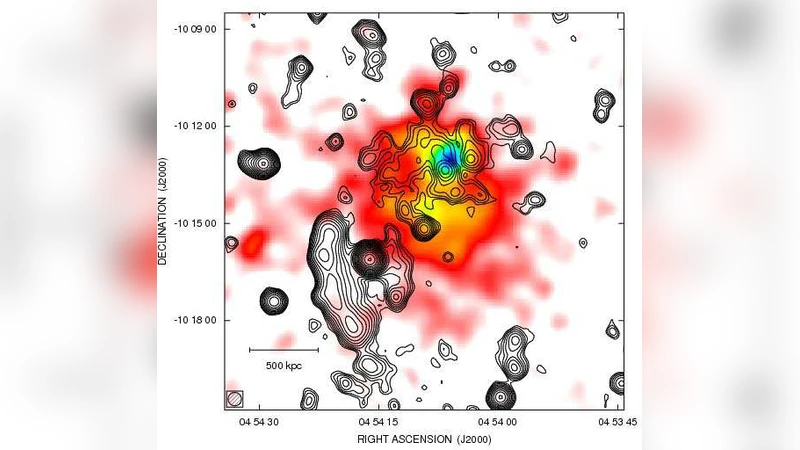
The Intra-Cluster Medium is characterized by thermal emission, and by the presence of large scale magnetic fields. In some clusters of galaxies a diffuse non-thermal emission is also present, located at the cluster center and named radio halo. These sources indicate the existence of relativistic particles and magnetic fields in the cluster volume. In this paper we collect data on all known nearby cluster radio halos (z < 0.4), to discuss their statistical properties and to investigate their origin. We searched for published data on radio halos and reduced new and archive VLA data to increase the number of known radio halos. We present data on 31 radio halos, 1 new relic source, and 1 giant filament. We note the discovery of a small size diffuse radio emission in a cluster (A1213) with very low X-ray luminosity. Among statistical results we confirm the correlation between the average halo radio spectral index and the cluster temperature. We also discuss the high percentage of clusters where both a relic and a radio halo is present. The sample of radio halos discussed here represents the population of radio halos observable with present radio telescopes. The new telescope generation is necessary for a more detailed multifrequency study, and to investigate the possible existence of a population of radio halos with different properties.
💡 Research Summary
This paper presents a comprehensive census of radio halos in nearby galaxy clusters with redshift z < 0.4, aiming to characterize their statistical properties and to shed light on their physical origin. The authors combined an exhaustive literature search with new reductions of archival and newly obtained Very Large Array (VLA) observations. As a result, they compiled a sample of 31 confirmed radio halos, one newly identified relic source, and one giant filamentary structure. A particularly noteworthy discovery is a faint, small‑scale diffuse radio emission in the low‑X‑ray‑luminosity cluster A1213, demonstrating that radio halos are not confined to the most X‑ray luminous systems.
The data were primarily obtained at 1.4 GHz and 330 MHz using the VLA in its C and D configurations, achieving surface‑brightness sensitivities of order 10 µJy beam⁻¹. This high sensitivity allowed the detection of low‑brightness, extended emission that would have been missed in earlier surveys. For each halo the authors measured size, total radio power, surface brightness, and spectral index, and they compiled the corresponding X‑ray properties of the host clusters (temperature, luminosity, mass).
Statistical analysis revealed three key correlations. First, the average radio spectral index (α) of a halo correlates positively with the host cluster’s X‑ray temperature (T_X); hotter clusters tend to host halos with flatter spectra, consistent with models in which stronger merger‑driven turbulence and shocks accelerate relativistic electrons more efficiently. Second, the fraction of clusters that host both a halo and a relic is higher than previously thought, suggesting that the same merger event can simultaneously energize particles in the cluster core (producing the halo) and in the periphery (producing the relic). Third, halo size and radio power both increase with the cluster’s X‑ray luminosity, indicating that the overall thermal energy budget of the intracluster medium influences the non‑thermal radio output.
The authors argue that the compiled sample represents the full population of radio halos that can be detected with current radio facilities. They emphasize that the next generation of radio telescopes—such as the Square Kilometre Array (SKA) and the next‑generation VLA (ngVLA)—will be essential to probe fainter, smaller, and higher‑redshift halos, as well as to conduct detailed multi‑frequency studies that can disentangle the contributions of primary acceleration, secondary (hadronic) production, and re‑acceleration mechanisms.
In addition to the observational results, the paper discusses theoretical implications. The high incidence of co‑existent halos and relics supports merger‑induced turbulence models over scenarios that treat halos and relics as independent phenomena. The detection of a halo in a low‑luminosity cluster challenges the notion of a strict X‑ray luminosity threshold for halo formation, suggesting that even modest mergers can generate sufficient turbulence under favorable magnetic‑field conditions.
Finally, the authors outline future directions: deep, low‑frequency observations to capture the steep‑spectrum component of halos; high‑frequency imaging to resolve spectral curvature; and coordinated X‑ray, Sunyaev–Zel’dovich, and optical studies to map the dynamical state of the host clusters. Such multi‑wavelength campaigns will enable a more complete picture of the energy transfer from large‑scale gravitational collapse to relativistic particles and magnetic fields in the intracluster medium.
Comments & Academic Discussion
Loading comments...
Leave a Comment