Construction of Coupled Period-Mass Functions in Extrasolar Planets through the Nonparametric Approach
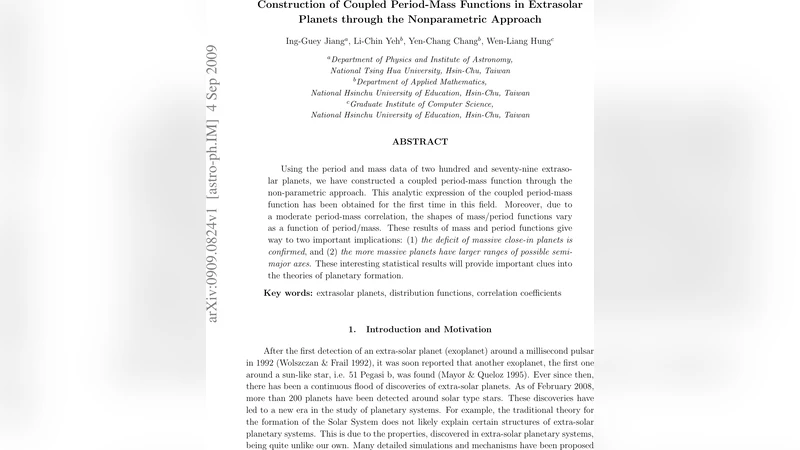
Using the period and mass data of two hundred and seventy-nine extrasolar planets, we have constructed a coupled period-mass function through the non-parametric approach. This analytic expression of the coupled period-mass function has been obtained for the first time in this field. Moreover, due to a moderate period-mass correlation, the shapes of mass/period functions vary as a function of period/mass. These results of mass and period functions give way to two important implications: (1) the deficit of massive close-in planets is confirmed, and (2) the more massive planets have larger ranges of possible semi-major axes. These interesting statistical results will provide important clues into the theories of planetary formation.
💡 Research Summary
The authors set out to construct a joint probability density function (PDF) for orbital period and planetary mass using a fully non‑parametric approach, a task that had not been attempted in exoplanet statistics before. They assembled a sample of 279 confirmed exoplanets for which both the orbital period (P) and the minimum mass (M sin i) are known. After converting periods to days and masses to Earth‑mass units, both variables were log‑transformed to reduce skewness and to place them on comparable scales.
For density estimation the authors employed kernel density estimation (KDE). A Gaussian kernel was chosen for its smoothness, and the bandwidths for the one‑dimensional and two‑dimensional KDEs were selected via leave‑one‑out cross‑validation, minimizing the mean integrated squared error (MISE). This data‑driven bandwidth selection avoids the strong assumptions inherent in parametric models such as power‑law or log‑normal distributions.
The two‑dimensional KDE yields an analytic expression for the joint PDF f(P, M). The authors explicitly write the PDF as a normalized sum of Gaussian kernels centered on each observed (log P, log M) pair, providing a closed‑form representation that can be evaluated at any point in the period–mass plane. To assess the degree of dependence between the two variables, both Pearson’s r and Spearman’s ρ were computed, giving values around 0.35 with p‑values < 0.01, indicating a moderate but statistically significant positive correlation.
The shape of the joint density reveals several key patterns. In the short‑period regime (P < 10 days) the probability of finding massive planets (> 30 M⊕) drops sharply, confirming the long‑known “deficit of massive close‑in planets.” Conversely, at longer periods (P > 100 days) the mass distribution becomes much broader, extending to high masses with appreciable probability. When the authors slice the joint PDF to obtain marginal distributions conditional on a fixed period, they find that the mass distribution is highly period‑dependent: short periods favor low‑mass planets, while long periods allow a wide mass range. The converse is also true: conditioning on high mass yields a period distribution that spans a large interval, whereas low‑mass planets are concentrated toward shorter periods.
These statistical findings have direct implications for planet formation theories. In the core‑accretion framework, rapid gas accretion onto a massive core can trigger swift inward migration; the observed scarcity of massive planets at small orbital radii suggests that either migration outpaces mass growth or that tidal interactions remove such planets from the observable sample. The broader period range associated with high‑mass planets supports scenarios where massive planets form farther out, perhaps via gravitational instability, or experience dynamical scattering that places them on a variety of wide orbits.
The paper also discusses methodological advantages. By avoiding a priori functional forms, the non‑parametric KDE captures subtle structures in the data that parametric fits would smooth over. The authors argue that as the exoplanet catalog expands to thousands of objects, the same KDE framework can be refined—e.g., by employing adaptive bandwidths or Bayesian copula models—to provide even more precise joint distributions.
In conclusion, the study delivers the first analytic, non‑parametric joint period–mass distribution for exoplanets, demonstrates a moderate positive correlation between the two variables, and shows that the marginal distributions are mutually dependent. These results quantitatively confirm the deficit of massive close‑in planets and reveal that more massive planets occupy a wider range of semi‑major axes. The work therefore supplies a robust statistical foundation for testing and refining theories of planetary formation and orbital evolution.
Comments & Academic Discussion
Loading comments...
Leave a Comment