An ansatz for the exclusion statistics parameters in macroscopic physical systems described by fractional exclusion statistics
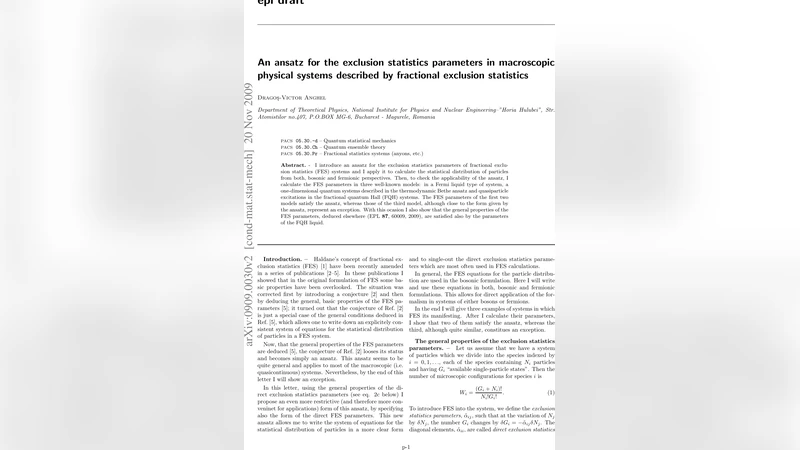
I introduce an ansatz for the exclusion statistics parameters of fractional exclusion statistics (FES) systems and I apply it to calculate the statistical distribution of particles from both, bosonic and fermionic perspectives. Then, to check the applicability of the ansatz, I calculate the FES parameters in three well-known models: in a Fermi liquid type of system, a one-dimensional quantum systems described in the thermodynamic Bethe ansatz and quasiparticle excitations in the fractional quantum Hall (FQH) systems. The FES parameters of the first two models satisfy the ansatz, whereas those of the third model, although close to the form given by the ansatz, represent an exception. With this ocasion I also show that the general properties of the FES parameters, deduced elsewhere (EPL 87, 60009, 2009), are satisfied also by the parameters of the FQH liquid.
💡 Research Summary
The paper introduces a compact and systematic ansatz for the exclusion‑statistics parameters that characterize fractional exclusion statistics (FES) in many‑body quantum systems. In Haldane’s formulation, the key quantities are the parameters (g_{ij}) which quantify how the presence of particles of species (j) reduces the number of available single‑particle states for species (i). Historically, each physical model required a separate, often cumbersome, derivation of these parameters, and no universal pattern had been identified.
The author proposes the following decomposition:
\
Comments & Academic Discussion
Loading comments...
Leave a Comment