An exactly solvable phase transition model: generalized statistics and generalized Bose-Einstein condensation
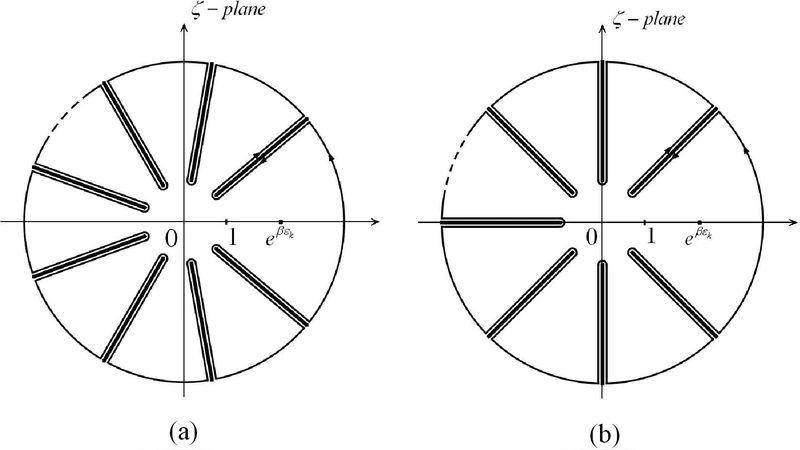
In this paper, we present an exactly solvable phase transition model in which the phase transition is purely statistically derived. The phase transition in this model is a generalized Bose-Einstein condensation. The exact expression of the thermodynamic quantity which can simultaneously describe both gas phase and condensed phase is solved with the help of the homogeneous Riemann-Hilbert problem, so one can judge whether there exists a phase transition and determine the phase transition point mathematically rigorously. A generalized statistics in which the maximum occupation numbers of different quantum states can take on different values is introduced, as a generalization of Bose-Einstein and Fermi-Dirac statistics.
💡 Research Summary
The paper introduces a novel exactly solvable model of a phase transition that is derived purely from statistical considerations, without invoking any explicit inter‑particle interactions. The authors generalize the familiar Bose‑Einstein (BE) and Fermi‑Dirac (FD) statistics by allowing each single‑particle quantum state (i) to have its own maximum occupation number (g_i). When all (g_i) are infinite the model reduces to the ordinary BE statistics; when all (g_i=1) it reduces to FD statistics. For arbitrary sets ({g_i}) the grand‑canonical partition function becomes a product of finite geometric series, \
Comments & Academic Discussion
Loading comments...
Leave a Comment