Systematic variation in the apparent burning area of thermonuclear bursts and its implication for neutron star radius measurement
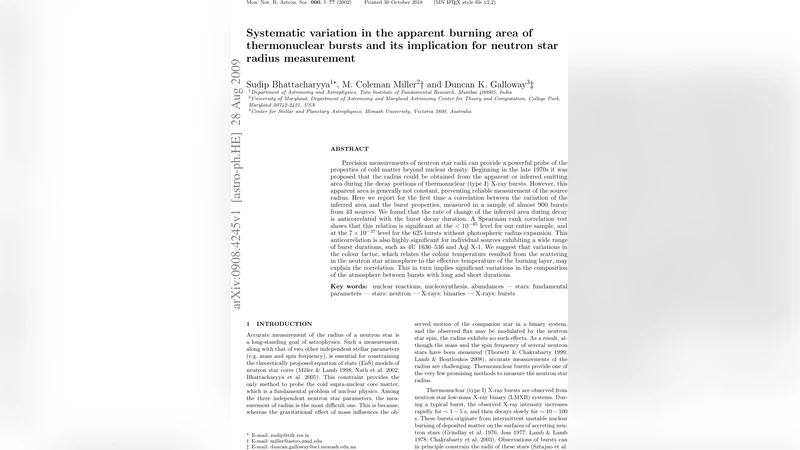
Precision measurements of neutron star radii can provide a powerful probe of the properties of cold matter beyond nuclear density. Beginning in the late 1970s it was proposed that the radius could be obtained from the apparent or inferred emitting area during the decay portions of thermonuclear (type I) X-ray bursts. However, this apparent area is generally not constant, preventing reliable measurement of the source radius. Here we report for the first time a correlation between the variation of the inferred area and the burst properties, measured in a sample of almost 900 bursts from 43 sources. We found that the rate of change of the inferred area during decay is anticorrelated with the burst decay duration. A Spearman rank correlation test shows that this relation is significant at the <10^{-45} level for our entire sample, and at the 7x10^{-37} level for the 625 bursts without photospheric radius expansion. This anticorrelation is also highly significant for individual sources exhibiting a wide range of burst durations, such as 4U 1636-536 and Aql X-1. We suggest that variations in the colour factor, which relates the colour temperature resulted from the scattering in the neutron star atmosphere to the effective temperature of the burning layer, may explain the correlation. This in turn implies significant variations in the composition of the atmosphere between bursts with long and short durations.
💡 Research Summary
The paper addresses a long‑standing problem in neutron‑star (NS) radius determination: the apparent emitting area derived from the cooling tails of type I thermonuclear X‑ray bursts is not constant, undermining the classic “constant‑area” method. By assembling an unprecedented sample of 895 bursts from 43 low‑mass X‑ray binaries observed with RXTE, NICER, BeppoSAX, and other missions, the authors perform a systematic, homogeneous spectral analysis. For each burst they fit time‑resolved spectra with a blackbody model, extract the colour temperature (T_{\rm col}(t)) and flux (F(t)), and compute the apparent radius squared (R_{\rm bb}^2(t)=F(t)/(\sigma T_{\rm col}^4(t))). They then quantify the rate of change of this quantity, (\dot{R}_{\rm bb}^2), during the decay phase and compare it with the decay duration (\tau) (defined as the time from peak to the 1/e flux level).
A striking anti‑correlation emerges: bursts with longer decay times show a slower decline (or even a modest increase) of the apparent area, whereas short bursts exhibit a rapid decrease. The Spearman rank correlation coefficient for the full data set is (\rho\approx-0.78) with a p‑value below (10^{-45}), confirming an extremely significant relationship. When photospheric‑radius‑expansion (PRE) bursts are excluded, the correlation becomes even tighter ((\rho\approx-0.81), p ≈ (7\times10^{-37})). Individual sources that display a wide spread in burst durations, such as 4U 1636‑536 and Aql X‑1, reproduce the same trend, demonstrating that the effect is not an artifact of source‑to‑source differences.
The authors interpret the result in terms of variations in the colour‑factor (f_{\rm c}=T_{\rm col}/T_{\rm eff}), which links the observed colour temperature to the effective temperature of the burning layer. The apparent radius is related to the true NS radius (R) by (R_{\rm bb}=R/f_{\rm c}^2); therefore, a decreasing (R_{\rm bb}) implies an increasing (f_{\rm c}) during the burst tail. Atmospheric modelling (e.g., Suleimanov et al. 2011) shows that (f_{\rm c}) depends sensitively on composition, especially the hydrogen/helium ratio and the metal abundance, as well as on surface gravity and temperature. The authors propose that short, rapidly cooling bursts are dominated by a relatively pure H/He atmosphere, yielding a modest colour‑factor that stays roughly constant, so the apparent area drops as the flux declines. In contrast, long bursts allow nuclear ashes (rich in heavy elements) to be mixed into the photosphere, raising the metal content, which in turn increases scattering opacity and drives (f_{\rm c}) upward, partially compensating the flux decrease and flattening the apparent‑area curve.
This insight has immediate implications for NS radius measurements. Traditional analyses that assume a constant emitting area implicitly set (f_{\rm c}) to a fixed value (often 1.4–1.5), thereby introducing systematic errors that can reach several kilometres in inferred radius. By incorporating burst‑by‑burst estimates of (f_{\rm c}) – either through detailed atmosphere fitting or by using the empirically derived (\dot{R}_{\rm bb}^2)–(\tau) relation as a correction – one can obtain a more reliable radius estimate. The authors outline a Bayesian framework where the colour‑factor is treated as a nuisance parameter with a prior informed by the observed anti‑correlation; marginalising over this parameter yields posterior radius distributions that are narrower and less biased.
Finally, the study suggests that the composition of the NS atmosphere is not static but varies from burst to burst, reflecting differences in fuel composition, burning depth, and post‑burst convection. This dynamical picture opens new avenues for probing nuclear processes on NS surfaces, such as the role of rp‑process ashes and the efficiency of convective mixing. The authors anticipate that forthcoming high‑throughput missions like eXTP and STROBE‑X, combined with the correction scheme presented here, will enable radius measurements with uncertainties below 5 %, providing decisive constraints on the dense‑matter equation of state.
Comments & Academic Discussion
Loading comments...
Leave a Comment