Rotation Velocities for M-dwarfs
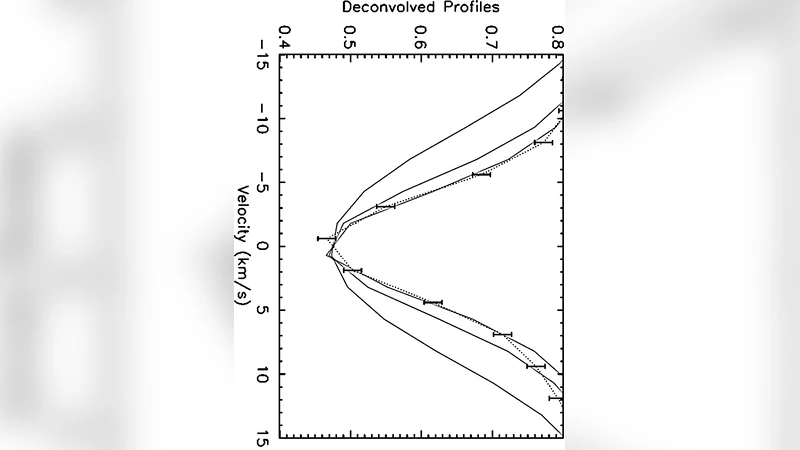
We present spectroscopic rotation velocities (v sin i) for 56 M dwarf stars using high resolution HET HRS red spectroscopy. In addition we have also determined photometric effective temperatures, masses and metallicities ([Fe/H]) for some stars observed here and in the literature where we could acquire accurate parallax measurements and relevant photometry. We have increased the number of known v sin is for mid M stars by around 80% and can confirm a weakly increasing rotation velocity with decreasing effective temperature. Our sample of v sin is peak at low velocities (~3 km/s). We find a change in the rotational velocity distribution between early M and late M stars, which is likely due to the changing field topology between partially and fully convective stars. There is also a possible further change in the rotational distribution towards the late M dwarfs where dust begins to play a role in the stellar atmospheres. We also link v sin i to age and show how it can be used to provide mid-M star age limits. When all literature velocities for M dwarfs are added to our sample there are 198 with v sin i less than or equal to 10 km/s and 124 in the mid-to-late M star regime (M3.0-M9.5) where measuring precision optical radial-velocities is difficult. In addition we also search the spectra for any significant Halpha emission or absorption. 43% were found to exhibit such emission and could represent young, active objects with high levels of radial-velocity noise. The tables presented here will aid any future M star planet search target selection to extract stars that will exhibit low radial-velocity jitter.
💡 Research Summary
This paper presents a comprehensive spectroscopic study of rotation velocities (v sin i) for 56 M‑dwarf stars, focusing on the mid‑to‑late spectral types (M3.0–M9.5) where precise optical radial‑velocity (RV) measurements become challenging. Using high‑resolution red‑band spectra obtained with the Hobby‑Eberly Telescope High‑Resolution Spectrograph (HET HRS), the authors derive v sin i values with typical uncertainties of ≤ 1 km s⁻¹ through a combination of cross‑correlation techniques and rotational line‑broadening modeling. In addition to rotation, they determine effective temperatures (T_eff), stellar masses, and metallicities (
Comments & Academic Discussion
Loading comments...
Leave a Comment