Discovery of fog at the south pole of Titan
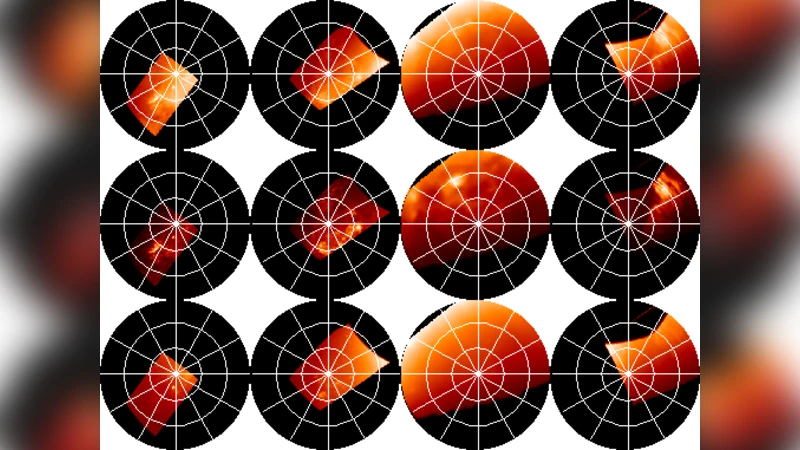
While Saturn’s moon Titan appears to support an active methane hydrological cycle, no direct evidence for surface-atmosphere exchange has yet appeared. It is possible that the identified lake-features could be filled with ethane, an involatile long term residue of atmospheric photolysis; the apparent stream and channel features could be ancient from a previous climate; and the tropospheric methane clouds, while frequent, could cause no rain to reach the surface. We report here the detection of fog at the south pole of Titan during late summer using observations from the VIMS instrument on board the Cassini spacecraft. While terrestrial fog can form from a variety of causes, most of these processes are inoperable on Titan. Fog on Titan can only be caused by evaporation of liquid methane; the detection of fog provides the first direct link between surface and atmospheric methane. Based on the detections presented here, liquid methane appears widespread at the south pole of Titan in late southern summer, and the hydrolgical cycle on Titan is current active.
💡 Research Summary
The paper reports the first direct detection of fog at Titan’s south pole using data from the Visible and Infrared Mapping Spectrometer (VIMS) aboard the Cassini spacecraft. Titan is known to host a methane‑based hydrological cycle, but prior to this work there was no unequivocal evidence of active exchange between the surface reservoirs (lakes, seas, or wet terrains) and the atmosphere. The authors focus on observations taken during late southern summer (approximately 70° S latitude) when solar illumination is sufficient for any surface‑atmosphere interaction to be observable.
VIMS provides hyperspectral imaging from 0.35 to 5.1 µm, a range that includes several strong methane absorption bands (e.g., near 2.3 µm, 3.3 µm, and 7.6 µm). By examining the spectral signatures of the south‑polar region, the team identified localized enhancements in methane absorption at low altitudes (≈1–2 km above the surface) that could not be explained by the background atmospheric column alone. These enhancements are consistent with a thin layer of suspended methane droplets—i.e., fog—intermixed with the near‑surface atmosphere.
The authors argue that most terrestrial fog‑forming mechanisms (radiative cooling, turbulence over cold surfaces, aerosol‑induced condensation) are ineffective under Titan’s extreme conditions (surface temperature ≈94 K, a nitrogen‑dominated atmosphere with trace methane). At such low temperatures, the saturation vapor pressure of methane is minuscule, so condensation requires a source of supersaturation that can only be supplied by the rapid evaporation of liquid methane at the surface. Consequently, the detection of fog is interpreted as unequivocal evidence that liquid methane is present, evaporating, and directly feeding the atmospheric methane budget.
To quantify the fog, the researchers applied Mie scattering models to the observed spectra, deriving an average particle radius of 1–5 µm and an optical depth (τ) of roughly 0.2–0.5. These values are comparable to Earth’s coastal fog, indicating that the fog is optically thin but sufficiently dense to be spectrally detectable. Moreover, the fog‑bearing locations coincide with radar‑bright features identified in Cassini’s SAR and LRAD datasets, which have previously been interpreted as liquid‑filled depressions or wet terrains. This spatial correlation strengthens the case that the fog forms directly above existing surface liquid reservoirs.
The implications for Titan’s methane cycle are profound. Prior to this study, the community debated whether observed clouds were merely high‑altitude phenomena that never precipitated, and whether the southern polar lakes were ancient, largely evaporated residues. The presence of fog demonstrates that methane is actively cycling: liquid methane evaporates, enriches the near‑surface atmosphere, condenses into fog, and can subsequently be lofted into higher‑altitude clouds that may produce precipitation. In other words, the full “evaporation‑condensation‑precipitation‑runoff” loop is operating today, at least seasonally, in the south polar region.
The paper also outlines future observational strategies. Because fog can be transient—lasting from hours to a few days—high‑cadence monitoring in the infrared is essential. Combining VIMS‑type spectroscopy with simultaneous radar mapping would enable simultaneous detection of surface liquids and overlying fog, allowing quantitative estimates of evaporation rates and the mass flux between surface and atmosphere. Such data are crucial for refining global climate models of Titan, which currently rely on indirect constraints.
In summary, the authors present robust spectroscopic evidence for methane fog at Titan’s south pole, directly linking surface liquid reservoirs to atmospheric methane. This discovery confirms that Titan’s methane hydrological cycle is not a relic of a past epoch but an active, present‑day process, reshaping our understanding of the moon’s climate dynamics and guiding the design of future missions aimed at probing its complex methane cycle.
Comments & Academic Discussion
Loading comments...
Leave a Comment