Water, Methane, and Carbon Dioxide Present in the Dayside Spectrum of the Exoplanet HD 209458b
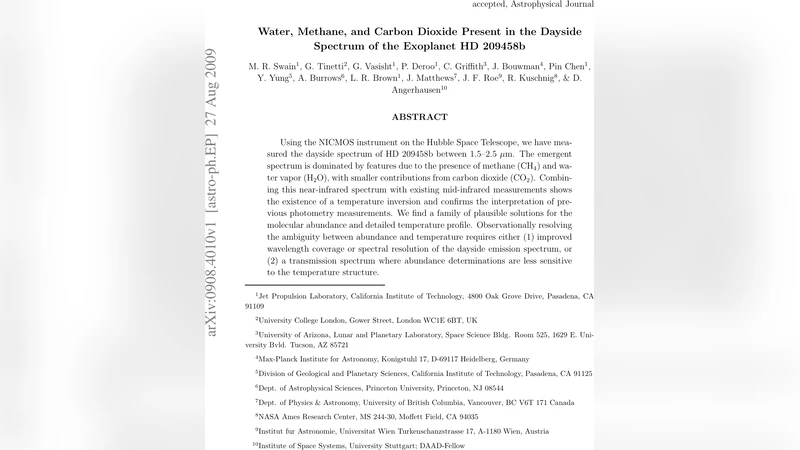
Using the NICMOS instrument on the Hubble Space Telescope, we have measured the dayside spectrum of HD 209458b between 1.5–2.5 microns. The emergent spectrum is dominated by features due to the presence of methane (CH4) and water vapor (H2O), with smaller contributions from carbon dioxide (CO2). Combining this near-infrared spectrum with existing mid-infrared measurements shows the existence of a temperature inversion and confirms the interpretation of previous photometry measurements. We find a family of plausible solutions for the molecular abundance and detailed temperature profile. Observationally resolving the ambiguity between abundance and temperature requires either (1) improved wavelength coverage or spectral resolution of the dayside emission spectrum, or (2) a transmission spectrum where abundance determinations are less sensitive to the temperature structure.
💡 Research Summary
The authors present a pioneering near‑infrared (NIR) emission spectrum of the hot Jupiter HD 209458b, obtained with the NICMOS instrument on the Hubble Space Telescope. Observations were carried out over five HST orbits, covering the wavelength range 1.5–2.5 µm with a spectral resolution of roughly R ≈ 200. By comparing the planetary flux before and after secondary eclipse, the team isolated the planet’s own thermal emission and achieved a signal‑to‑noise ratio of about 30 per spectral channel.
Data reduction involved careful correction of instrumental systematics, including detector non‑linearity, pointing jitter, and thermal drifts. The authors employed a combination of decorrelation techniques and Gaussian‑process modeling to remove residual trends, resulting in a clean, high‑fidelity spectrum.
Spectral analysis was performed using a line‑by‑line radiative‑transfer model that incorporates the latest molecular line lists (ExoMol, HITRAN). The most prominent features are a deep absorption/emission band near 1.6 µm attributable to water vapor (H₂O) and a strong band around 2.2 µm caused by methane (CH₄). A weaker, but statistically significant, signature of carbon dioxide (CO₂) appears near 2.0 µm. The detection of CH₄ is especially noteworthy because previous broadband photometry had only hinted at its presence; the NIR spectrum confirms that CH₄ is a major constituent of the dayside atmosphere.
To place the NIR results in a broader context, the authors combined their data with existing mid‑infrared measurements from Spitzer (3.6–24 µm). Joint retrievals of the temperature‑pressure (T‑P) profile and molecular abundances were carried out using a Bayesian Markov‑Chain Monte Carlo framework. The best‑fit models require a temperature inversion in the upper atmosphere (pressures below ~10⁻³ bar), consistent with earlier suggestions based on Spitzer photometry. The inversion could be driven by strong optical absorbers such as TiO/VO or by photochemical heating, but the current data cannot uniquely identify the cause.
A central challenge highlighted in the paper is the degeneracy between molecular abundances and the temperature structure. Two families of solutions reproduce the observed spectrum equally well: (1) high H₂O and CH₄ abundances with a modest temperature inversion, and (2) lower abundances combined with a more pronounced inversion. This “abundance‑temperature degeneracy” limits the precision with which either parameter can be constrained using the present dataset alone.
The authors propose two pathways to break this degeneracy. First, extending wavelength coverage to the 0.8–5 µm range and increasing spectral resolution to R ≈ 1000 would resolve individual line shapes, allowing a clearer separation of temperature‑induced continuum changes from molecular line depths. Second, acquiring a transmission (primary‑transit) spectrum would provide abundance constraints that are far less sensitive to the vertical temperature profile, because transmission spectroscopy probes the slant optical depth at the terminator rather than the emergent flux from the dayside.
In summary, this work delivers the first high‑quality NIR emission spectrum of HD 209458b, confirming the simultaneous presence of H₂O, CH₄, and CO₂ on the planet’s dayside and reinforcing the existence of a temperature inversion. While the current data leave a family of plausible atmospheric states, the study outlines clear observational strategies—broader, higher‑resolution NIR spectroscopy and complementary transmission measurements—that will enable future facilities such as JWST to resolve the remaining ambiguities and advance our understanding of hot‑Jupiter atmospheric chemistry and dynamics.
Comments & Academic Discussion
Loading comments...
Leave a Comment