The study of debris disks with SPICA
Debris disks are evidence that stars harbor reservoirs of dust-producing plantesimals on spatial scales similar the solar system. Debris disks present a wide range of sizes and structural features and there is growing evidence that, in some cases, they might be the result of the dynamical perturbations of a massive planet. Our solar system also harbors a debris disk and some of its properties resemble those of extra-solar debris disks. This contribution discusses how the study of debris disks with SPICA can shed light on the diversity of planetary systems, the link between debris disks and planets and the link between extra-solar planetary systems and our own.
💡 Research Summary
The paper presents a comprehensive assessment of how the upcoming SPICA (Space Infrared Telescope for Cosmology and Astrophysics) mission can transform the study of debris disks and, by extension, our understanding of planetary system diversity. Debris disks are circumstellar structures composed of dust and larger planetesimals generated by continuous collisional cascades. Their thermal emission peaks in the far‑infrared (30–100 K), making them observable only with highly sensitive infrared facilities. Existing observatories such as Spitzer, Herschel, ALMA, and JWST have provided valuable detections, yet they are limited either by sensitivity, wavelength coverage, or spatial resolution, especially in the critical 30–50 µm band where small grains (∼1 µm) and larger particles (∼100 µm) emit simultaneously.
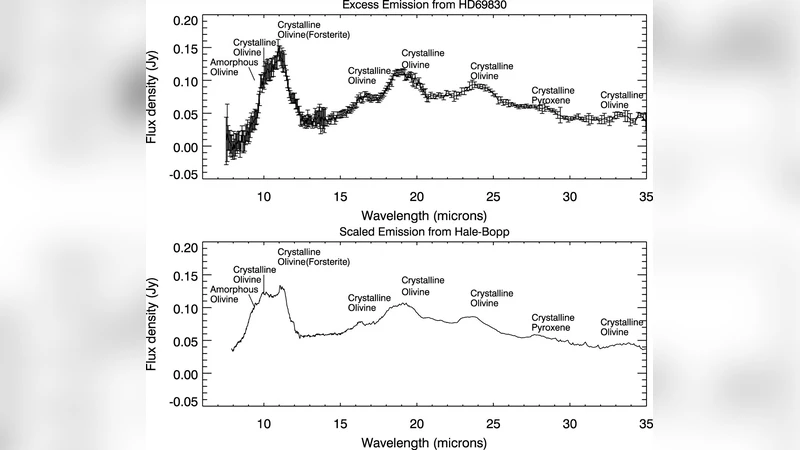
SPICA’s 2.5‑meter cryogenically cooled mirror and detectors operating below 4.5 K will deliver an order‑of‑magnitude improvement in sensitivity across 12–200 µm, together with ∼0.3 arcsec imaging resolution. This capability enables three major scientific advances. First, precise measurement of disk mass and grain‑size distribution becomes possible by simultaneously sampling the spectral signatures of both fine and coarse dust populations. Second, high‑resolution imaging will resolve structural features such as narrow rings, gaps, eccentric offsets, and spiral density waves that are hallmarks of planetary perturbations. By modeling these morphologies, the mass, orbital radius, and inclination of unseen planets can be inferred. Third, SPICA’s spectroscopic coverage includes diagnostic mineralogical bands (silicates at 10 µm and 20 µm, carbonaceous features near 6 µm, and water‑ice at 44 µm), allowing a detailed inventory of disk composition. Chemical composition traces the provenance of material (e.g., inner‑system versus outer‑system reservoirs) and the thermal history of the system.
The authors propose a unified multi‑wavelength modeling framework that integrates SPICA data with existing optical, near‑infrared, and radio observations. Using Bayesian inference, the framework simultaneously fits disk mass, grain‑size power‑law index, and compositional fractions while mapping observed asymmetries to dynamical simulations of planet–disk interactions. This approach transforms debris disks from static photometric detections into dynamic “fossil records” of planetary system evolution.
A key motivation is the comparative analysis between our Solar System’s Kuiper Belt and the ensemble of extrasolar debris disks. By placing the Kuiper Belt within the broader parameter space defined by SPICA observations, the study aims to determine whether the Solar System is a typical outcome of planet formation or an outlier.
In summary, SPICA will provide the sensitivity, spectral breadth, and spatial resolution required to (1) quantify the physical and chemical properties of debris disks with unprecedented precision, (2) detect and characterize the dynamical imprints of hidden planets, and (3) place the Solar System’s debris structure in a broader galactic context. The paper argues that these capabilities will fundamentally advance our understanding of how planetary systems form, evolve, and diversify across the Galaxy.
Comments & Academic Discussion
Loading comments...
Leave a Comment