Will the Large Synoptic Survey Telescope detect extra-solar planetesimals entering the solar system?
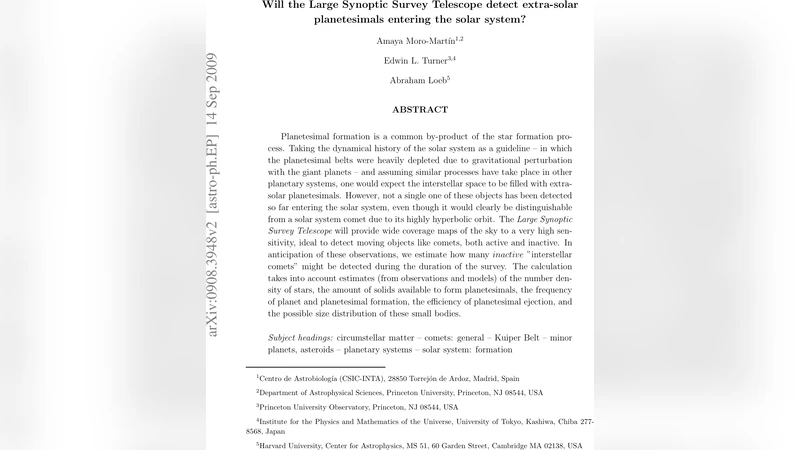
Planetesimal formation is a common by-product of the star formation process. Taking the dynamical history of the Solar system as a guideline – in which the planetesimal belts were heavily depleted due to graviational perburbation with the giant planets – and assuming similar processes have take place in other planetary systems, one would expect the interestellar space to be filled with extra-solar planetesimals. However, not a single one of these objects has been detected so far entering the Solar system, even though it would clearly be distinguishable from a Solar system comet due to its highly hyperbolic orbit. The Large Synoptic Survey Telescope (LSST) will provide wide coverage maps of the sky to a very high sensitivity, ideal to detect moving objects like comets, both active and inactive. In anticipation of these observations, we estimate how many inactive “interstellar comets” might be detected during the duration of the survey. The calculation takes into account estimates (from observations and models) of the number density of stars, the amount of solids available to form planetesimals, the frequency of planet and planetesimal formation, the efficiency of planetesimal ejection, and the possible size distribution of these small bodies.
💡 Research Summary
The paper tackles a deceptively simple question: will the forthcoming Large Synoptic Survey Telescope (LSST) be able to spot solid bodies that originated in other planetary systems and are now passing through the Solar System on hyperbolic trajectories? The authors begin by assuming that planet formation is a ubiquitous by‑product of star formation and that, just as in our own Solar System, nascent planetary systems develop belts of planetesimals (asteroids, comets, Kuiper‑belt analogues). Gravitational interactions with giant planets then eject a fraction of these bodies into interstellar space. If this process is common, the Galaxy should be filled with a low‑density sea of “interstellar comets” (ICs), objects that are essentially inactive comet nuclei drifting at tens of kilometres per second relative to the Sun.
To translate this qualitative picture into a quantitative detection forecast, the authors construct a multi‑step model. First, they estimate the solid mass budget per star. Using observed metallicities of star‑forming regions, they adopt a typical dust‑to‑gas ratio that yields about 10⁻⁴ M⊙ of refractory material per star. They assume roughly 1 % of this material ends up in a planetesimal belt. Second, they incorporate the observed occurrence rate of giant planets (≈50 % for Sun‑like stars) and a plausible ejection efficiency (10–30 % of the belt’s mass) driven by planet–planetesimal scattering. This leads to an average ejection of 10⁸–10⁹ kg yr⁻¹ per star, or equivalently a steady‑state number density of ~10⁻⁴ AU⁻³ for kilometre‑scale bodies when averaged over the Galactic disk (stellar density ≈0.1 pc⁻³).
The size distribution of ejected bodies is taken to follow a power law dN/dR ∝ R⁻α with α between 3.5 and 4.5, bounded by a minimum radius of ~10 m and a maximum of ~10 km. The authors note that the recent discovery of ‘Oumuamua suggests that the small‑end tail could be much more populated than previously thought, but they keep the distribution conservative for the baseline calculation.
Next, the LSST’s observational capabilities are folded in. LSST will repeatedly image ~18,000 deg² of sky every few nights to a 5σ point‑source depth of r≈24.5. For an inactive body with a geometric albedo of 0.04, a 1 km object would be detectable out to ~2 AU; a 100 m object only out to ~0.2 AU. The survey’s cadence (≈3‑day revisit) and total planned duration (10 years) translate into an effective sky‑time coverage of about 10⁶ deg²·yr. Combining this with the spatial density of ICs yields an expected detection probability of order 10⁻³–10⁻² per year, i.e., roughly 0.1–1 interstellar planetesimal over the entire LSST mission.
The paper devotes a substantial discussion to the dominant sources of uncertainty. The ejection efficiency is poorly constrained; if it is an order of magnitude lower, LSST’s chances drop to near zero. The size‑distribution slope and the minimum size are equally critical: a steeper slope or a more abundant sub‑100 m population could raise the expected number to several detections. Dynamical heating (collisions, tidal disruption) over Gyr timescales could also deplete the reservoir. Conversely, if ‘Oumuamua is representative of a huge swarm of sub‑kilometre objects, LSST could see a handful of detections, especially if some retain faint activity that boosts their brightness.
Finally, the authors argue that LSST should not be viewed in isolation. Complementary facilities—radio arrays such as SKA, infrared space telescopes like JWST or the upcoming Roman Space Telescope, and even dedicated small‑aperture surveys—could capture thermal emission or reflected radio signals from otherwise invisible ICs. Multi‑wavelength follow‑up would be essential to confirm hyperbolic orbits, measure colours, and assess any cometary activity. They also suggest that machine‑learning pipelines be trained to flag high‑velocity, non‑periodic tracks in LSST data streams, reducing the risk that an interstellar visitor is missed amid the torrent of Solar System minor‑planet detections.
In summary, under conservative but plausible assumptions, LSST is expected to detect on the order of one inactive interstellar planetesimal during its ten‑year survey. This estimate sits at the intersection of astrophysical theory (planet formation and ejection), Galactic demographics (stellar density, solid mass budget), and instrumental performance (depth, cadence, sky coverage). The result is both encouraging—LSST will at least probe the low‑density tail of the interstellar small‑body population—and sobering, because the detection hinges on parameters that remain highly uncertain. Future improvements in our understanding of planetesimal ejection mechanisms, the true size distribution of interstellar debris, and the development of robust, high‑speed moving‑object pipelines will be decisive in turning LSST’s potential into concrete discoveries.
Comments & Academic Discussion
Loading comments...
Leave a Comment