Energetic Protons, Radionuclides and Magnetic Activity in Protostellar Disks
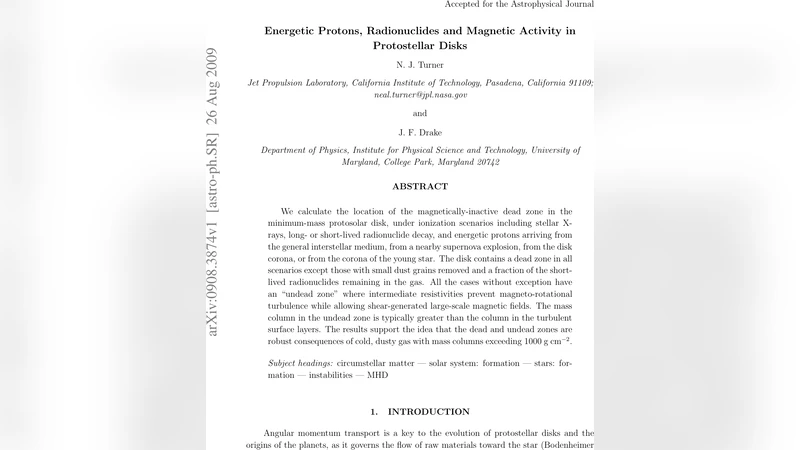
We calculate the location of the magnetically-inactive dead zone in the minimum-mass protosolar disk, under ionization scenarios including stellar X-rays, long- or short-lived radionuclide decay, and energetic protons arriving from the general interstellar medium, from a nearby supernova explosion, from the disk corona, or from the corona of the young star. The disk contains a dead zone in all scenarios except those with small dust grains removed and a fraction of the short-lived radionuclides remaining in the gas. All the cases without exception have an “undead zone” where intermediate resistivities prevent magneto-rotational turbulence while allowing shear-generated large-scale magnetic fields. The mass column in the undead zone is typically greater than the column in the turbulent surface layers. The results support the idea that the dead and undead zones are robust consequences of cold, dusty gas with mass columns exceeding 1000 g/cm^2.
💡 Research Summary
This paper investigates the magnetic activity structure of the minimum‑mass protosolar nebula (MMSN) by calculating where magnetorotational instability (MRI) can operate under a variety of ionization scenarios. The authors consider ionization from stellar X‑rays, long‑lived radionuclide (LRN) decay (e.g., ^40K), short‑lived radionuclide (SRN) decay (e.g., ^26Al, ^60Fe), and energetic protons originating in four distinct environments: the diffuse interstellar medium, a nearby supernova explosion, the corona of the disk itself, and the corona of the young host star.
Using a standard MMSN surface density profile (Σ≈1700 g cm⁻² at 1 AU) and temperature gradient, they compute the ionization rate ζ at each radius for each source. X‑rays penetrate only the upper ≈10 g cm⁻², providing ζ≈10⁻¹⁶–10⁻¹⁴ s⁻¹ near the surface. LRNs supply a constant background ζ≈10⁻¹⁹ s⁻¹, while SRNs can boost ζ up to ≈10⁻¹⁸ s⁻¹ in the early disk if the radionuclides remain in the gas phase. Galactic cosmic‑ray protons contribute a relatively uniform ζ≈10⁻¹⁶ s⁻¹, whereas a supernova within ~10 pc can raise ζ to 10⁻¹⁴ s⁻¹ for a short interval. Coronal flares from the star or the disk generate energetic particles that sustain ζ≈10⁻¹⁵–10⁻¹⁴ s⁻¹ in the upper layers.
From ζ they derive electron and ion abundances, then calculate the three non‑ideal MHD diffusivities: Ohmic (η_O), Hall (η_H), and ambipolar (η_A). The MRI criterion is expressed in terms of the magnetic Reynolds number Re_M = v_A²/(η_O Ω) > 1, together with the requirement that the ionization timescale be shorter than the orbital period.
The results show that, for a dust‑rich disk containing the full interstellar grain population (including sub‑micron grains) and with SRNs locked into solids, η_O becomes large enough that Re_M < 1 throughout a broad radial range (≈0.1–10 AU). This creates a “dead zone” where MRI turbulence is completely suppressed. If the small grains are removed (e.g., by coagulation to >10 µm) and a modest fraction (∼10 %) of SRNs remains in the gas, the ionization fraction rises, η_O drops, and the entire column can become MRI‑active.
Crucially, every model—regardless of ionization source—exhibits an intermediate‑resistivity region the authors term an “undead zone.” In this zone η_O is low enough that the gas is not completely decoupled from the magnetic field, yet η_H and η_A remain sufficiently high to prevent full turbulence. Shear can still amplify large‑scale magnetic fields, allowing a quasi‑steady, laminar magnetic stress to transport angular momentum. The column density of the undead zone (typically 100–300 g cm⁻²) exceeds that of the MRI‑active surface layers (≈10 g cm⁻²), implying that most of the disk mass resides in a region where only weak, large‑scale magnetic torques operate.
The authors discuss the astrophysical implications. Small dust grains dramatically increase electron recombination rates, suppressing ionization and expanding the dead zone. Short‑lived radionuclides are a potent internal ionization source, but their effectiveness depends on whether they are sequestered in solids. External energetic protons can temporarily thin the dead zone (especially after a nearby supernova), but the effect is short‑lived compared with the disk’s evolutionary timescale. Consequently, the presence of a robust dead/undead structure appears to be a generic outcome for cold, massive disks with Σ ≳ 1000 g cm⁻².
In summary, the paper demonstrates that the magnetic dead zone is a resilient feature of protoplanetary disks, persisting under a wide range of plausible ionization environments. Only a combination of grain growth (removing sub‑micron particles) and retention of short‑lived radionuclides in the gas can eradicate it entirely. The undead zone, however, is unavoidable and may play a key role in governing angular momentum transport, dust settling, and the early stages of planet formation.
Comments & Academic Discussion
Loading comments...
Leave a Comment