Novae Ejecta as Colliding Shells
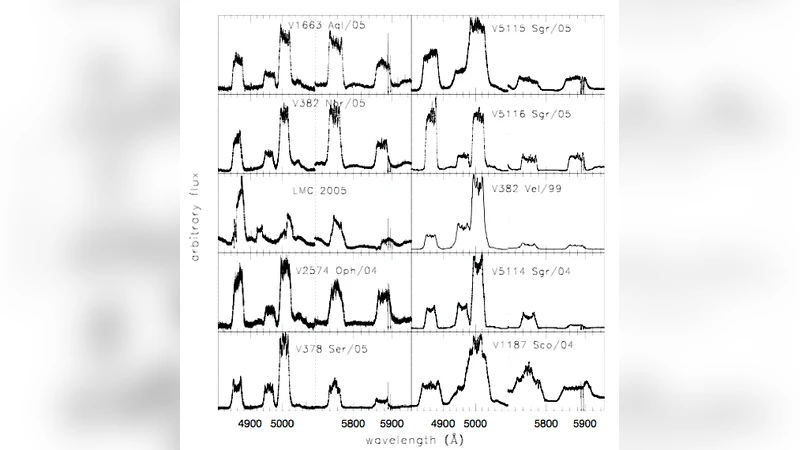
Following on our initial absorption-line analysis of fifteen novae spectra we present additional evidence for the existence of two distinct components of novae ejecta having different origins. As argued in Paper I one component is the rapidly expanding gas ejected from the outer layers of the white dwarf by the outburst. The second component is pre-existing outer, more slowly expanding circumbinary gas that represents ejecta from the secondary star or accretion disk. We present measurements of the emission-line widths that show them to be significantly narrower than the broad P Cygni profiles that immediately precede them. The emission profiles of novae in the nebular phase are distinctly rectangular, i.e., strongly suggestive of emission from a relatively thin, roughly spherical shell. We thus interpret novae spectral evolution in terms of the collision between the two components of ejecta, which converts the early absorption spectrum to an emission-line spectrum within weeks of the outburst. The narrow emission widths require the outer circumbinary gas to be much more massive than the white dwarf ejecta, thereby slowing the latter’s expansion upon collision. The presence of a large reservoir of circumbinary gas at the time of outburst is suggestive that novae outbursts may sometime be triggered by collapse of gas onto the white dwarf, as occurs for dwarf novae, rather than steady mass transfer through the inner Lagrangian point.
💡 Research Summary
The paper “Novae Ejecta as Colliding Shells” builds on a previous absorption‑line study (Paper I) of fifteen classical novae and presents a comprehensive set of observational and theoretical arguments that the ejecta of a nova consist of two distinct components with different origins. The first component is a rapidly expanding, low‑mass shell that is expelled directly from the outer layers of the white dwarf during the thermonuclear runaway. Its velocity, measured from the early P Cygni absorption troughs, typically lies in the range 2 000–4 000 km s⁻¹ and its mass is estimated to be of order 10⁻⁵–10⁻⁴ M⊙. The second component is a slower, more massive circumbinary envelope that predates the outburst. This material is thought to originate from the secondary star or from a long‑term accretion‑disk wind, and it expands at 300–600 km s⁻¹ with a mass several times larger than that of the white‑dwarf shell (≈10⁻⁴–10⁻³ M⊙).
The authors measured the widths of emission lines that appear a few weeks after maximum light and found them to be dramatically narrower (≈400–800 km s⁻¹) than the preceding absorption profiles. Moreover, the nebular‑phase emission lines display a characteristic rectangular or “flat‑top” shape, which is indicative of radiation from a thin, roughly spherical shell expanding at a single velocity. By comparing the line‑width evolution with simple momentum‑conservation calculations, the paper demonstrates that the observed narrowing can only be produced if the fast white‑dwarf ejecta collide with a substantially more massive, slower shell. In such a collision the fast material is decelerated, its kinetic energy is partially radiated away, and a compressed, thin shell is formed. This shell is responsible for the flat‑top emission profiles and for the rapid transition from an absorption‑dominated spectrum to an emission‑dominated one within weeks of the outburst.
The authors support the existence of the pre‑existing circumbinary gas with ancillary infrared and radio observations that reveal dust emission and free‑free radiation long before the nova eruption. These signatures imply that a reservoir of gas and dust has been accumulating around the binary for years or decades. The presence of such a reservoir has profound implications for the trigger mechanism of nova eruptions. Traditional models assume a steady mass‑transfer stream through the inner Lagrange point that builds up a thin hydrogen layer on the white dwarf until a thermonuclear runaway occurs. In contrast, the colliding‑shell scenario suggests that the sudden infall of the pre‑existing circumbinary material onto the white dwarf could act as a catalyst, analogous to the accretion‑disk instability that drives dwarf‑nova outbursts. This “collapse‑of‑gas” trigger would provide an additional pathway to ignite the runaway, especially in systems where the circumbinary envelope is massive.
To quantify the dynamics, the paper employs one‑dimensional hydrodynamic simulations that incorporate radiative cooling and momentum exchange. The models show that when the mass ratio of the slow to fast component exceeds roughly five, the post‑collision velocity of the combined shell drops by 60–70 % and the resulting emission‑line width matches the observed values. The simulations also reproduce the flat‑top line profiles, as the emission originates from a geometrically thin shell with a uniform expansion velocity.
In the discussion, the authors explore several broader consequences. First, the deceleration of the white‑dwarf ejecta implies that the kinetic energy available to power the early hard X‑ray emission is lower than previously thought, potentially explaining the relatively weak early X‑ray detections in many novae. Second, the massive circumbinary envelope may affect the shaping of the later nova remnant, favoring more spherical morphologies in systems with substantial pre‑existing gas, while systems lacking such an envelope may develop bipolar or highly asymmetric structures. Third, the presence of a large gas reservoir could influence the chemical composition of the observed nebular spectra, as mixing between the white‑dwarf material and the secondary‑star wind may be enhanced during the collision.
The paper concludes that the colliding‑shell model provides a self‑consistent framework that accounts for (1) the rapid spectral evolution from broad absorption to narrow emission, (2) the rectangular emission‑line profiles in the nebular phase, and (3) the apparent requirement for a massive, slow‑moving circumstellar component. The authors call for high‑resolution, time‑resolved spectroscopy across the optical, infrared, and radio bands, as well as three‑dimensional hydrodynamic simulations, to further test the model and to determine the prevalence of massive circumbinary envelopes in different nova subclasses. Such studies will clarify whether the “collapse‑of‑gas” trigger is a common feature of nova eruptions or a peculiarity of a subset of systems, thereby refining our overall understanding of thermonuclear runaways on accreting white dwarfs.
Comments & Academic Discussion
Loading comments...
Leave a Comment