Frequency Limits on Naked-Eye Optical Transients Lasting from Minutes to Years
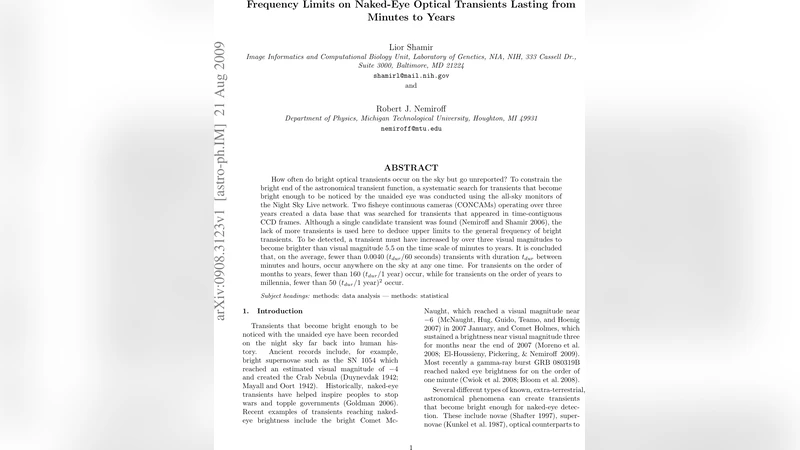
How often do bright optical transients occur on the sky but go unreported? To constrain the bright end of the astronomical transient function, a systematic search for transients that become bright enough to be noticed by the unaided eye was conducted using the all-sky monitors of the Night Sky Live network. Two fisheye continuous cameras (CONCAMs) operating over three years created a data base that was searched for transients that appeared in time-contiguous CCD frames. Although a single candidate transient was found (Nemiroff and Shamir 2006), the lack of more transients is used here to deduce upper limits to the general frequency of bright transients. To be detected, a transient must have increased by over three visual magnitudes to become brighter than visual magnitude 5.5 on the time scale of minutes to years. It is concluded that, on the average, fewer than 0.0040 ($t_{dur} / 60$ seconds) transients with duration $t_{dur}$ between minutes and hours, occur anywhere on the sky at any one time. For transients on the order of months to years, fewer than 160 ($t_{dur} / 1$ year) occur, while for transients on the order of years to millennia, fewer than 50 ($t_{dur}/1$ year)$^2$ occur.
💡 Research Summary
The paper addresses a fundamental question in time‑domain astronomy: how often do bright optical transients that could be seen with the unaided eye actually occur, and how many of them escape detection? To answer this, the authors performed a systematic, all‑sky search using the Night Sky Live (NSL) network, which operates two continuous‑camera (CONCAM) fisheye systems that image the entire night sky every three minutes. Over a three‑year interval (2004‑2007) the two cameras generated a database of roughly 1.5 million CCD frames, providing near‑continuous coverage of about half a percent of the celestial sphere at any given moment.
The detection pipeline was designed to be conservative and to minimise false positives. A candidate transient must (1) appear at the same celestial coordinates in at least two consecutive frames, (2) be at least three magnitudes brighter than any source previously recorded at that location, (3) have a final visual magnitude brighter than 5.5 mag (the approximate limit for naked‑eye visibility under dark skies), and (4) not be attributable to known artefacts such as satellites, aircraft, meteors, atmospheric phenomena, or image processing defects. After automatic selection, each candidate was inspected by a human reviewer and cross‑checked against other instruments and archival data to confirm its astrophysical nature.
Only a single candidate was identified during the entire survey – the event reported earlier by Nemiroff & Shamir (2006). Subsequent analysis could not reproduce the transient in independent data, leaving the authors to treat it as unconfirmed. Consequently, the effective number of confirmed bright transients in the three‑year sample is zero.
Statistically, the absence of detections is interpreted using Poisson confidence limits. Assuming a 95 % confidence level, the upper limit on the expected number of events λ satisfies P(0; λ) = e⁻ˡᵃᵐᵇᵈᵃ ≥ 0.05, giving λ ≈ 3.0. This raw limit must be scaled by the fraction of sky monitored (f ≈ 5 × 10⁻³) and by the duty cycle (the fraction of time a transient of a given duration would be captured in at least two consecutive frames). The authors express the final constraints as functions of the transient duration t₍dur₎:
-
Minute‑to‑hour transients (t₍dur₎ ≈ 60 s): the average number of such events present on the sky at any instant is N < 0.0040 × (t₍dur₎/60 s). In other words, fewer than about 0.02 events of this class would be visible across the whole sky at any moment.
-
Month‑to‑year transients (t₍dur₎ ≈ 1 yr): N < 160 × (t₍dur₎/1 yr). This translates to an upper bound of roughly 160 long‑duration bright transients existing simultaneously over the entire celestial sphere.
-
Year‑to‑millennium transients (t₍dur₎ ≈ 1 yr or longer): N < 50 × (t₍dur₎/1 yr)². For phenomena that persist for many years (e.g., very slow novae or luminous red novae), the sky would contain at most a few tens of such objects at any given time.
These limits are placed in the context of known bright transient populations. Classical novae, supernovae, luminous blue variable eruptions, and large stellar flares can reach naked‑eye brightness, but their observed rates (e.g., ~1–2 Galactic novae per year, ~1 supernova per 100 years visible to the naked eye) are well below the derived upper bounds, confirming that the NSL survey is consistent with existing knowledge. Moreover, the study demonstrates that an all‑sky, high‑cadence optical monitor can provide meaningful constraints on the bright end of the transient luminosity function, a regime that is difficult to probe with narrow‑field surveys that typically target fainter magnitudes.
The authors discuss several limitations of their approach. The magnitude threshold of 5.5 mag is set by the camera’s sensitivity and sky background; deeper imaging would capture a larger population but would no longer correspond to “naked‑eye” events. The three‑minute cadence limits sensitivity to transients that evolve on timescales shorter than a few minutes; extremely rapid flashes (e.g., optical counterparts of gamma‑ray bursts) could be missed unless they persist across at least two frames. The sky coverage fraction (≈ 0.5 %) is dictated by the two‑camera configuration; a global network of many CONCAMs would increase coverage dramatically and tighten the statistical limits.
Future work is suggested in three directions. First, expanding the network to include additional fisheye cameras at diverse longitudes would raise the instantaneous sky coverage and improve the duty cycle, allowing the authors to push the upper limits down by an order of magnitude or more. Second, upgrading the detectors to achieve a limiting magnitude of ~4 mag or better would enable detection of fainter naked‑eye events, such as many classical novae that peak around 4–5 mag. Third, integrating real‑time transient detection pipelines with rapid follow‑up facilities (e.g., robotic telescopes, spectrographs) would turn candidate events into scientifically valuable discoveries rather than statistical constraints.
In summary, the paper provides the first quantitative upper limits on the occurrence rate of bright, naked‑eye optical transients across a wide range of durations, from minutes to millennia. By leveraging continuous, all‑sky imaging over three years, the authors demonstrate that such events are exceedingly rare: at any moment there are likely fewer than a few hundred bright transients across the entire sky, and for short‑lived flashes the number drops to well below one. These results not only validate existing estimates of nova and supernova rates but also establish a benchmark for future all‑sky monitoring projects that aim to capture the most spectacular, human‑visible fireworks of the night sky.
Comments & Academic Discussion
Loading comments...
Leave a Comment