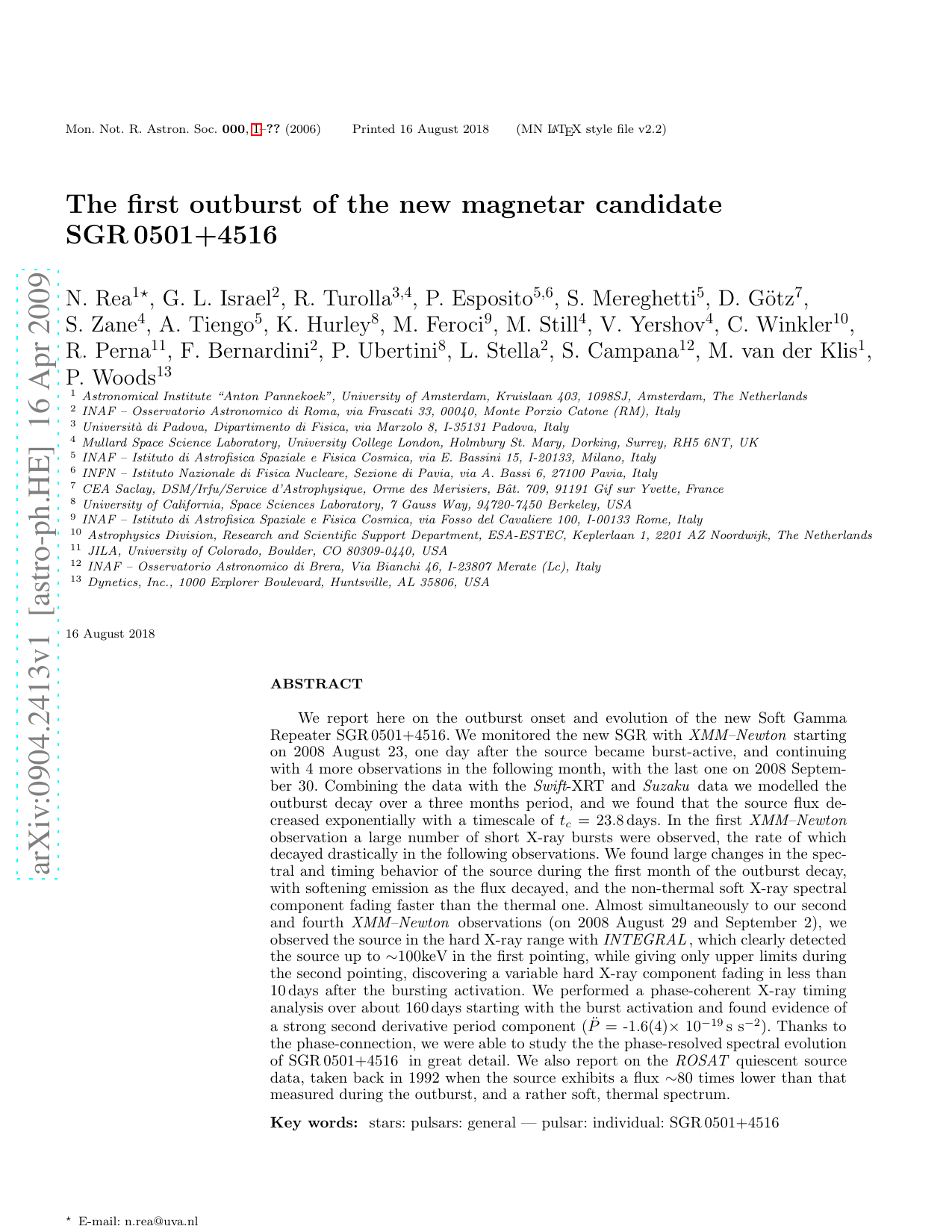
We report here on the outburst onset and evolution of the new Soft Gamma Repeater SGR 0501+4516. We monitored the new SGR with XMM-Newton starting on 2008 August 23, one day after the source became burst-active, and continuing with 4 more observations, with the last one on 2008 September 30. Combining the data with the Swift-XRT and Suzaku data, we modelled the outburst decay over 160 days, and we found that the source flux decreased exponentially with a timescale of t_c=23.8 days. In the first XMM-Newton observation a large number of short X-ray bursts were observed, the rate of which decayed drastically in the following observations. We found large changes in the spectral and timing behavior of the source during the outburst, with softening emission as the flux decayed, and the non-thermal soft X-ray spectral component fading faster than the thermal one. Almost simultaneously to our XMM-Newton observations (on 2008 August 29 and September 2), we observed the source in the hard X-ray range with INTEGRAL, which clearly detected the source up to ~100keV in the first pointing, while giving only upper limits during the second pointing, discovering a variable hard X-ray component fading in less than 10 days after the bursting activation. We performed a phase-coherent X-ray timing analysis over about 160 days starting with the burst activation and found evidence of a strong second derivative period component (\ddot{P} = -1.6(4)x10^{-19} s/s^{-2}). Thanks to the phase-connection, we were able to study the the phase-resolved spectral evolution of SGR 0501+4516 in great detail. We also report on the ROSAT quiescent source data, taken back in 1992 when the source exhibits a flux ~80 times lower than that measured during the outburst, and a rather soft, thermal spectrum.
Deep Dive into The first outburst of the new magnetar candidate SGR 0501+4516.
We report here on the outburst onset and evolution of the new Soft Gamma Repeater SGR 0501+4516. We monitored the new SGR with XMM-Newton starting on 2008 August 23, one day after the source became burst-active, and continuing with 4 more observations, with the last one on 2008 September 30. Combining the data with the Swift-XRT and Suzaku data, we modelled the outburst decay over 160 days, and we found that the source flux decreased exponentially with a timescale of t_c=23.8 days. In the first XMM-Newton observation a large number of short X-ray bursts were observed, the rate of which decayed drastically in the following observations. We found large changes in the spectral and timing behavior of the source during the outburst, with softening emission as the flux decayed, and the non-thermal soft X-ray spectral component fading faster than the thermal one. Almost simultaneously to our XMM-Newton observations (on 2008 August 29 and September 2), we observed the source in the hard X-ray
Over the last few years, a number of observational discoveries have placed "magnetars" (ultra-magnetized isolated neutron stars) in the limelight again. These extreme objects comprise the Anomalous X-ray Pulsars (AXPs; 10 objects), and the Soft Gamma-ray Repeaters (SGRs; 4 objects), which are observationally very similar classes in many respects (for a recent review see Mereghetti et al. 2008).
They are all slow X-ray pulsars with spin periods clustered in a narrow range (P ∼ 2-12 s), relatively large period derivatives ( Ṗ ∼ 10 -13 -10 -10 s s -1 ), spin-down ages of 10 3 -10 4 yr, and magnetic fields, as inferred from the classical magnetic dipole spin-down formula, of 10 14 -10 15 G, much higher than the electron quantum critical field (Bcr ≃ 4.4 × 10 13 G). About a dozen AXPs and SGRs are strong persistent X-ray emitters, with X-ray luminosities of about 10 34 -10 36 erg s -1 , and a few transient ones have been discovered in recent years. A peculiarity of these neutron stars is that their X-ray energy output is much larger than their rotational energy losses, so they can not be only rotationally powered. Furthermore, they lack a companion, so they can not be accretion-powered either. Rather, the powering mechanism of AXPs and SGRs is believed to reside in the neutron star ultra-strong magnetic field (Duncan & Thompson 1992;Thompson & Duncan 1993). Other scenarios, beside the “magnetar” model, were proposed to explain AXP and SGR emission, such as the fossil disk (Chatterjee, Hernquist & Narayan 2000;Perna, Hernquist, & Narayan 2000) and the quark-star model (Ouyed, Leahy, & Niebergal 2007a,b).
In the 0.1-10 keV energy band, magnetars spectra are relatively soft and empirically modeled by an absorbed blackbody (kT ∼ 0.2-0.6 keV) plus a power-law (Γ ∼ 2-4). Thanks to INTEGRAL -ISGRI and RXTE-HEXTE, hard X-ray emission up to ∼200 keV has recently been detected from some sources (Kuiper et al. 2004(Kuiper et al. , 2006;;Mereghetti et al. 2005;Götz et al. 2006). This discovery has opened a new window on magnetars studies and has shown that their energy output may be dominated by hard, rather than soft emission.
At variance with other isolated neutron stars, AXPs and SGRs exhibit spectacular episodes of bursting and flaring activity, during which their luminosity may change up to 10 orders of magnitude on timescales down to few milliseconds. Different types of X-ray flux variability have been observed, ranging from slow and moderate flux changes up to a factor of a few on timescales of years (shown by virtually all members of the class), to more intense outbursts with flux variations up to ∼100 lasting for ∼1-3 years, and to short and intense X-ray burst activity on sub-second timescales (see Kaspi 2007 andMereghetti 2008 for reviews of X-ray variability).
In particular, SGRs are characterized by periods of activity during which they emit numerous short bursts in the hard X-ray / soft gamma-ray energy range (t ∼ 0.1 -0.2 s; L ∼ 10 38 -10 41 erg/s). This is indeed the defining property that led to the discovery of this class of sources. In addition, they have been observed to emit intermediate flares, with typical durations of t ∼ 1 -60 s and luminosities of L ∼ 10 41 -10 43 erg/s, and spectacular Giant Flares. The latter are rare and unique events in the X-ray sky, by far the most energetic (∼ 10 44 -10 47 erg/s) Galactic events currently known, second only to Supernova explosions. Indeed, the idea that SGRs host an ultra-magnetized neutron star was originally proposed to explain the very extreme properties of their bursts and flares: in this model the frequent short bursts are associated with small cracks in the neutron star crust, driven by magnetic diffusion, or, alternatively, with the sudden loss of magnetic equilibrium through the development of a tearing instability, while the giant flares would be linked to global rearrangements of the magnetic field in the neutron stars magnetosphere and interior (Thompson & Duncan 1995;Lyutikov 2003).
Bursts and flares do not seem to repeat with any regular, predictable pattern. Giant flares have been so far observed only three times from the whole sample of SGRs (from SGR 0526-66 in 1979, Mazets et al. 1979;from SGR 1806-20 in 1998, Hurley et al. 1999; and from SGR 1900+14 in 2004, e.g. Hurley et al. 2005, Palmer et al. 2005), and never twice from the same source. As far as short bursts and intermediate flares are concerned, while some SGRs (such as SGR 1806-20 ) are extremely active sources, in other cases no bursts have been detected for many years (as in the case of SGR 1627-41, that re-activated in May 2008 after a 10-yr long stretch of quiescence; Esposito et al. 2008). This suggests that a relatively large number of members of this class has not been discovered yet, and may manifest themselves in the future. On 2008 August 22, a new SGR, namely SGR 0501+4516 , was discovered (the first in ten years), thanks to the Swift-BAT detection of a series of shor
…(Full text truncated)…
This content is AI-processed based on ArXiv data.