📝 Original Info
- Title: Modified Slim-Disk Model Based on Radiation-Hydrodynamic Simulation Data: The Conflict Between Outflow and Photon Trapping
- ArXiv ID: 0904.4598
- Date: 2015-05-13
- Authors: Researchers from original ArXiv paper
📝 Abstract
Photon trapping and outflow are two key physics associated with the supercritical accretion flow. We investigate the conflict between these two processes based on two-dimensional radiation-hydrodynamic (RHD) simulation data and construct a simplified (radially) one-dimensional model. Mass loss due to outflow, which is not considered in the slim-disk model, will reduce surface density of the flow, and if very significant, it will totally suppress photon trapping effects. If the photon trapping is very significant, conversely, outflow will be suppressed because radiation pressure force will be reduced. To see what actually occurs, we examine the RHD simulation data and evaluate the accretion rate and outflow rate as functions of radius. We find that the former monotonically decreases, while the latter increases, as the radius decreases. However, the former is kept constant at small radii, inside several Schwarzschild radii, since the outflow is suppressed by the photon trapping effects. To understand the conflict between the photon trapping and outflow in a simpler way, we model the radial distribution of the accretion rate from the simulation data and build up a new (radially) one-dimensional model, which is similar to the slim-disk model but incorporates the mass loss effects due to the outflow. We find that the surface density (and, hence, the optical depth) is much reduced even inside the trapping radius, compared with the case without outflow, whereas the effective temperature distribution hardly changes. That is, the emergent spectra do not sensitively depend on the amount of mass outflow. We conclude that the slim-disk approach is valid for interpreting observations, even if the outflow is taken into account.
💡 Deep Analysis
Deep Dive into Modified Slim-Disk Model Based on Radiation-Hydrodynamic Simulation Data: The Conflict Between Outflow and Photon Trapping.
Photon trapping and outflow are two key physics associated with the supercritical accretion flow. We investigate the conflict between these two processes based on two-dimensional radiation-hydrodynamic (RHD) simulation data and construct a simplified (radially) one-dimensional model. Mass loss due to outflow, which is not considered in the slim-disk model, will reduce surface density of the flow, and if very significant, it will totally suppress photon trapping effects. If the photon trapping is very significant, conversely, outflow will be suppressed because radiation pressure force will be reduced. To see what actually occurs, we examine the RHD simulation data and evaluate the accretion rate and outflow rate as functions of radius. We find that the former monotonically decreases, while the latter increases, as the radius decreases. However, the former is kept constant at small radii, inside several Schwarzschild radii, since the outflow is suppressed by the photon trapping effects.
📄 Full Content
Supercritical (or super-Eddington) accretion onto black holes remains one of the most fundamental, classical issues in the present-day astrophysics and is now discussed in wide fields of astrophysics (see Chapter 10 of Kato et al. 2008 for a concise review). It is well known for the case of spherical accretion that there is an upper limit to the luminosity; that is the Eddington luminosity, L E . It is thus impossible for gas to accrete onto a black hole at a rate exceeding the critical accretion rate, Ṁcrit [≡ L E /(ηc 2 )] where c is the speed of light, η is the efficiency. Then, how about the cases of disk accretion? Is the supercritical accretion (accretion at a rate exceeding the Eddington rate) feasible? This is the enigmatic issue and has been discussed from the 1970's by many authors, including Shakura & Sunyaev (1973), but it still remains as a controversial issue because of technical difficulties by the analytical approach. One of the reasons for these technical difficulties stems from the multi-dimensional properties of the supercritical accretion flow.
There are two key processes which appear when the disk luminosity approaches the Eddington luminosity: photon trapping and radiation pressure-driven outflow, and both are multi-dimensional effects. At very high luminosity, the accretion rate should also be very high, and so is the optical depth. Then, the photon diffusion timescale in the vertical direction may become shorter than the accretion time of gas. If this happens, photons generated deep inside the accretion flow are not able to reach the surface before the material is swallowed by a black hole. This is the photon trapping effects (Katz 1977;Begelman 1978;Begelman & Meier 1982;Flammang 1984;Blondin 1986;Colpi 1988;Wang & Zhou 1999;Ohsuga et al. 2002). Furthermore, the flow of high luminosities are supported by radiation pressure, which is likely to induce outflow (Bisnovatyi-Kogan & Blinnikov 1977;Meier 1979;Icke 1980;Tajima & Fukue 1998). For complete understanding of the supercritical accretion flow, we need to solve the multi-dimensional radiation-hydrodynamic (RHD) equations. This has become possible quite recently thanks to the rapid developments of high-speed computers. Ohsuga et al. (2005) were the first to succeed in the global RHD simulations of the supercritical accretion flow until the flow settles down on the quasi-steady phase. They have demonstrated that the accretion rate can be arbitrarily high, that the Eddington luminosity can be exceeded, and that the luminosity increases with an increase of the mass input rate in a logarithmic fashion (see also Ohsuga 2006). The reason for the occurrence of super-Eddington luminosity is the combination of two effects: significant radiation anisotropy and photon trapping (Ohsuga & Mineshige 2007).
The slim-disk model was proposed by Abramowicz et al. (1988) as a simplified model of supercritical accretion flow. This model is constructed on (radially) the one-dimensional formulation, like Shakura & Sunyaev (1973), and the photon trapping effects are expressed as the (radial) advection of radiation entropy, though the outflow effect is not considered. Despite this weakness this model has been used by many authors as a “standard model” of the supercritical accretion because of its technical simplicity (e.g., Szuszkiewicz et al. 1996;Beloborodov 1998;Watarai & Fukue 1999;Mineshige et al. 2000;Fukue 2000;Watarai et al. 2000;Kawaguchi 2003;Gu & Lu 2007).
It is not easy to construct one-dimensional models (like the slim-disk model) which incorporate both of photon trapping and outflow effects, since the combined effects are essentially multidimensional. There have been several attempts (e.g., Lipunova 1999;Kitabatake et al. 2002;Fukue 2004;Kohri et al. 2007;Poutanen et al. 2007), but these studies rely on simplifications and assumptions. It will be much more preferable to study this issue by using the multi-dimensional RHD simulations, but such simulations are expensive and it is not easy to gain physical insight from simulation data. In the present study we thus construct a one-dimensional model as an extension of the slim-disk model based on the information regarding the conflict between photon trapping and outflow, which we gain from the simulation data. Our goal is to examine how the flow structure and its appearance are affected by the counteracting effects of photon trapping and outflow.
The plan of this paper is as follows: In the next section, we overview the RHD simulations of supercritical accretion flow and calculate the accretion rate and the mass outflow rate of the simulated flow. In section 3, we present our improved slim-disk model and see some details of the flow structure. We then discuss several important effects of the supercritical flow based on our simple model. The final section is devoted to summary.
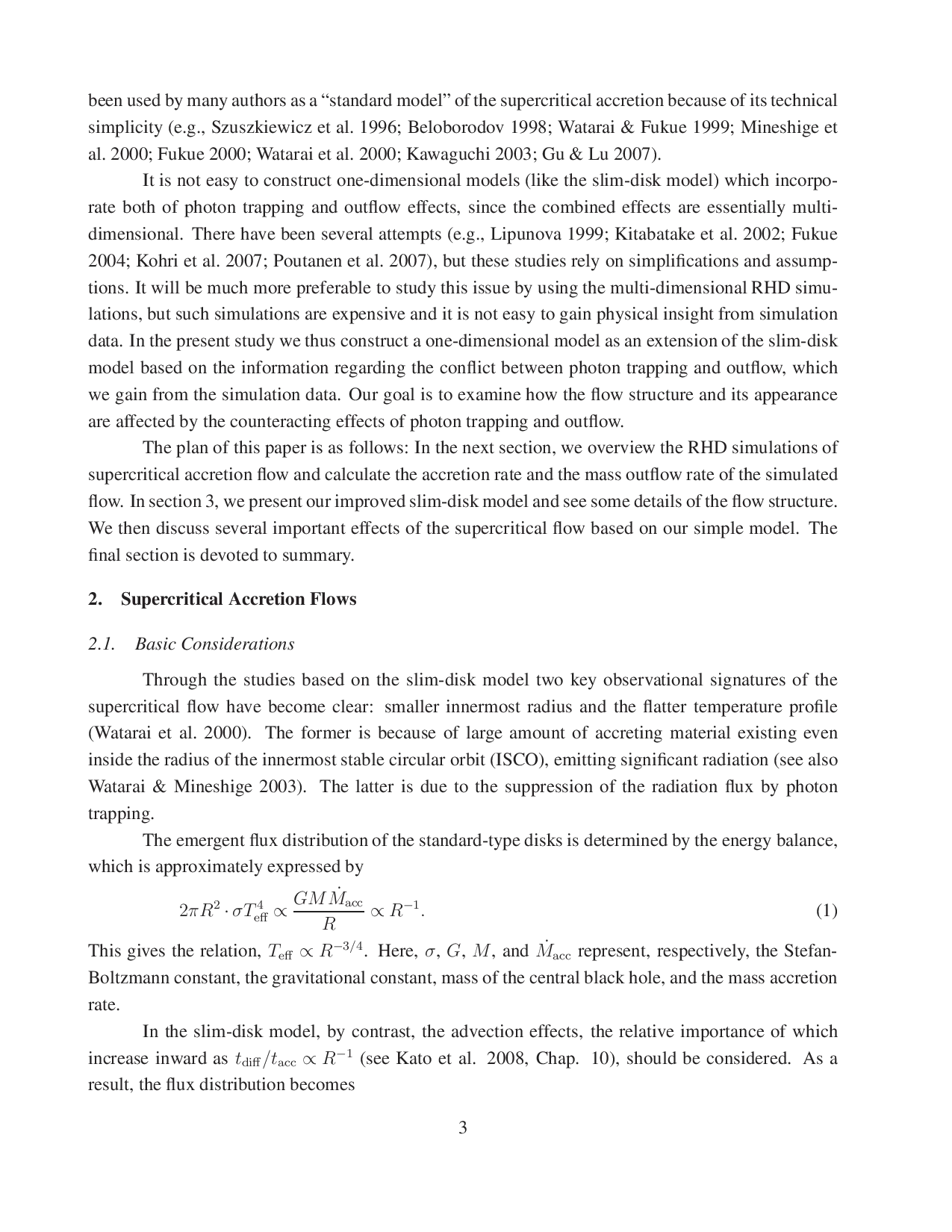
Through the studies based on the slim-disk model two key observational signatures of the supercritical flow have bec
…(Full text truncated)…
📸 Image Gallery
Reference
This content is AI-processed based on ArXiv data.