Finding the optimal assignment in budget-constrained auctions is a combinatorial optimization problem with many important applications, a notable example being the sale of advertisement space by search engines (in this context the problem is often referred to as the off-line AdWords problem). Based on the cavity method of statistical mechanics, we introduce a message passing algorithm that is capable of solving efficiently random instances of the problem extracted from a natural distribution, and we derive from its properties the phase diagram of the problem. As the control parameter (average value of the budgets) is varied, we find two phase transitions delimiting a region in which long-range correlations arise.
Deep Dive into Statistical mechanics of budget-constrained auctions.
Finding the optimal assignment in budget-constrained auctions is a combinatorial optimization problem with many important applications, a notable example being the sale of advertisement space by search engines (in this context the problem is often referred to as the off-line AdWords problem). Based on the cavity method of statistical mechanics, we introduce a message passing algorithm that is capable of solving efficiently random instances of the problem extracted from a natural distribution, and we derive from its properties the phase diagram of the problem. As the control parameter (average value of the budgets) is varied, we find two phase transitions delimiting a region in which long-range correlations arise.
We consider the following model of budget-constrained auctions, inspired from the sale of advertisement space on internet search engines: a set of advertisers a ∈ {1, • • • , N a } are interested in appearing on the results pages of the searches relative to some keywords k ∈ {1, • • • , N k }. Advertiser a offers to pay a bid w ka ∈ Ê + in order to appear on the results page each time that keyword k is searched. We assume that all the bids are expressed before the auction begins. In this setting, advertiser a doesn't know how many auctions he will end up winning, and therefore how much he will spend. In order to encourage the advertisers to make more bids without risking to spend too much, each advertiser a can also specify a budget B a ∈ Ê + which is the maximum sum that he is willing to pay in a given period of time.
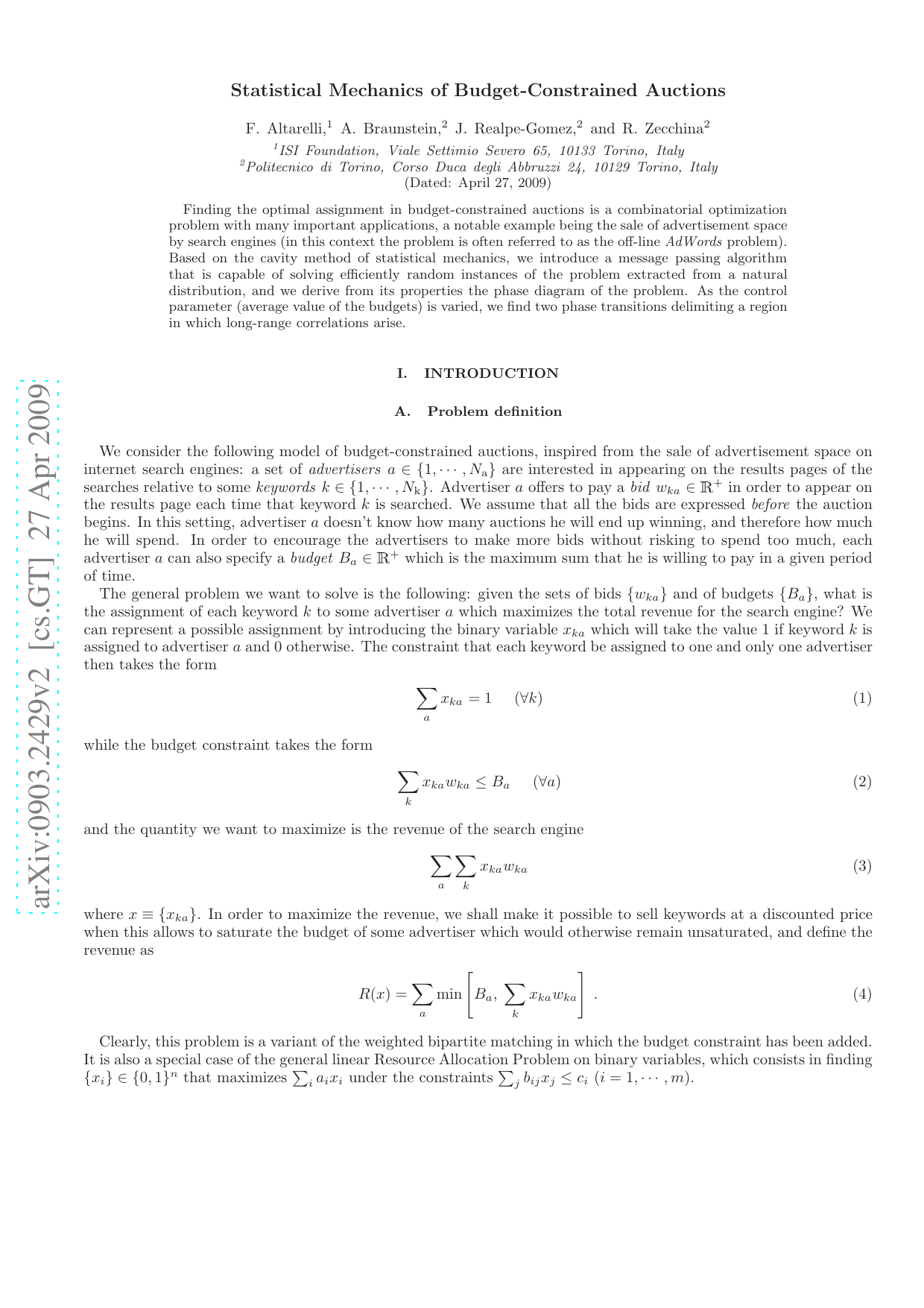
The general problem we want to solve is the following: given the sets of bids {w ka } and of budgets {B a }, what is the assignment of each keyword k to some advertiser a which maximizes the total revenue for the search engine? We can represent a possible assignment by introducing the binary variable x ka which will take the value 1 if keyword k is assigned to advertiser a and 0 otherwise. The constraint that each keyword be assigned to one and only one advertiser then takes the form a x ka = 1 (∀k) (1) while the budget constraint takes the form k
x ka w ka ≤ B a (∀a) (2) and the quantity we want to maximize is the revenue of the search engine a k
x ka w ka (3) where x ≡ {x ka }. In order to maximize the revenue, we shall make it possible to sell keywords at a discounted price when this allows to saturate the budget of some advertiser which would otherwise remain unsaturated, and define the revenue as
Clearly, this problem is a variant of the weighted bipartite matching in which the budget constraint has been added. It is also a special case of the general linear Resource Allocation Problem on binary variables, which consists in finding {x i } ∈ {0, 1} n that maximizes i a i x i under the constraints j b ij x j ≤ c i (i = 1, • • • , m).
Both the on-line and the off-line versions of the AdWords problem have been the object of considerable attention in recent years. The off-line version is NP-hard even if there are only 2 advertisers [1]. An exact algorithm to solve it with time complexity O(N a 4 N k ) and an approximate algorithm based on Integer Programming relaxation with an approximation ratio1 e/(e -1) (on the revenue) are presented in [2]. An improvement over this result is provided by [3], where an algorithm with approximation ratio 3/2 is introduced. An approximate algorithm for the on-line version of the problem with competitive ratio2 e/(e -1) is introduced in [4].
These results are concerned with the worst-case analysis of the performance (scaling of time and approximation ratio) of the algorithms. In what follows, we shall be interested in a different question: is there an algorithm which has a good performance on average for some given ensemble of instances of the problem? The ensemble of instances will be specified by defining the distributions of the bids and of the budgets.
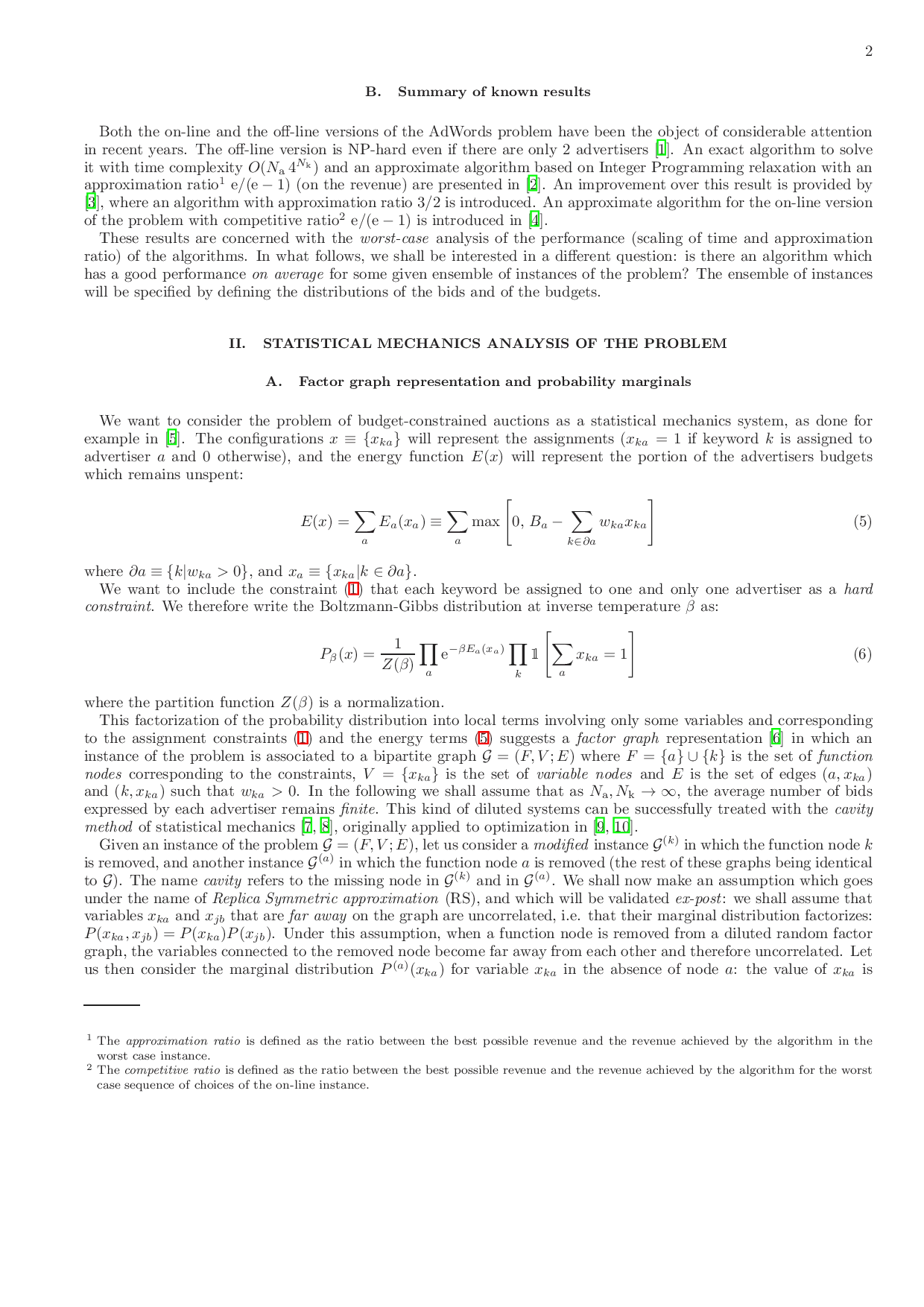
We want to consider the problem of budget-constrained auctions as a statistical mechanics system, as done for example in [5]. The configurations x ≡ {x ka } will represent the assignments (x ka = 1 if keyword k is assigned to advertiser a and 0 otherwise), and the energy function E(x) will represent the portion of the advertisers budgets which remains unspent:
where ∂a ≡ {k|w ka > 0}, and x a ≡ {x ka |k ∈ ∂a}.
We want to include the constraint (1) that each keyword be assigned to one and only one advertiser as a hard constraint. We therefore write the Boltzmann-Gibbs distribution at inverse temperature β as:
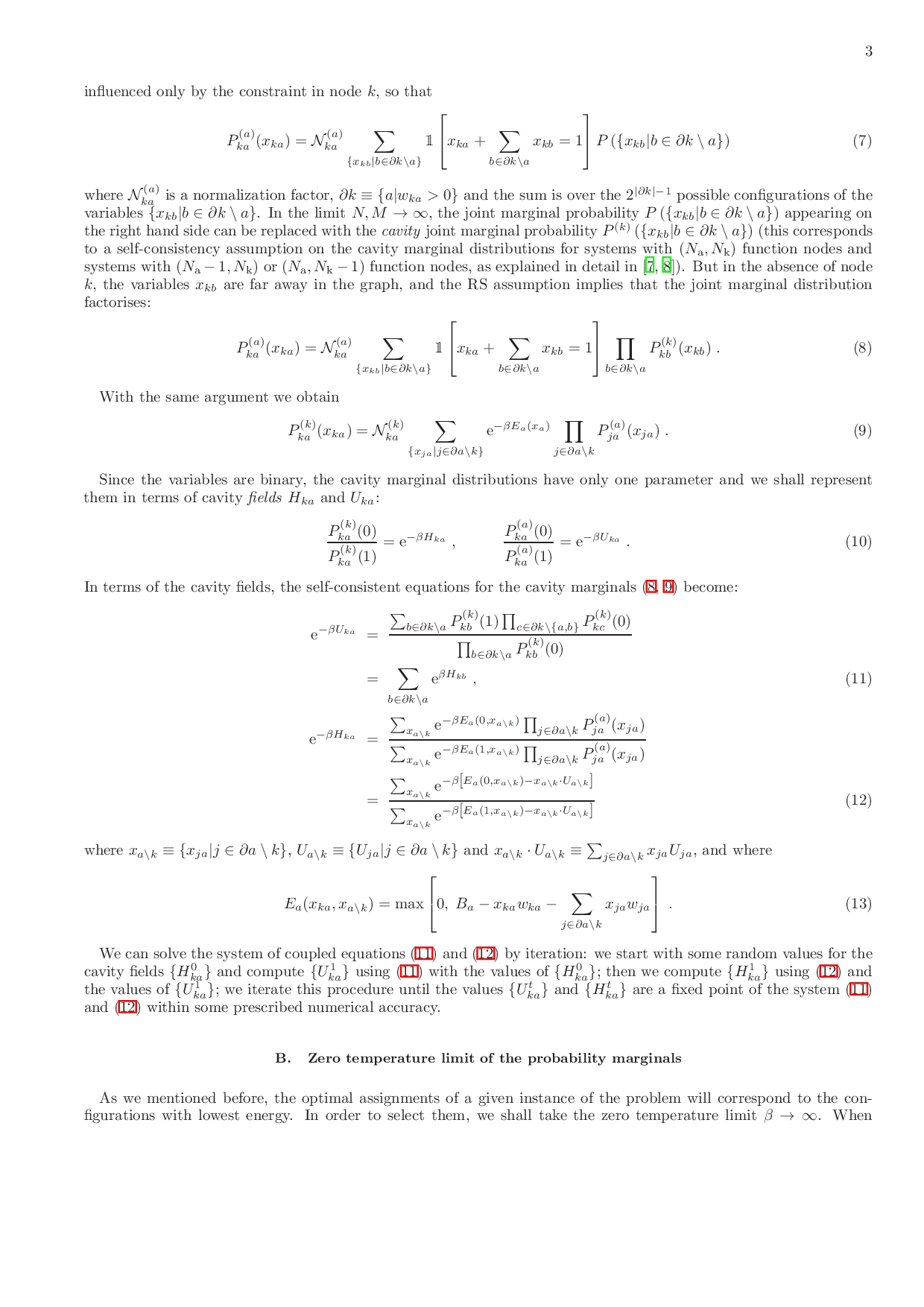
where the partition function Z(β) is a normalization. This factorization of the probability distribution into local terms involving only some variables and corresponding to the assignment constraints (1) and the energy terms (5) suggests a factor graph representation [6] in which an instance of the problem is associated to a bipartite graph G = (F, V ; E) where F = {a} ∪ {k} is the set of function nodes corresponding to the constraints, V = {x ka } is the set of variable nodes and E is the set of edges (a, x ka ) and (k, x ka ) such that w ka > 0. In the following we shall assume that as N a , N k → ∞, the average number of bids expressed by each advertiser remains finite. This kind of diluted systems can be successfully treated with the cavity method of statistical mechanics [7,8], originally applied to optimization in [9,10].
Given an instance of the problem G = (F, V ; E), let us consider a modified instance G (k) in which the function node k is removed, and another instance G (a) in which the function node a is removed (the rest of these graphs being identical to G). The name cavity refers to the missing node in G (k) and in G (a) . We shall now make an assumption which goes under the name
…(Full text truncated)…
This content is AI-processed based on ArXiv data.