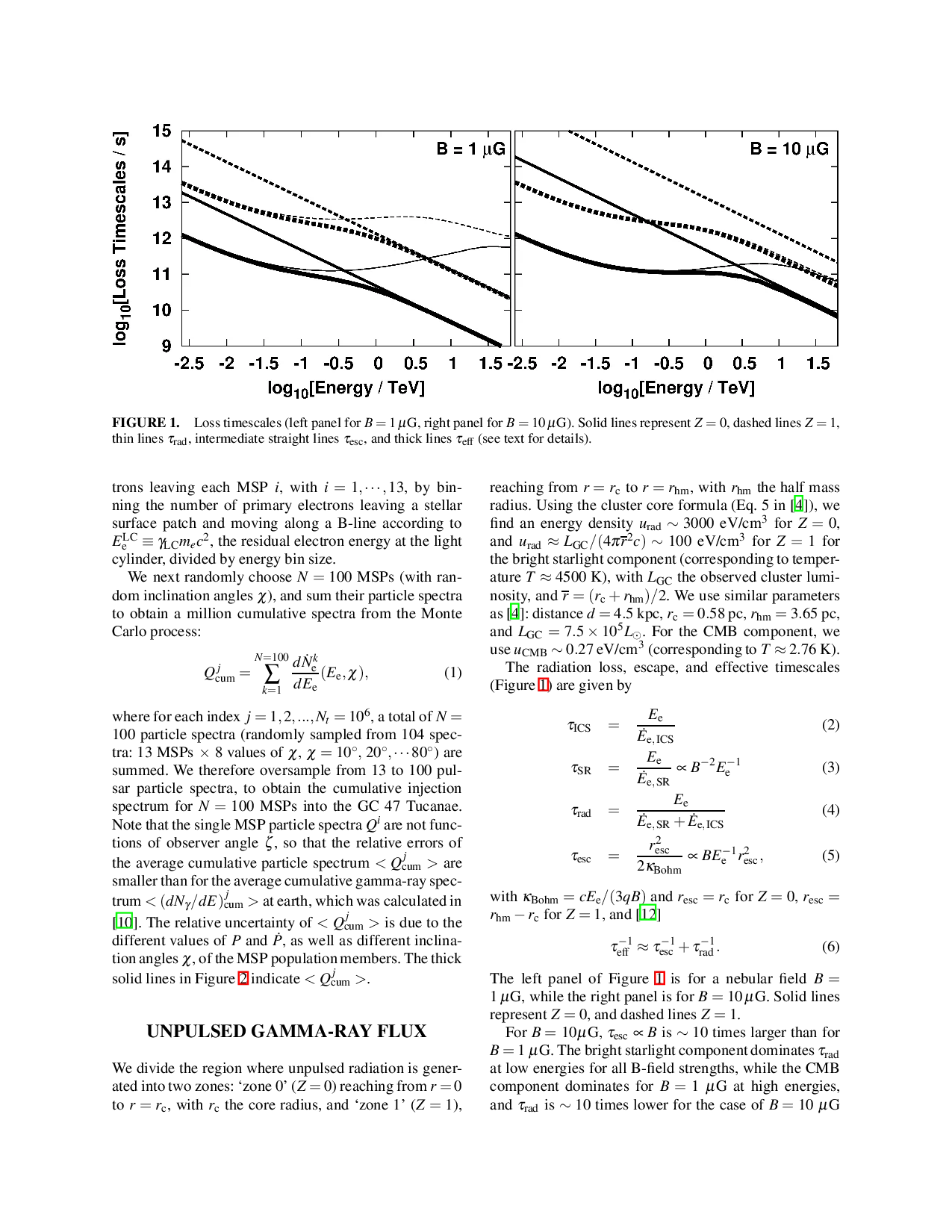
Low-Mass X-ray Binaries (LMXRBs), believed to be the progenitors of recycled millisecond pulsars (MSPs), occur abundantly in globular clusters (GCs). GCs are therefore expected to host large numbers of MSPs. This is also confirmed observationally. The MSPs continuously inject relativistic electrons into the ambient region beyond their light cylinders, and these relativistic particles produce unpulsed radiation via the synchrotron and inverse Compton (IC) processes. It is thus possible, in the context of General Relativistic (GR) frame-dragging MSP models, to predict unpulsed very high energy radiation expected from nearby GCs. We use a period-derivative cleaned sample of MSPs in 47 Tucanae, where the effects of the cluster potential on the individual period derivatives have been removed. Using a Monte Carlo process to include effects of pulsar geometry, we obtain average injection spectra (with relatively small errors) of particles leaving the MSPs. These spectra are next used to predict cumulative synchrotron and IC spectra expected from 47 Tucanae, which is a lower limit, as no reacceleration is assumed. We find that the IC radiation from 47 Tucanae may be visible for H.E.S.S., depending on the nebular field B as well as the number of MSPs N in the GC. Telescopes such as Chandra and Hubble may find it difficult to test the SR component prediction of diffuse radiation if there are many unresolved sources in the field of view. These results may be rescaled for other GCs where less information is available, assuming universal GC MSP characteristics.
Deep Dive into Estimates for Very High Energy Gamma Rays from Globular Cluster Pulsars.
Low-Mass X-ray Binaries (LMXRBs), believed to be the progenitors of recycled millisecond pulsars (MSPs), occur abundantly in globular clusters (GCs). GCs are therefore expected to host large numbers of MSPs. This is also confirmed observationally. The MSPs continuously inject relativistic electrons into the ambient region beyond their light cylinders, and these relativistic particles produce unpulsed radiation via the synchrotron and inverse Compton (IC) processes. It is thus possible, in the context of General Relativistic (GR) frame-dragging MSP models, to predict unpulsed very high energy radiation expected from nearby GCs. We use a period-derivative cleaned sample of MSPs in 47 Tucanae, where the effects of the cluster potential on the individual period derivatives have been removed. Using a Monte Carlo process to include effects of pulsar geometry, we obtain average injection spectra (with relatively small errors) of particles leaving the MSPs. These spectra are next used to predi
arXiv:0903.3047v2 [astro-ph.HE] 21 Sep 2009
Estimates for Very High Energy
Gamma Rays from Globular Cluster Pulsars
C. VENTER∗,† and O.C. DE JAGER∗,∗∗
∗Unit for Space Physics, North-West University, Potchefstroom Campus, Private Bag X6001, Potchefstroom
2520, South Africa
†The Centre for High Performance Computing, CSIR Campus, 15 Lower Hope Street, Rosebank, Cape Town,
South Africa
∗∗South African Department of Science and Technology, and National Research Foundation Research Chair:
Astrophysics and Space Science
Abstract. Low-Mass X-ray Binaries (LMXRBs), believed to be the progenitors of recycled millisecond pulsars (MSPs),
occur abundantly in globular clusters (GCs). GCs are therefore expected to host large numbers of MSPs. This is also confirmed
observationally. The MSPs continuously inject relativistic electrons into the ambient region beyond their light cylinders, and
these relativistic particles produce unpulsed radiation via the synchrotron and inverse Compton (IC) processes. It is thus
possible, in the context of General Relativistic (GR) frame-dragging MSP models, to predict unpulsed very high energy
radiation expected from nearby GCs. We use a period-derivative cleaned sample of MSPs in 47 Tucanae, where the effects of
the cluster potential on the individual period derivatives have been removed. This MSP population is likely to have significant
pair production inhibition, so that slot gaps and outer gaps are not expected to form in the pulsar magnetospheres. The
utilisation of unscreened pulsar potentials is therefore justified, and fundamental tests for the predicted average single pulsar
gamma-ray luminosities and associated particle acceleration are simplified. Using a Monte Carlo process to include effects
of pulsar geometry, we obtain average injection spectra (with relatively small errors) of particles leaving the MSPs. These
spectra are next used to predict cumulative synchrotron and IC spectra expected from 47 Tucanae, which is a lower limit, as
no reacceleration is assumed. We find that the IC radiation from 47 Tucanae may be visible for H.E.S.S., depending on the
nebular field B as well as the number of MSPs N in the GC. Telescopes such as Chandra and Hubble may find it difficult to
test the SR component prediction of diffuse radiation if there are many unresolved sources in the field of view. These results
may be rescaled for other GCs where less information is available, assuming universal GC MSP characteristics.
Keywords: Pulsars, Globular clusters in the Milky Way, Radiation mechanisms
PACS: 97.60.Gb, 98.20.Gm, 95.30.Gv
INTRODUCTION
A total of 137 globular cluster (GC) pulsars have been
discovered in 25 GCs1, following the discovery of the
first GC millisecond pulsar (MSP) in M28 [1]. Low-Mass
X-ray Binaries (LMXRBs), believed to be the progeni-
tors of recycled MSPs [2], occur abundantly in GCs. GCs
are therefore expected to host large numbers of MSPs, up
to ∼200 MSPs or more [3, 4]. Indeed, GC MSP spin
properties seem consistent with the recycling scenario
[5].
Terzan 5, 47 Tucanae, and M28 collectively contain
nearly half of all GC pulsars, housing 33, 23, and 11 pul-
sars respectively [5]. GC MSPs are sources of relativistic
electrons, which are continuously being injected into the
ambient region beyond the MSPs’ light cylinders. These
relativistic particles produce high-energy emission via
synchrotron radiation (SR) and inverse Compton scatter-
ing (ICS) on bright starlight photons as well as on the
1 http://www.naic.edu/∼pfreireGCpsr.html
cosmic microwave background (CMB).
In this paper, we calculate the cumulative injection
spectrum and resulting unpulsed SR and ICS fluxes, us-
ing a population of 13 MSPs in 47 Tucanae, with cor-
rected values of their period-derivatives [6]. GC gamma-
ray visibility is also discussed. We use a more refined
injection spectrum, originating from a General Relativis-
tic (GR) frame-dragging MSP model (e.g. [7, 8, 9]), than
that assumed by [4], and our calculations are comple-
mentary to pulsed gamma-ray flux predicted by [10]. As
we only consider particles originating from MSP magne-
tospheres, with no further acceleration, our calculations
should be viewed as lower limits to the expected TeV
flux.
INJECTION SPECTRUM
CALCULATION
As in [10, 11], we use a population of 13 MSPs in 47 Tu-
canae, with corrected values of their period-derivatives
˙P [6]. We calculate the injection spectrum Qi of elec-
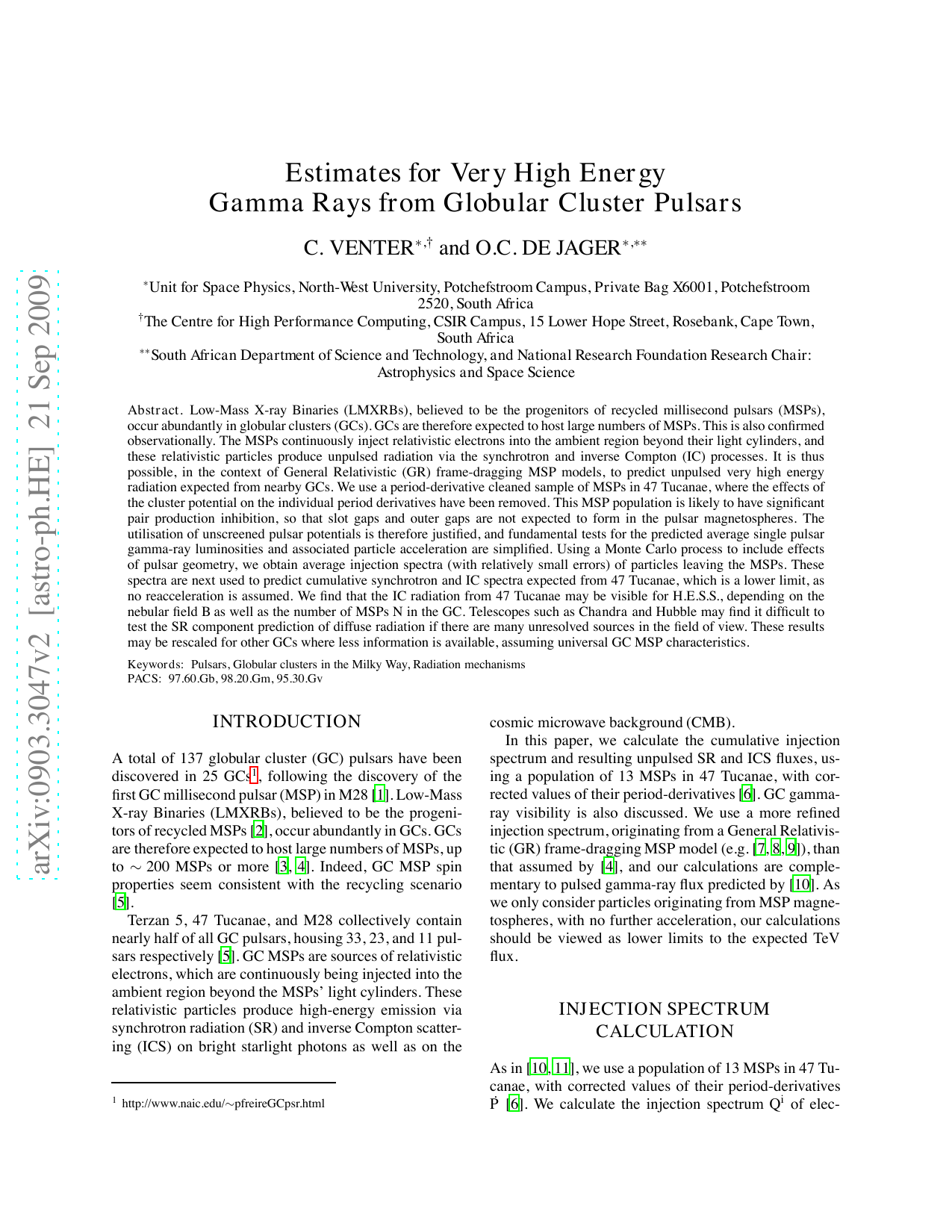
FIGURE 1.
Loss timescales (left panel for B = 1µG, right panel for B = 10µG). Solid lines represent Z = 0, dashed lines Z = 1,
thin lines τrad, intermediate straight lines τesc, and thick lines τeff (see text for details).
trons leaving each MSP i, with i = 1,···,13, by bin-
ning the number of primary electrons leaving a stellar
surface patch and moving along a B-line according to
ELC
e
≡γLCmec2, the residual electron energy at the light
cylinder, divided by energy bin size.
We next randomly choose N = 100 MSPs (with ran-
dom inclination angles χ), and sum their pa
…(Full text truncated)…
This content is AI-processed based on ArXiv data.