We investigate the symbiotic star BI Crucis through a comprehensive and self-consistent analysis of the spectra emitted in three different epochs: 60's, 70's, and late 80's. In particular, we would like to find out the physical conditions in the shocked nebula and in the dust shells, as well as their location within the symbiotic system, by exploiting both photometric and spectroscopic data from radio to UV. We suggest a model which, on the basis of optical imaging, emission line ratios and spectral energy distribution profile, is able to account for collision of the winds, formation of lobes and jets by accretion onto the WD, as well as for the interaction of the blast wave from a past, unrecorded outburst with the ISM. We have found that the spectra observed throughout the years show the marks of the different processes at work within BI Cru, perhaps signatures of a post-outburst evolution. We then call for new infrared and millimeter observations, potentially able to resolve the inner structure of the symbiotic nebula.
Deep Dive into Shock fronts in the symbiotic system BI Crucis.
We investigate the symbiotic star BI Crucis through a comprehensive and self-consistent analysis of the spectra emitted in three different epochs: 60’s, 70’s, and late 80’s. In particular, we would like to find out the physical conditions in the shocked nebula and in the dust shells, as well as their location within the symbiotic system, by exploiting both photometric and spectroscopic data from radio to UV. We suggest a model which, on the basis of optical imaging, emission line ratios and spectral energy distribution profile, is able to account for collision of the winds, formation of lobes and jets by accretion onto the WD, as well as for the interaction of the blast wave from a past, unrecorded outburst with the ISM. We have found that the spectra observed throughout the years show the marks of the different processes at work within BI Cru, perhaps signatures of a post-outburst evolution. We then call for new infrared and millimeter observations, potentially able to resolve the inn
BI Crucis (BICru) is a dusty (D-type) symbiotic system (SS) (Kenyon et al. 1986) which hosts an early Mira whose pulsation period is 280d (Whitelock et al. 1983), and a hot star of T * ∼ 26500 K (Rossi et al. 1988, hereafter R88). With respect to other dusty SSs, BI Cru shows a less strong IR excess which can be attributed to thermal emission of relatively cool dust (Angeloni et al. 2007a).
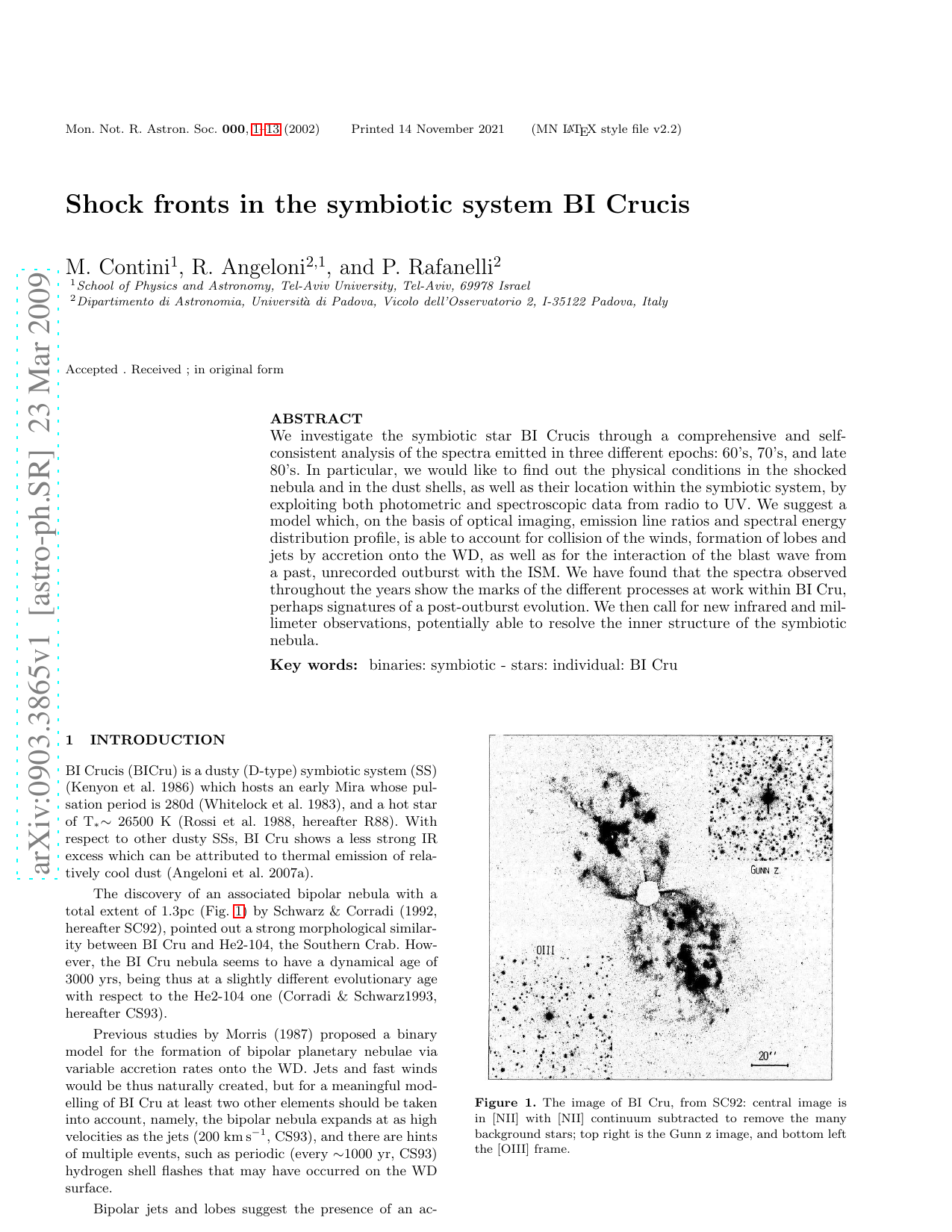
The discovery of an associated bipolar nebula with a total extent of 1.3pc (Fig. 1) by Schwarz & Corradi (1992, hereafter SC92), pointed out a strong morphological similarity between BI Cru and He2-104, the Southern Crab. However, the BI Cru nebula seems to have a dynamical age of 3000 yrs, being thus at a slightly different evolutionary age with respect to the He2-104 one (Corradi & Schwarz1993, hereafter CS93).
Previous studies by Morris (1987) proposed a binary model for the formation of bipolar planetary nebulae via variable accretion rates onto the WD. Jets and fast winds would be thus naturally created, but for a meaningful modelling of BI Cru at least two other elements should be taken into account, namely, the bipolar nebula expands at as high velocities as the jets (200 km s -1 , CS93), and there are hints of multiple events, such as periodic (every ∼1000 yr, CS93) hydrogen shell flashes that may have occurred on the WD surface.
Bipolar jets and lobes suggest the presence of an ac- cretion disk, whose formation may be plausible assuming a typical accretion rate of 10 -7 M⊙ yr -1 (Morris 1987). CS93 suggest that the fast winds from the hot star are produced by thermonuclear runaways on the surface of the WD. Disk instabilities are less indicated because stable hydrogen burning occurs only in a very little range of accretion rates, which would constrain the binary parameters.
Previous modelling of SSs in different phases of outburst and quiescence (Contini et al. 2009a, Angeloni et al 2007a, andreferences therein) led to recognize some main dynamical mechanisms, that can be summarized by: the collision of the stellar winds which leads to shocked nebulae at different location on the orbital plane, the formation of a disk as a consequence of accretion phenomena, the ejection of jets and lobes perpendicularly to the orbital plane, and the outburst of the WD, at the origin of the blast wave propagation outwards in the ISM. Furthermore, also the dust shells emitted by the Mira contribute to the line and continuum spectra and might be responsible for obscuration episodes.
In this paper, we investigate the origin of the emission fluxes at different epochs. analyzing the spectral and morphological appearance of BI Cru. On the basis of the observational and theoretical evidences described previously, we will account for episodes of wind collisions, ejection of lobes and jets due to the accretion processes, and expansion of the blast wave in the surrounding medium as a consequence of past outbursts of the WD.
Quantitative informations can be derived only by modelling the 1962 spectrum presented by Henize & Carlson (1980, hereafter HC80), which provides intensities and velocities of several observed lines. Further, important informations can be obtained by the observation of the broad Hα line reported by Whitelock et al. (1983) and by the polarization of its wings discussed by Harries (1996). Eventually, some upper and/or lower limits to the physical parameters derived from the spatial distribution of some important emission lines (e.g. [OII], [OIII]) were found by SC92.
We adopt the models presented for He2-104 and for R Aqr by Contini &Formiggini (2001 and2003, respectively). There, the winds from the WD and the red giant star collide head-on between the stars and head-on-back outward the binary system, leading to a network of shock fronts in the equatorial plane of the binary system (Girard & Willson 1987). Moreover, the jets from the accretion disk, colliding with the circumstellar matter, give origin to the bipolar nebula in the perpendicular direction (Contini & Formiggini 2003). In fact, the jet velocity and the velocities observed in the bipolar nebula are similar (∼ 200-250 km s -1 ).
The modelling of line and continuum spectra makes use of SUMA 1 , a code that simulates the physical conditions of an emitting gaseous nebula under the coupled effect of photoionization from an external source and shocks. The important role of dust is investigated following Angeloni et al. (2007a,b,c).
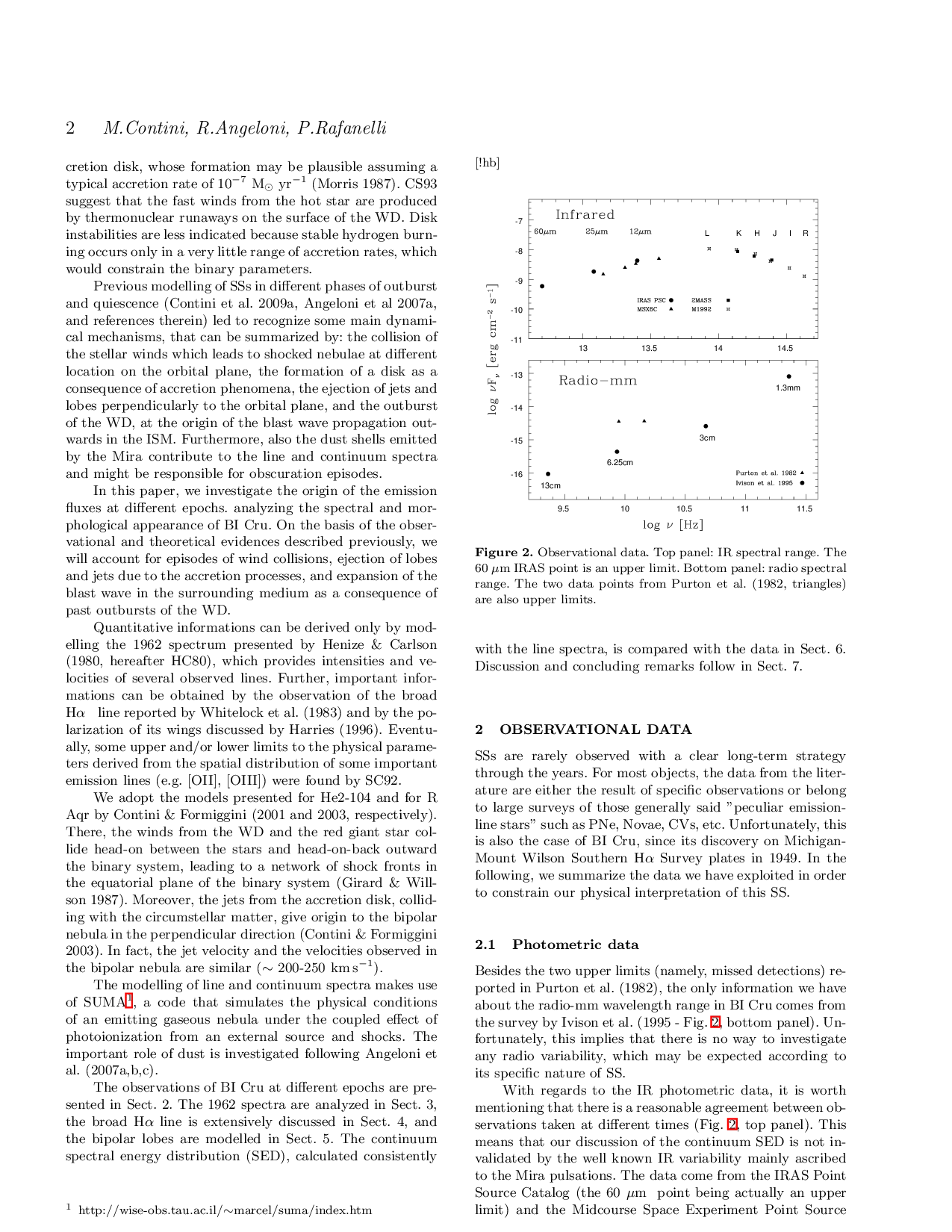
The observations of BI Cru at different epochs are presented in Sect. 2. The 1962 spectra are analyzed in Sect. 3, the broad Hα line is extensively discussed in Sect. 4, and the bipolar lobes are modelled in Sect. 5. The continuum spectral energy distribution (SED), calculated consistently Purton et al. (1982, triangles) are also upper limits.
with the line spectra, is compared with the data in Sect. 6. Discussion and concluding remarks follow in Sect. 7.
SSs are rarely observed with a clear long-term strategy through the yea
…(Full text truncated)…
This content is AI-processed based on ArXiv data.