Radio Spectral Index Analysis and Classes of Ejection in LS I +61 303
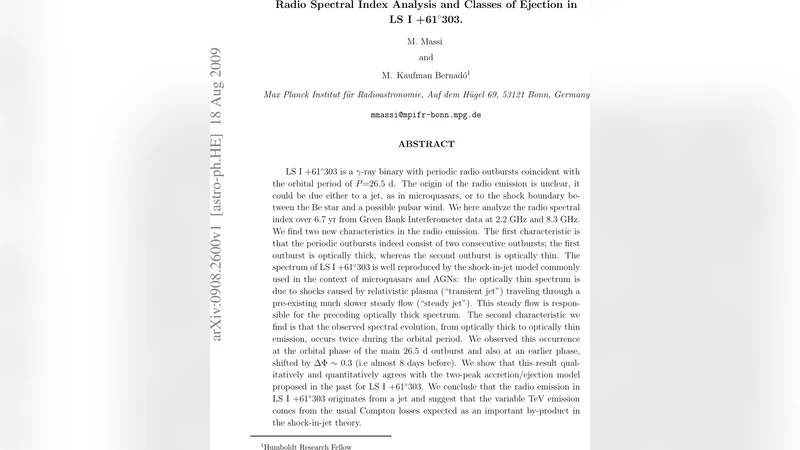
LS I +61303 is a gamma-ray binary with periodic radio outbursts coincident with the orbital period of P=26.5 d. The origin of the radio emission is unclear,it could be due either to a jet, as in microquasars, or to the shock boundary between the Be star and a possible pulsar wind. We here analyze the radio spectral index over 6.7 yr from Green Bank Interferometer data at 2.2 GHz and 8.3 GHz. We find two new characteristics in the radio emission. The first characteristic is that the periodic outbursts indeed consist of two consecutive outbursts; the first outburst is optically thick, whereas the second outburst is optically thin. The spectrum of LS I +61 303 is well reproduced by the shock-in-jet model commonly used in the context of microquasars and AGNs: the optically thin spectrum is due to shocks caused by relativistic plasma (“transient jet”) traveling through a pre-existing much slower steady flow (“steady jet”). This steady flow is responsible for the preceding optically thick spectrum. The second characteristic we find is that the observed spectral evolution, from optically thick to optically thin emission, occurs twice during the orbital period. We observed this occurrence at the orbital phase of the main 26.5 d outburst and also at an earlier phase, shifted by $\Delta \Phi \sim$ 0.3 (i.e almost 8 days before). We show that this result qualitatively and quantitatively agrees with the two-peak accretion/ejection model proposed in the past for LS I +61303. We conclude that the radio emission in LS I +61303 originates from a jet and suggest that the variable TeV emission comes from the usual Compton losses expected as an important by-product in the shock-in-jet theory.
💡 Research Summary
LS I +61 303 is a gamma‑ray binary that exhibits periodic radio outbursts synchronized with its 26.5‑day orbital period. The nature of the radio emission has been debated: either a microquasar‑like relativistic jet or a shock formed where a putative pulsar wind collides with the Be star’s outflow. In this work the authors performed a comprehensive spectral‑index analysis using 6.7 years of Green Bank Interferometer data at 2.2 GHz and 8.3 GHz. By averaging the data in 0.02‑day bins they obtained a densely sampled light curve for many orbital cycles.
The key observational result is that each orbital outburst actually consists of two distinct sub‑outbursts. The first sub‑outburst shows a positive spectral index (α > 0), i.e., it is optically thick, while the second sub‑outburst has a negative index (α < 0), i.e., it is optically thin. This double‑peak behaviour repeats twice per orbit: once near orbital phase φ ≈ 0.0–0.3 (the main outburst) and again about Δφ ≈ 0.3 earlier (≈ 8 days before the main peak).
These findings are naturally interpreted within the shock‑in‑jet framework that is widely used for microquasars and active galactic nuclei. In this picture a slow, steady jet (the “steady flow”) is continuously present; its synchrotron emission produces the optically thick spectrum observed at the beginning of each outburst. Later, a faster, transient plasma ejection (the “transient jet”) catches up with the steady flow, generating internal shocks. The shock‑accelerated electrons radiate synchrotron emission with a steep, optically thin spectrum, accounting for the second sub‑outburst. The transition from thick to thin therefore marks the passage of the shock through the pre‑existing jet.
The timing of the two thick‑to‑thin transitions matches the two‑peak accretion/ejection model previously proposed for LS I +61 303. According to that model, the eccentric orbit and the misaligned Be‑star disc cause two episodes of enhanced mass transfer per orbit: one when the compact object passes through the dense part of the disc, and a second when it encounters a less dense but still significant portion of the disc displaced in orbital phase. Each episode supplies enough material to power a fresh jet episode, producing the observed double spectral‑index evolution.
Beyond the radio band, the shock‑in‑jet scenario predicts strong inverse‑Compton losses. The same relativistic electrons that emit the optically thin synchrotron radiation will up‑scatter stellar photons (external Compton) and their own synchrotron photons (synchrotron self‑Compton), producing variable GeV–TeV emission. This provides a coherent explanation for the observed TeV variability that is correlated with the radio outbursts.
In summary, the authors demonstrate that the radio emission of LS I +61 303 is best explained by a jet that undergoes internal shocks, rather than by a pulsar‑wind shock. The double‑peak spectral‑index evolution, its repeatability each orbit, and its quantitative agreement with the two‑peak accretion model together constitute strong evidence for a jet‑driven scenario. The work also links the radio behaviour to high‑energy gamma‑ray production via standard Compton processes, offering a unified picture that can be tested with coordinated multi‑wavelength campaigns.
Comments & Academic Discussion
Loading comments...
Leave a Comment