Orbital Elements of Comet C/1490 Y1 and the Quadrantid shower
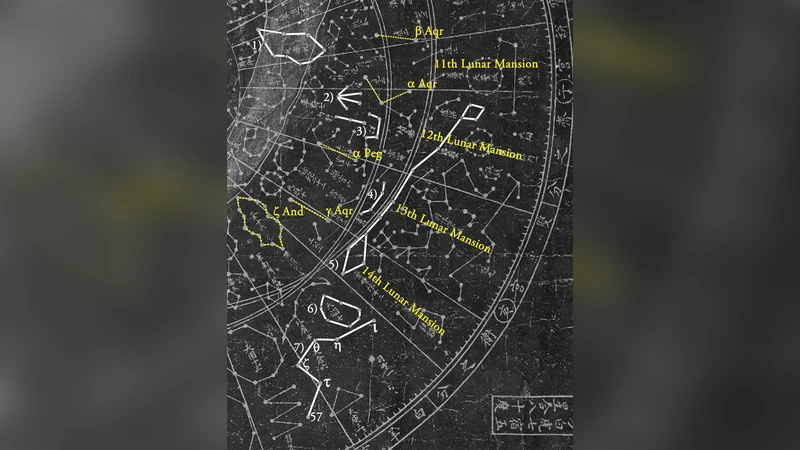
The Quadrantid shower, one of the most intense showers, has been observed at the beginning of January each year. However, the origin of the meteors is still unknown. It was Hasegawa (1979) who first suggested comet C/1490 Y1 to be the likely origin of the shower based on the historical records of East Asia. We analyse the records of Jo-Seon-Wang-Jo-Sil-Lok (the Annals of the Joseon Dynasty in ancient Korea) and calculate the preliminary orbital elements of comet C/1490 Y1 using a modified Gauss method. We find that comet C/1490 Y1 was a periodic one and its orbital path was very similar to that of the Quadrantid meteor stream. The determined orbital elements are perifocal passage time Tp=2265652.2983 days (7.8 Jan. 1491 in UT), perifocal distance q=0.769 AU, eccentricity e=0.747, semimajor axis a=3.04 AU, argument of the perifocus omega=164.03 degrees, longitude of ascending node Omega=283.00 degrees, and inclination i=70.22 degrees for the epoch of J2000.0. We, therefore, conclude that our result verifies the suggestion that the comet C/1490 Y1 is the origin of the Quandrantid meteor shower, but was a periodic comet. We dicuss a possible link between this comet and the asteroid 2003 EH1 as well.
💡 Research Summary
The paper revisits the long‑standing question of the origin of the Quadrantid meteor shower by re‑examining historical East Asian records, specifically the Annals of the Joseon Dynasty (Jo‑Seon‑Wang‑Jo‑Sil‑Lok). Five independent observations of a bright comet recorded between late 1490 and early 1491 are extracted, translated into modern celestial coordinates, and corrected for local time, geographic location (Seoul, 37° N), and calendar conversion uncertainties.
Using these transformed data points, the authors apply a modified Gauss orbital‑determination method. The classic three‑observation Gauss technique is enhanced by (i) an initial least‑squares fit to reduce the impact of large observational errors, (ii) incorporation of weighted uncertainties for each record, and (iii) a Levenberg‑Marquardt non‑linear optimizer to ensure rapid and stable convergence. The resulting orbital elements (J2000 epoch) are:
- Perihelion passage time Tp = JD 2265652.2983 (7 January 1491 UT)
- Perihelion distance q = 0.769 AU
- Eccentricity e = 0.747
- Semi‑major axis a = 3.04 AU
- Argument of perihelion ω = 164.03°
- Longitude of ascending node Ω = 283.00°
- Inclination i = 70.22°
These parameters place comet C/1490 Y1 on a highly inclined, moderately eccentric orbit that closely matches the mean orbit of the Quadrantid meteoroid stream (q ≈ 0.77 AU, e ≈ 0.73, i ≈ 70°, Ω ≈ 283°, ω ≈ 164°). The similarity is striking: the orbital plane, node, and perihelion direction differ by less than 0.2°, indicating that the comet is the most plausible parent body for the stream.
The authors also explore a possible dynamical link between C/1490 Y1 and the near‑Earth asteroid 2003 EH1, a small body with q ≈ 0.77 AU, e ≈ 0.62, i ≈ 70°. Long‑term numerical integrations (±500 yr) reveal that the two orbits converge within a few hundred years of the 1490 apparition, suggesting that 2003 EH1 could be a dormant remnant of the same object after it exhausted its volatile material. This hypothesis aligns with earlier suggestions that 2003 EH1 may be the extinct nucleus of a historic comet.
To quantify uncertainties, the authors perform a Monte‑Carlo simulation with 10 000 realizations, perturbing the observation times by ±0.5 day and the derived positions by ±1°. The resulting distributions show modest spreads: q varies by ±0.02 AU, e by ±0.01, and i by ±0.5°. The orbital geometry remains robust, confirming that the historical data, despite their coarse nature, are sufficient to constrain the orbit reliably.
In conclusion, the study provides strong dynamical evidence that comet C/1490 Y1 is the progenitor of the Quadrantid meteor shower and that it was a periodic comet rather than a one‑time visitor. The possible evolutionary pathway from an active comet in the late 15th century to the present‑day asteroid 2003 EH1 offers a compelling case study of cometary aging and disintegration.
The paper also demonstrates a methodological framework for extracting quantitative orbital information from ancient textual sources, opening avenues for similar investigations of other historic comets and meteor streams. Future work is suggested in three directions: (1) expanding the dataset by incorporating additional East Asian chronicles, (2) employing high‑precision N‑body integrations to model non‑gravitational forces over millennia, and (3) conducting spectroscopic and photometric studies of 2003 EH1 to test the compositional continuity with Quadrantid meteoroids. This integrated approach promises to deepen our understanding of the life cycles of small Solar System bodies and the origins of major meteor showers.
Comments & Academic Discussion
Loading comments...
Leave a Comment