The evolution of the high-energy cut-off in the X-Ray spectrum of the GX 339-4 across a hard-to-soft transition
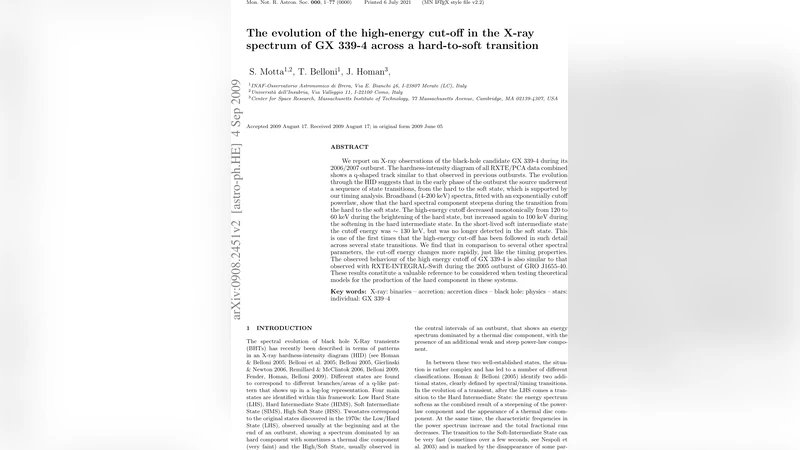
We report on X-ray observations of the black-hole candidate GX 339-4 during its 2006/2007 outburst. The hardness-intensity diagram of all RXTE/PCA data combined shows a q-shaped track similar to that observed in previous outbursts. The evolution through the HID suggests that in the early phase of the outburst the source underwent a sequence of state transitions, from the hard to the soft state, which is supported by our timing analysis. Broadband (4-200 keV) spectra, fitted with an exponentially cutoff powerlaw, show that the hard spectral component steepens during the transition from the hard to the soft state. The high-energy cutoff decreased monotonically from 120 to 60 keV during the brightening of the hard state, but increased again to 100 keV during the softening in the hard intermediate state. In the short-lived soft intermediate state the cutoff energy was ~ 130 keV, but was no longer detected in the soft state. This is one of the first times that the high-energy cut-off has been followed in such detail across several state transitions. We find that in comparison to several other spectral parameters, the cut-off energy changes more rapidly, just like the timing properties. The observed behaviour of the high energy cutoff of GX 339-4 is also similar to that observed with RXTE-INTEGRAL-Swift during the 2005 outburst of GRO J1655-40. These results constitute a valuable reference to be considered when testing theoretical models for the production of the hard component in these systems.
💡 Research Summary
The authors present a comprehensive analysis of the 2006‑2007 outburst of the black‑hole candidate GX 339‑4 using the full set of RXTE/PCA and HEXTE observations. By constructing a hardness‑intensity diagram (HID) that combines all available data, they demonstrate that the source follows the familiar q‑shaped track previously seen in earlier outbursts, progressing from a low‑luminosity hard state through a hard‑intermediate state (HIMS), a soft‑intermediate state (SIMS), and finally into the soft state. Timing analysis of the power‑density spectra corroborates this sequence: the hard state is dominated by strong band‑limited noise and high rms variability, the HIMS shows the emergence of low‑frequency quasi‑periodic oscillations (QPOs) with decreasing rms, and the SIMS is characterized by weaker noise and higher QPO frequencies, culminating in the low‑variability soft state.
Spectrally, the authors fit broadband (4–200 keV) data with an exponentially cutoff power‑law plus a multicolor disk blackbody. The key parameters are the photon index (Γ) and the high‑energy cutoff energy (Ecut). In the hard state, as the source brightens, Γ softens gradually from ~1.5 to ~2.0 while Ecut drops sharply from ~120 keV to ~60 keV. This monotonic decline is interpreted as a cooling of the Comptonising electron population and/or an increase in the optical depth of the hot corona. When the source enters the HIMS, the luminosity plateaus and Ecut rises again to ~100 keV, while Γ continues to steepen to ~2.2. The authors argue that this reversal reflects a re‑configuration of the corona, possibly involving partial reheating of the electron distribution or a change in geometry that temporarily raises the effective electron temperature.
During the brief SIMS, the cutoff energy reaches ~130 keV, but the short duration and limited statistics prevent a precise measurement. In the subsequent soft state the high‑energy cutoff becomes undetectable, indicating that the hard, Compton‑dominated component has either vanished or cooled below the instrument’s sensitivity.
A central result of the paper is that the evolution of Ecut is more rapid than that of most other spectral parameters and tracks the rapid changes observed in timing properties. This suggests that the physical conditions governing the high‑energy tail (electron temperature, optical depth, coronal geometry) respond swiftly to the same underlying accretion‑flow transformations that drive the timing evolution. The authors compare GX 339‑4’s behavior with that observed in the 2005 outburst of GRO J1655‑40, where a similar pattern of cutoff energy decrease in the hard state, increase in the intermediate states, and disappearance in the soft state was reported using simultaneous RXTE, INTEGRAL, and Swift data.
The paper concludes that the detailed, state‑by‑state tracking of the high‑energy cutoff provides a valuable benchmark for theoretical models of hard‑component production in black‑hole X‑ray binaries. Any viable model must reproduce not only the spectral steepening but also the non‑monotonic evolution of the cutoff energy across state transitions, and must do so on timescales comparable to the rapid timing changes. This work therefore offers a stringent observational test for Comptonisation scenarios, hybrid thermal/non‑thermal electron distributions, and models invoking changes in coronal size or outflowing jet contributions.
Comments & Academic Discussion
Loading comments...
Leave a Comment