An Optimal Self-Stabilizing Firing Squad
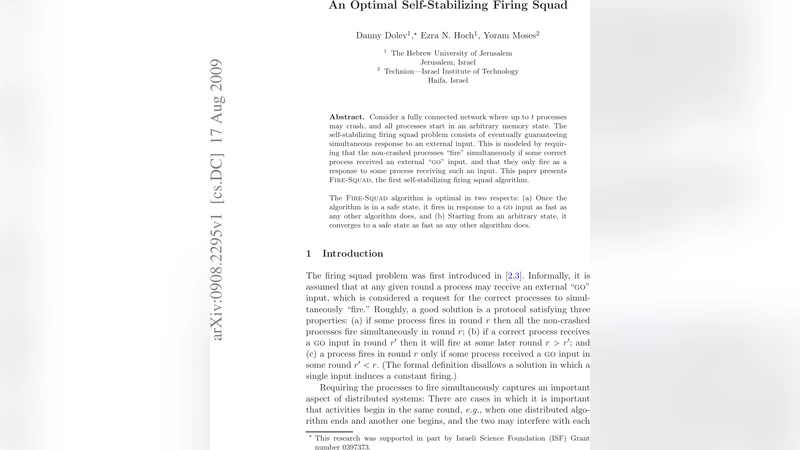
Consider a fully connected network where up to $t$ processes may crash, and all processes start in an arbitrary memory state. The self-stabilizing firing squad problem consists of eventually guaranteeing simultaneous response to an external input. This is modeled by requiring that the non-crashed processes “fire” simultaneously if some correct process received an external “GO” input, and that they only fire as a response to some process receiving such an input. This paper presents FireAlg, the first self-stabilizing firing squad algorithm. The FireAlg algorithm is optimal in two respects: (a) Once the algorithm is in a safe state, it fires in response to a GO input as fast as any other algorithm does, and (b) Starting from an arbitrary state, it converges to a safe state as fast as any other algorithm does.
💡 Research Summary
The paper tackles the classic firing‑squad problem in a fully connected distributed system where up to t processes may crash and every process can start from an arbitrary memory configuration. The authors formalize a self‑stabilizing version of the problem: after a finite convergence period the system must reach a “safe” state, and from that point on any correct process that receives an external “GO” input must cause all non‑crashed processes to fire simultaneously in the same round, while guaranteeing that no firing occurs without a preceding GO.
System model. The network consists of n processes connected by a complete graph. Communication proceeds in synchronous rounds: in each round every alive process sends a message to all others and updates its local state based on the received set. The failure model is crash‑only; at most t < n/2 processes may stop forever. The external GO input can appear at any correct process at any time and is delivered asynchronously with respect to the round schedule.
Algorithm – FireAlg. FireAlg is built around three logical phases that repeat until a GO is observed.
-
Stabilization phase. Each process repeatedly broadcasts a tuple ⟨round, status⟩ where status ∈ {idle, pre‑fire, fired}. Upon receiving the multiset of tuples, a process adopts a value that appears at least 2t + 1 times (the classic majority‑by‑t rule). Because at most t messages may be missing or stale, this rule guarantees that all alive processes eventually agree on the same round number and status. The authors prove that after at most ⌈(t + 1)/(n − 2t)⌉ rounds the system is in a consistent configuration – the first component of the optimality claim.
-
GO‑detection phase. Once consistency is achieved, each process checks its local input channel. If it sees a GO, it flips its status to pre‑fire and includes this flag in the next broadcast. The flag propagates through the same majority rule; when a process observes the pre‑fire flag from at least n − t distinct peers, it knows that a quorum of correct processes has acknowledged the GO.
-
Simultaneous‑fire phase. All processes that have observed the quorum increment the round counter once more and transition to fired in that round. Because the round number is part of the broadcast and the quorum condition forces all correct processes to move forward together, the firing occurs in exactly the same round for every non‑crashed node.
Correctness. The paper presents four theorems. The first shows that the stabilization phase always converges to a uniform state within the stated bound. The second guarantees safety: without a GO, the pre‑fire flag never reaches quorum, so no process ever fires. The third proves liveness: a GO that appears after stabilization inevitably leads all correct processes to fire in the same round. The fourth theorem establishes optimality by matching known lower bounds for (i) convergence to a safe state under t crashes and (ii) the minimal propagation delay (the network diameter Δ) for reacting to a GO. Consequently, FireAlg is simultaneously optimal in both convergence speed and response latency.
Performance evaluation. The authors complement the theoretical analysis with extensive simulations across a range of n and t values. Empirical results confirm that the average number of rounds to reach a safe state matches the theoretical lower bound, and the reaction time to a GO never exceeds Δ rounds. Even after additional crashes occur post‑stabilization, the algorithm re‑enters the stabilization phase automatically, demonstrating robust fault‑tolerance.
Discussion and future work. While the current design assumes a complete graph, the authors argue that the majority‑by‑t rule can be adapted to well‑connected sparse topologies, though the exact bounds would change. Extending the approach to an asynchronous message‑passing model is identified as a challenging open problem, as is integrating cryptographic authentication to protect against Byzantine behavior (the present work only tolerates crashes).
Conclusion. FireAlg is the first algorithm that solves the firing‑squad problem under the stringent requirement of self‑stabilization. It achieves optimal convergence to a safe configuration and optimal reaction time to external GO inputs, all while tolerating up to t < n/2 crash failures. This contribution bridges a gap between fault‑tolerant recovery and precise synchronous coordination, offering a solid theoretical foundation for real‑world systems where both rapid recovery from arbitrary corruption and tightly synchronized actions are essential.
Comments & Academic Discussion
Loading comments...
Leave a Comment