Collisional Grooming of Debris Disks
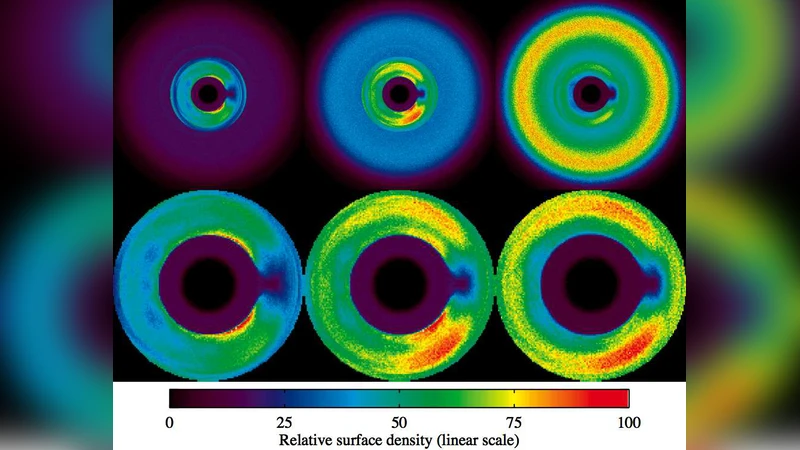
Debris disk images show clumps, rings, warps, and other structures, many of which have been interpreted as perturbations from hidden planets. But so far, no models of these structures have properly accounted for collisions between dust grains. We have developed new steady-state 3D models of debris disks that self-consistently incorporate grain-grain collisions. We summarize our algorithm and use it to illustrate how collisions interact with resonant trapping in the presence of a planet.
💡 Research Summary
The paper addresses a long‑standing gap in debris‑disk modeling: the simultaneous treatment of gravitational resonances induced by planets and the collisional evolution of dust grains. Traditional models have excelled at reproducing structures such as rings, clumps, and warps by invoking mean‑motion resonances or secular perturbations, but they typically ignore grain‑grain collisions or treat them in a highly simplified manner. This omission is problematic because collisions dictate the size distribution, spatial density, and lifetime of the dust, all of which directly affect observable brightness and morphology.
To overcome this, the authors introduce a “collisional grooming” algorithm that constructs a self‑consistent, steady‑state three‑dimensional model of a debris disk. The method proceeds in several stages. First, a dynamical backbone is built: a central star, a single planet (with configurable mass, eccentricity, and inclination), and the forces of radiation pressure and Poynting‑Robertson drag are included. An initial population of dust grains is generated with a prescribed size distribution and spatial spread, representing a “primordial” disk. The orbits of all grains are integrated using a high‑order symplectic scheme, while the algorithm records whether each grain becomes trapped in a planetary resonance.
Next, the local collision environment for every grain is evaluated. The authors compute a “local mean free time” based on the instantaneous grain density and relative velocities within a spatial cell. This yields a probabilistic collision rate without simulating each individual impact. When a collision is deemed to occur, the grain either fragments or is destroyed according to a size‑dependent catastrophic disruption threshold. Fragments are injected back into the simulation with a power‑law size spectrum and appropriate velocity offsets, thereby preserving mass balance. The grain‑size distribution and spatial density are updated accordingly.
The grooming loop repeats these steps until convergence: the total mass loss rate, the radial density profile, and the size spectrum cease to change beyond a small tolerance. Because the algorithm treats collisions statistically rather than deterministically, it reduces computational cost dramatically—by roughly an order of magnitude compared to full N‑body plus direct‑collision codes—while still capturing the essential physics of collisional cascades.
Simulation results reveal several key insights. In resonant zones (e.g., 2:1 or 3:2 exterior resonances), grains can linger for many orbital periods, leading to density enhancements. However, the same prolonged residence raises the probability of destructive collisions, which in turn erodes the resonant overdensity. The net effect is a softened or even partially erased ring, depending on the planet’s mass and the intrinsic collisional strength of the grains. Larger grains (tens of microns) survive longer and maintain resonant trapping, whereas sub‑micron particles are quickly ground down, producing a pronounced size‑dependent morphology: bright, clumpy rings at longer wavelengths (tracing larger grains) and smoother, fainter structures at shorter wavelengths (tracing the small‑grain population).
When the planet’s orbit is eccentric or inclined, the collisional by‑products are not symmetrically distributed. The algorithm shows that fragments released near pericenter preferentially populate one side of the disk, generating observable asymmetries and warps that match features seen in systems such as β Pictoris. Moreover, the model predicts that the spectral energy distribution of a disk will vary azimuthally, a testable signature for upcoming high‑resolution facilities.
The authors apply their framework to two well‑studied disks. For β Pictoris, incorporating collisions reproduces the inner warp without invoking additional unseen planets, while for HR 8799 the clumpy outer ring emerges naturally from resonant trapping moderated by collisional grinding. These case studies demonstrate that neglecting collisions can lead to overestimates of planet mass or misinterpretations of disk geometry.
In conclusion, the collisional grooming method provides a robust, computationally efficient tool for interpreting debris‑disk images. By unifying resonant dynamics and collisional cascades, it enables more accurate constraints on hidden planetary companions and on the physical properties of the dust itself. Future extensions could include multiple planets, gas drag, and time‑dependent dust production, opening the door to fully realistic simulations that will be essential for exploiting the unprecedented resolution of ALMA, JWST, and next‑generation observatories.
Comments & Academic Discussion
Loading comments...
Leave a Comment