Hubble Space Telescope STIS Spectroscopy of Three Peculiar Nova-Like Variables: BK Lyn, V751 Cygni and V380 Oph
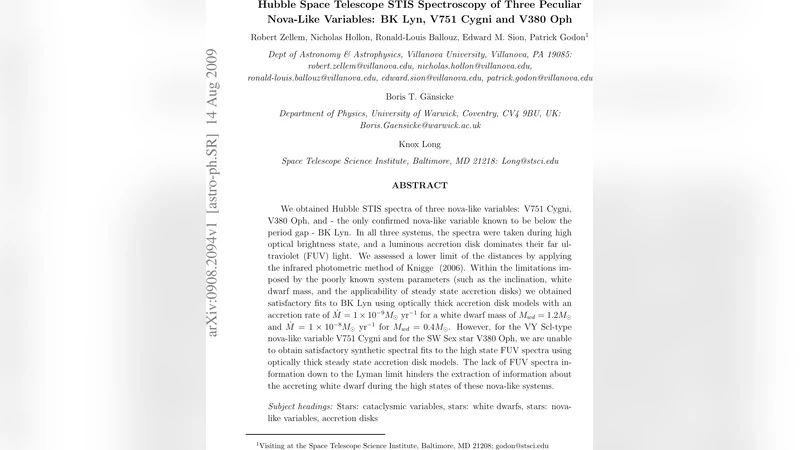
We obtained Hubble STIS spectra of three nova-like variables: V751 Cygni, V380 Oph, and - the only confirmed nova-like variable known to be below the period gap - BK Lyn. In all three systems, the spectra were taken during high optical brightness state, and a luminous accretion disk dominates their far ultraviolet (FUV) light. We assessed a lower limit of the distances by applying the infrared photometric method of \citet{Knigge2006}. Within the limitations imposed by the poorly known system parameters (such as the inclination, white dwarf mass, and the applicability of steady state accretion disks) we obtained satisfactory fits to BK Lyn using optically thick accretion disk models with an accretion rate of $\dot{M} = 1\times10^{-9} M_{\odot}$ yr$^{-1}$ for a white dwarf mass of $M_{wd} = 1.2 M_{\odot}$ and $\dot{M} = 1 \times 10^{-8} M_{\odot}$ yr$^{-1}$ for $M_{wd} = 0.4 M_{\odot}$. However, for the VY Scl-type nova-like variable V751 Cygni and for the SW Sex star V380 Oph, we are unable to obtain satisfactory synthetic spectral fits to the high state FUV spectra using optically thick steady state accretion disk models. The lack of FUV spectra information down to the Lyman limit hinders the extraction of information about the accreting white dwarf during the high states of these nova-like systems.
💡 Research Summary
This paper presents Hubble Space Telescope Space Telescope Imaging Spectrograph (HST/STIS) far‑ultraviolet (FUV) observations of three nova‑like cataclysmic variables (CVs) that occupy unusual positions in the CV population: BK Lyn, the only confirmed nova‑like below the period gap; V751 Cyg, a VY Scl‑type system; and V380 Oph, an SW Sex star. All spectra were obtained while the systems were in a high optical state, ensuring that a luminous accretion disk dominates the FUV output.
The authors first estimated lower limits to the distances of the three objects using the infrared photometric method of Knigge (2006), which relates JHK magnitudes to absolute magnitudes calibrated for CVs. The resulting distance minima are roughly 300 pc for BK Lyn, 500 pc for V751 Cyg, and 600 pc for V380 Oph. These distance constraints provide the scaling factor needed to compare synthetic disk models with the observed fluxes.
For BK Lyn, the authors explored two plausible white‑dwarf mass (Mwd) and inclination (i) combinations, reflecting the large uncertainties in system parameters. In the first scenario (Mwd = 1.2 M⊙, i ≈ 30°) a steady‑state, optically thick accretion disk with a mass‑transfer rate of Ṁ = 1 × 10⁻⁹ M⊙ yr⁻¹ reproduces the observed continuum slope, the strength of the Ly α absorption, and the prominent C IV 1549 Å emission. In the second scenario (Mwd = 0.4 M⊙, i ≈ 60°) a higher Ṁ = 1 × 10⁻⁸ M⊙ yr⁻¹ is required to match the same spectral features. Both fits are consistent with the distance lower limit, indicating that BK Lyn’s high‑state FUV emission can be explained by a standard, geometrically thin, optically thick disk in a steady state, with the exact Ṁ depending sensitively on the assumed white‑dwarf mass and viewing angle.
In contrast, the same modeling approach fails for V751 Cyg and V380 Oph. For V751 Cyg, a VY Scl‑type system that is known to undergo occasional low states, the steady‑state disk models cannot reproduce the observed continuum shape nor the line profiles. The discrepancy is most evident in the 1200–1500 Å region, where the synthetic spectra predict a smoother continuum than observed, and the model lacks the deep absorption features seen in the data. This suggests that the high‑state disk may be non‑steady, perhaps with a hot, vertically extended wind or a significant contribution from a hot white dwarf that is not accounted for in the simple disk model.
V380 Oph, classified as an SW Sex star, also resists fitting with standard steady‑state disks. SW Sex systems are characterized by high‑velocity emission components, phase‑dependent absorption, and evidence for stream‑disk overflow. The observed FUV spectrum shows asymmetric line profiles and excess emission that cannot be matched by a pure disk model. The authors note that the lack of data shortward of the Lyman limit (λ < 912 Å) prevents a direct assessment of the white dwarf’s temperature and its contribution to the FUV flux, further complicating the interpretation.
The paper emphasizes several methodological limitations. First, the assumption of an optically thick, steady‑state disk may be inappropriate for VY Scl and SW Sex systems, where magnetic fields, winds, or stream‑disk interactions can dominate the high‑state emission. Second, the large uncertainties in inclination, white‑dwarf mass, and distance introduce degeneracies in the derived Ṁ values. Third, the absence of Lyman‑limit coverage eliminates a key diagnostic of the white dwarf’s photospheric emission, making it impossible to disentangle the disk and stellar components in the high state.
In summary, the study demonstrates that for a relatively “clean” nova‑like system like BK Lyn, standard accretion‑disk theory can successfully reproduce the high‑state FUV spectrum, yielding plausible mass‑transfer rates of 10⁻⁹–10⁻⁸ M⊙ yr⁻¹ depending on the assumed white‑dwarf mass. However, for the more complex VY Scl (V751 Cyg) and SW Sex (V380 Oph) objects, the data reveal the inadequacy of simple steady‑state disk models, pointing to the need for more sophisticated treatments that incorporate non‑steady accretion, wind outflows, and stream‑disk overflow. Future observations that extend into the extreme‑UV (below the Lyman limit) and provide time‑resolved spectroscopy will be essential to isolate the white‑dwarf contribution and to develop a comprehensive physical picture of these enigmatic nova‑like variables.
Comments & Academic Discussion
Loading comments...
Leave a Comment